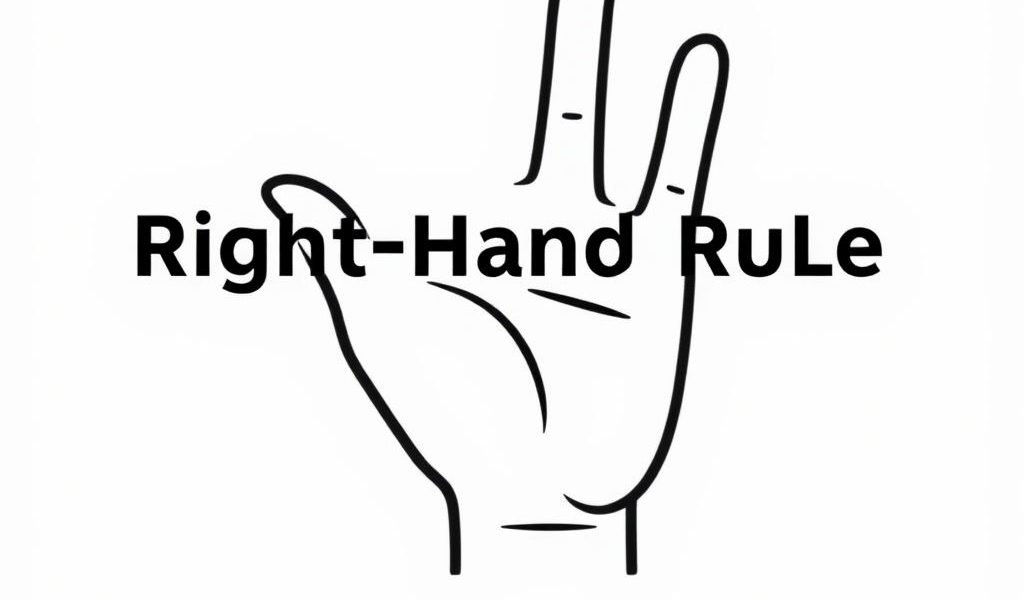
Understanding electromagnetic concepts such as the Right Hand Thumb Rule is essential for students studying physics, particularly in electricity and magnetism. This rule helps visualize and determine the direction of magnetic fields or current in a wire. Despite being a conceptual topic, the Right Hand Thumb Rule can be made easy with sufficient practice and clear application-based questions. This topic explores multiple questions on the Right Hand Thumb Rule to help learners build confidence and deepen their grasp of this topic.
Understanding the Right Hand Thumb Rule
Definition and Explanation
The Right Hand Thumb Rule is a technique used to find the direction of the magnetic field surrounding a current-carrying conductor. When you hold a current-carrying straight conductor in your right hand such that your thumb points in the direction of the electric current, your curled fingers will point in the direction of the magnetic field lines.
Key Points to Remember
- The thumb represents the direction of current.
- The curled fingers represent the direction of the magnetic field.
- The field lines form concentric circles around the wire.
Basic Conceptual Questions
1. What does the Right Hand Thumb Rule determine?
It determines the direction of magnetic field lines around a straight current-carrying conductor.
2. What happens to the magnetic field direction if the current is reversed?
The magnetic field direction also reverses. This is because the thumb will now point in the opposite direction, thus changing the orientation of the curled fingers.
3. Is the Right Hand Thumb Rule applicable to both straight and circular conductors?
Yes, it is mainly used for straight conductors but can also apply to loops and solenoids in modified forms.
Multiple Choice Questions (MCQs)
1. What does the thumb indicate in the Right Hand Thumb Rule?
- (a) Direction of magnetic field
- (b) Direction of electric field
- (c) Direction of current
- (d) Direction of force
Answer (c) Direction of current
2. If the current is flowing upwards in a vertical wire, the magnetic field lines will be
- (a) Clockwise
- (b) Anticlockwise
- (c) Straight lines
- (d) None of the above
Answer (b) Anticlockwise
3. The magnetic field direction is reversed when
- (a) The wire is cut
- (b) The current is reduced
- (c) The direction of current is reversed
- (d) The temperature is increased
Answer (c) The direction of current is reversed
Diagram-Based Questions
1. Identify the magnetic field direction for the following current direction
If the current flows from bottom to top in a vertical wire, curl your right-hand fingers around the wire. The field lines will form concentric circles in the anticlockwise direction.
2. In a horizontal conductor with current flowing left to right, where will the magnetic field lines point?
Using the rule, place the thumb pointing left to right. The field lines circle the wire in a direction that appears clockwise from the front.
Short Answer Questions
1. What is the use of the Right Hand Thumb Rule in electric motors?
In electric motors, the rule helps determine the direction of the magnetic force acting on the current-carrying conductor placed in a magnetic field, aiding in understanding rotation and motion.
2. Can the Right Hand Thumb Rule be used for induced currents?
No, for induced currents and electromotive forces, the Right Hand Rule for electromagnetic induction or Fleming’s Right Hand Rule is used instead.
3. How does the Right Hand Thumb Rule help in solenoids?
In solenoids, if you curl your fingers in the direction of current in the loops, your thumb gives the direction of the magnetic field inside the solenoid.
Application-Based Questions
1. A vertical wire carries current upward. What is the direction of magnetic field at a point in front of the wire?
Use your right hand, point the thumb upward (current direction), and curl the fingers. At a point in front of the wire, the fingers will point to the left, indicating the magnetic field direction is towards the left.
2. Explain what happens to the magnetic field when the current is increased.
As the current increases, the magnetic field around the conductor becomes stronger. The direction remains unchanged unless the current direction is reversed.
3. A student reverses the current in a conductor. How does the magnetic field change?
The magnetic field also reverses. If it was clockwise around the conductor, it will now become anticlockwise.
True or False Questions
- The Right Hand Thumb Rule is only applicable to magnetic fieldsFalse
- The direction of curled fingers gives the current directionFalse
- Magnetic field lines are concentric around a straight wireTrue
- Reversing current reverses the magnetic field directionTrue
Fill in the Blanks
- The thumb in the Right Hand Thumb Rule indicates the ________ of current. →direction
- Magnetic field lines around a straight conductor form ________ circles. →concentric
- If current flows downward in a vertical wire, the magnetic field is in ________ direction. →clockwise
Practical Applications
1. In Electrical Wiring
Electricians use the Right Hand Thumb Rule to determine the magnetic field around conductors, which is important in planning circuit layouts to minimize interference.
2. In Designing Electromagnets
Engineers apply this rule while designing electromagnets so that the direction of the magnetic field aligns with functional requirements, such as attracting metallic objects.
3. In MRI Machines
Magnetic Resonance Imaging machines use strong magnetic fields created by currents in wires. Understanding the field direction is key to building effective MRI systems.
Questions on the Right Hand Thumb Rule often appear in physics exams because they reinforce the understanding of magnetic fields and their relationships with electric current. By practicing a variety of question types from MCQs to application-based problems students can build a strong foundation in electromagnetism. The rule offers a simple yet powerful way to determine direction, making abstract concepts more tangible. Whether for school exams, practical circuits, or engineering designs, mastering the Right Hand Thumb Rule is a step toward deeper scientific understanding and real-world application.