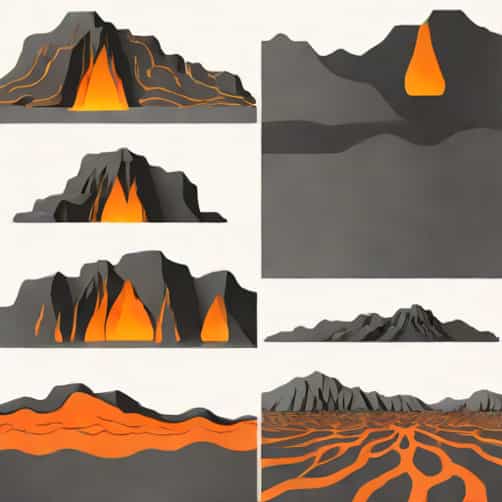
Lava is molten rock that erupts from volcanoes and flows over the Earth’s surface, and it can vary significantly in composition, temperature, and behavior. Among the different types of lava, basaltic and andesitic lava are the most commonly studied due to their contrasting properties. Understanding the difference between basaltic and andesitic lava is essential for geology students, volcanologists, and anyone interested in volcanic activity, as these two lava types affect eruption style, landscape formation, and volcanic hazards in distinct ways.
Basaltic Lava
Basaltic lava is the most common type of lava on Earth, primarily found at mid-ocean ridges, shield volcanoes, and hot spots like Hawaii. It is low in silica content, usually between 45% and 55%, which makes it relatively fluid compared to other lava types. Its low viscosity allows basaltic lava to flow easily over long distances, forming broad lava fields and gentle slopes. This fluidity also reduces the explosiveness of eruptions, making basaltic volcanoes less dangerous in terms of sudden explosive activity, though the lava flows themselves can still cause significant property damage.
Characteristics of Basaltic Lava
- Low silica content (45-55%)
- High temperature, typically 1100-1200°C
- Low viscosity, allowing it to flow easily
- Forms broad, gently sloping shield volcanoes
- Relatively non-explosive eruptions
Formation and Types
Basaltic lava forms from partial melting of the Earth’s mantle, producing magma that is rich in iron and magnesium but poor in silica. This magma can solidify into pahoehoe lava with smooth, rope-like textures or a’a lava with rough, jagged surfaces depending on cooling rates and flow conditions. The ability of basaltic lava to travel long distances makes it responsible for creating large lava plains, lava tubes, and extensive volcanic islands. Basaltic lava is also the primary component of the oceanic crust.
Andesitic Lava
Andesitic lava is typically found at stratovolcanoes along convergent plate boundaries, especially in volcanic arcs above subduction zones, such as the Andes Mountains, hence the name. It has a higher silica content than basaltic lava, usually between 55% and 65%, which makes it more viscous and less fluid. This increased viscosity slows the flow of andesitic lava, causing it to pile up near the volcanic vent and create steeper volcanic cones. Due to its thicker consistency, eruptions of andesitic lava are more likely to be explosive, producing pyroclastic flows, ash clouds, and significant volcanic hazards.
Characteristics of Andesitic Lava
- Intermediate silica content (55-65%)
- Lower temperature, around 800-1000°C
- Higher viscosity, flows slowly
- Forms steep stratovolcanoes
- Often associated with explosive eruptions
Formation and Types
Andesitic lava forms from the partial melting of the subducting oceanic crust combined with the overlying mantle material. This process generates magma with higher silica content, which increases its viscosity. Andesitic lava can produce blocky lava flows and pyroclastic materials such as volcanic bombs and ash. Its inability to flow far from the vent contributes to the formation of steep-sided stratovolcanoes. Because of the high gas content trapped in viscous magma, eruptions can be highly explosive, posing greater risk to nearby communities.
Comparing Basaltic and Andesitic Lava
The differences between basaltic and andesitic lava are primarily rooted in their chemical composition, viscosity, eruption style, and the landforms they create. These differences influence not only the behavior of individual eruptions but also the long-term shape and structure of the volcanoes themselves.
Chemical Composition
Basaltic lava has low silica content (45-55%), high iron and magnesium, and fewer volatile gases. In contrast, andesitic lava has higher silica content (55-65%), more aluminum, and often higher concentrations of dissolved gases, which makes it more explosive. This chemical difference is key to understanding how lava flows behave and why certain volcanoes erupt more violently than others.
Viscosity and Flow
Viscosity is a measure of a fluid’s resistance to flow. Basaltic lava, being low in silica, has low viscosity and flows easily, forming long lava rivers and extensive plains. Andesitic lava, with higher silica content, is much more viscous, causing it to move slowly and accumulate near the vent. This slower flow leads to thicker, steeper lava deposits and contributes to the stratified structure of andesitic volcanoes.
Eruption Style
Basaltic eruptions are generally effusive, with lava steadily flowing out of fissures and vents. The low viscosity allows gases to escape easily, reducing explosive potential. Andesitic eruptions are more likely to be explosive due to trapped gases in viscous magma. These eruptions can produce pyroclastic flows, ash plumes, and lahars, making andesitic volcanoes more hazardous despite sometimes smaller lava flows.
Volcanic Landforms
- Basaltic lava forms shield volcanoes, lava plateaus, and islands with gentle slopes.
- Andesitic lava forms stratovolcanoes, lava domes, and steep cones.
Geographical Distribution
Basaltic lava is most commonly found at divergent plate boundaries and hot spots, including the Hawaiian Islands, Iceland, and the East African Rift. Andesitic lava, however, is typical of convergent plate boundaries, especially subduction zones, such as the Andes, the Cascades, and the volcanoes around the Pacific Ring of Fire. Understanding these patterns helps geologists predict volcanic activity and assess regional volcanic hazards.
Impact on Human Activity
The differences in lava type also affect human settlement and safety. Basaltic lava flows, though extensive, are usually slow enough to allow evacuation and reduce casualties. Andesitic eruptions, with their explosive potential, pose more immediate threats to nearby populations and require monitoring, early warning systems, and hazard preparedness plans. Urban planning in volcanic regions often considers the type of lava expected based on regional geology.
Scientific Importance
Studying the differences between basaltic and andesitic lava provides insights into Earth’s internal processes, magma formation, and tectonic activity. Geologists use chemical composition, viscosity, and eruption patterns to infer mantle composition, subduction processes, and volcanic history. This knowledge is critical for hazard assessment, disaster mitigation, and understanding the formation of Earth’s surface features over geological time scales.
In summary, the difference between basaltic and andesitic lava lies in their chemical composition, viscosity, eruption style, and the resulting landforms. Basaltic lava is low in silica, flows easily, and produces broad, gentle volcanoes, while andesitic lava has higher silica content, flows slowly, and is associated with explosive eruptions and steep stratovolcanoes. Understanding these differences is crucial for volcanology, hazard management, and studying the Earth’s geological processes. By analyzing lava types, scientists can better predict volcanic behavior and minimize risks to human life and property in active volcanic regions.