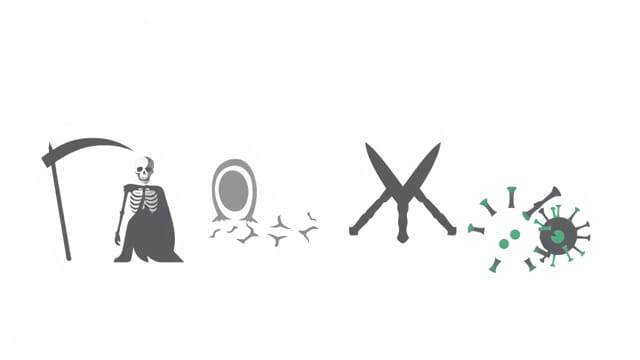
Throughout history, humanity has been haunted by four devastating forces that symbolize profound suffering and destruction: death, famine, war, and pestilence. These four have often been seen not only as real-world catastrophes but also as symbolic harbingers of chaos and moral decline. In religious texts, particularly in Christian tradition, they are known as the Four Horsemen of the Apocalypse, representing divine judgment. Yet beyond religious symbolism, these four elements have repeatedly shaped the course of civilizations. Their impacts are felt across continents and eras, from ancient plagues and medieval famines to modern warfare and pandemics. Exploring these forces in detail reveals not only how deeply they have influenced human history but also how they continue to affect global society today.
Historical and Symbolic Origins
The Four Horsemen in Religious Thought
The concept of death, famine, war, and pestilence as unified forces comes prominently from the Book of Revelation in the Christian Bible. In Revelation 6, the Four Horsemen appear as part of the seven seals, each riding a horse of a different color and each representing a specific form of devastation:
- White Horse: Often associated with conquest or pestilence.
- Red Horse: Symbolizing war and bloodshed.
- Black Horse: Representing famine and economic disparity.
- Pale Horse: Embodying death, with Hades following close behind.
These symbols have become enduring metaphors for catastrophe and decline, appearing in art, literature, and historical commentary for centuries. While they originate from a religious context, their meaning has expanded to encompass real-world crises that continue to plague humanity.
War: A Continuous Human Tragedy
Conflict Through the Ages
War has been a defining element of human history. From tribal disputes in prehistory to global conflicts like the World Wars, war has led to immense destruction, reshaped borders, and altered the course of nations. Armed conflict results in death not only on battlefields but also through the destruction of infrastructure, displacement of populations, and collapse of economies.
Modern Impacts of Warfare
- Destabilization of regions, such as the Middle East after recent interventions.
- Rise in refugee crises, with millions displaced by civil wars in Syria, Sudan, and beyond.
- Psychological trauma affecting generations of soldiers and civilians alike.
Despite advances in diplomacy and international law, war remains a grim reality, often driven by power, resources, and ideology.
Famine: The Slow Killer
Causes of Famine
Famine is more than the absence of food; it is a systemic failure often caused by a combination of environmental disasters, poor governance, conflict, and economic collapse. Historically, famines have led to the deaths of millions and have been central to many social upheavals.
Famous Historical Famines
- The Great Famine (13151317): A major European crisis caused by heavy rainfall and crop failure.
- The Irish Potato Famine (18451852): Led to mass starvation and emigration, killing around one million people.
- Holodomor (19321933): A man-made famine in Soviet Ukraine, resulting in the deaths of millions.
Today, famine still threatens parts of Africa and Asia, particularly in conflict zones where access to food and aid is blocked or manipulated as a weapon of war.
Pestilence: The Invisible Enemy
Plagues and Pandemics
Pestilence refers to deadly infectious diseases that spread rapidly and uncontrollably, often with devastating consequences. From the Black Death to COVID-19, pestilence has been a constant threat to public health and stability.
Major Historical Epidemics
- The Plague of Justinian (541542 CE): One of the first recorded pandemics, killing up to 25 million people.
- The Black Death (13471351): A bubonic plague that wiped out one-third of Europe’s population.
- The Spanish Flu (19181919): Infected over 500 million people worldwide, causing more than 50 million deaths.
- COVID-19 (2019present): A modern pandemic that disrupted global health systems, economies, and daily life.
Pestilence reveals the vulnerability of modern civilization, especially when preparedness and cooperation are lacking. These outbreaks often expose inequalities in healthcare access and create long-term economic and psychological scars.
Death: The Final Consequence
The Cumulative Toll
While death is the inevitable end of all life, in the context of the Four Horsemen, it represents large-scale mortality brought by famine, war, and pestilence. Death becomes not just personal but societal a shared trauma that can wipe out generations and reshape collective memory.
Global Mortality from Human-Caused Crises
- Deaths in World War II: Over 70 million.
- Deaths during the Great Chinese Famine (19591961): Estimated 1545 million.
- COVID-19 deaths globally (as of 2025): Over 8 million.
The scale of death linked to these disasters often overwhelms the capacity of societies to grieve, respond, and rebuild, highlighting the fragility of even the most powerful civilizations.
Combined Effects of the Four Forces
Interconnected Disasters
War, famine, pestilence, and death rarely occur in isolation. In many cases, one leads to another, creating a cycle of catastrophe:
- War destroys crops and infrastructure, leading to famine.
- Malnutrition weakens populations, making them more susceptible to disease.
- Pandemics spread more quickly in war-torn regions with poor sanitation.
- All contribute to mass death, often overwhelming systems of care and governance.
This cycle has been evident in numerous historical crises, including the Thirty Years’ War in Europe, which brought all four Horsemen into motion across much of the continent.
Symbolism and Cultural Legacy
The Four Horsemen in Modern Thought
The image of death, famine, war, and pestilence continues to influence modern storytelling, political discourse, and academic thought. These symbols are used to critique political regimes, warn of environmental collapse, and explore moral decay in literature and film.
Examples in Culture
- Post-apocalyptic novels and films that reflect these themes (e.g., ‘The Road,’ ‘Mad Max’).
- Political rhetoric warning against the four horsemen of nuclear war or climate change.
- Religious sermons using the imagery to inspire repentance or social justice.
In all contexts, they serve as warnings of the potential consequences when humanity strays from justice, compassion, and foresight.
Death, famine, war, and pestilence are more than just ancient symbols they are enduring realities that have shaped human civilization across millennia. As challenges that continue to threaten the world, understanding their historical and contemporary relevance is crucial. Whether seen as literal disasters or metaphorical warnings, these forces call for vigilance, cooperation, and a renewed sense of responsibility among global societies. In facing them, humanity must draw upon both past lessons and future vision to create a more resilient and compassionate world.