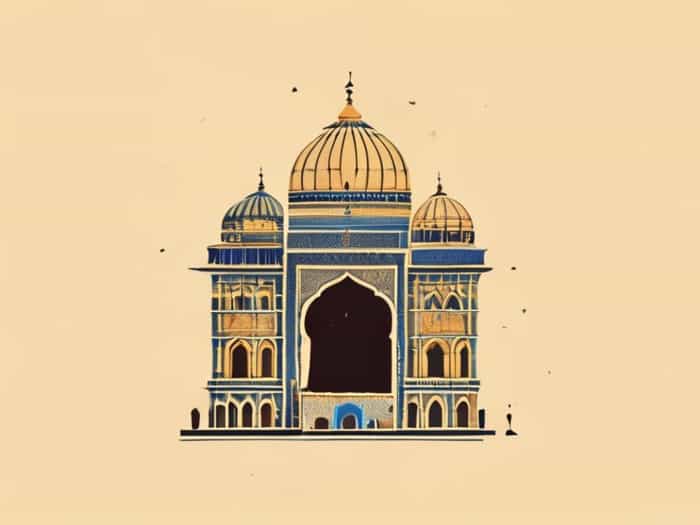
The Delhi Sultanate was one of the most significant periods in Indian history, marking the establishment of Muslim rule in northern India from the 13th to the 16th century. It laid the foundation for new political, cultural, and architectural developments that shaped the subcontinent for centuries. Many people searching for information about the Delhi Sultanate in Hindi want to understand its origins, rulers, and influence in a clear and accessible way. This topic explains the key features of the Delhi Sultanate, its major dynasties, and its lasting legacy in Indian history.
Origin and Establishment of the Delhi Sultanate
The Delhi Sultanate began in 1206 CE when Qutb-ud-din Aibak, a former slave and general of Muhammad Ghori, became the ruler of northern India after his master’s death. This event marked the beginning of Muslim rule in India and the rise of the Slave Dynasty, also known as the Mamluk Dynasty. Delhi was chosen as the capital because of its strategic location and strong fortifications, making it a center of administration and power for centuries to come.
The term Sultanate refers to a government ruled by a Sultan, a title used by Muslim monarchs. Over time, the Delhi Sultanate expanded its territory across large parts of the Indian subcontinent, from Bengal in the east to the Deccan Plateau in the south. The rulers introduced Islamic governance, Persian culture, and new forms of art and architecture, influencing India’s diverse cultural landscape.
Major Dynasties of the Delhi Sultanate
The Delhi Sultanate lasted from 1206 to 1526 and was ruled by five major dynasties. Each dynasty contributed uniquely to administration, culture, and architecture.
1. The Slave Dynasty (1206 1290)
The first dynasty of the Delhi Sultanate was founded by Qutb-ud-din Aibak. Although his reign was short, he started the construction of the Qutub Minar in Delhi, which remains one of India’s most famous monuments. His successor, Iltutmish, strengthened the empire and introduced a centralized administration. Iltutmish’s daughter, Razia Sultana, was the first and only female ruler of the Delhi Sultanate. Despite her short reign, she remains one of the most remarkable figures in Indian history.
2. The Khilji Dynasty (1290 1320)
The Khilji rulers were known for their military campaigns and expansion of the empire. Alauddin Khilji was the most powerful ruler of this dynasty. He introduced significant economic reforms, including price control systems and strict market regulations. His military successfully defended India against Mongol invasions, ensuring the stability of the kingdom. The Khilji period also witnessed growth in trade and urbanization, making Delhi one of the wealthiest cities of its time.
3. The Tughlaq Dynasty (1320 1414)
The Tughlaq dynasty was founded by Ghiyasuddin Tughlaq. His son, Muhammad bin Tughlaq, is remembered for his ambitious but often unsuccessful experiments, such as moving the capital from Delhi to Daulatabad and introducing token currency. These policies caused unrest among the people, but they also demonstrated his visionary nature and desire to modernize governance. Later rulers like Firoz Shah Tughlaq focused on infrastructure, building canals, mosques, and schools throughout the empire.
4. The Sayyid Dynasty (1414 1451)
The Sayyid rulers came to power after the invasion of Timur, a Central Asian conqueror, who sacked Delhi in 1398. The empire was greatly weakened after this event, and the Sayyid dynasty ruled only a small portion of northern India. Though they could not restore the Sultanate’s former glory, they maintained the administrative system and continued to promote Islamic traditions and learning.
5. The Lodi Dynasty (1451 1526)
The Lodi dynasty was the last of the Delhi Sultanate. Founded by Bahlul Lodi, it was the first Afghan dynasty to rule India. His successors, Sikandar Lodi and Ibrahim Lodi, worked to strengthen the empire, but internal disputes and administrative challenges weakened their control. The Delhi Sultanate came to an end in 1526 when Ibrahim Lodi was defeated by Babur at the Battle of Panipat, marking the beginning of the Mughal Empire in India.
Administration and Governance
The Delhi Sultanate introduced several administrative innovations. The rulers implemented a centralized system with the Sultan as the supreme authority. They were supported by ministers who managed different aspects of governance such as finance, the military, and justice. Land revenue became the main source of income for the empire, and the system of Iqta was introduced, where land was assigned to officers in exchange for military service.
The Sultans also established a network of spies and a disciplined army to maintain law and order. They emphasized loyalty and merit among officials, especially during the reigns of strong rulers like Iltutmish and Alauddin Khilji. The administrative structure of the Delhi Sultanate later influenced the Mughal Empire and even modern Indian governance systems.
Culture and Society Under the Delhi Sultanate
The Delhi Sultanate played a crucial role in blending Indian and Islamic cultures. Persian became the official language of administration and literature, influencing local languages like Hindi and Urdu. The period saw a remarkable exchange of ideas, art, and traditions between Hindus and Muslims. Sufi saints and scholars spread messages of peace and spirituality, bridging social divides and promoting tolerance.
Architecture and Art
Architectural development flourished during the Delhi Sultanate. The rulers introduced Indo-Islamic architecture, combining Persian styles with traditional Indian designs. Some of the most notable monuments from this period include
- Qutub Minar built by Qutb-ud-din Aibak and completed by Iltutmish.
- Alai Darwaza constructed during Alauddin Khilji’s reign, known for its intricate carvings.
- Tughlaqabad Fort built by Ghiyasuddin Tughlaq as a symbol of strength and defense.
- Firoz Shah Kotla an urban complex featuring mosques and administrative buildings.
These structures not only demonstrate architectural excellence but also reflect the cultural synthesis that defined the Delhi Sultanate era.
Economy and Trade
The economy during the Delhi Sultanate was largely agrarian, supported by taxation on land. However, trade also played an important role. Indian merchants traded goods like textiles, spices, and precious stones with countries in Central Asia and the Middle East. Alauddin Khilji’s market reforms ensured fair trade practices and price stability in Delhi. Cities grew rapidly as centers of commerce, attracting traders, artisans, and scholars from across the world.
Education and Literature
Education flourished during this period, with many madrasas (Islamic schools) and libraries established in Delhi and other cities. Persian literature and poetry were highly encouraged by the Sultans. Scholars translated works from Arabic and Sanskrit into Persian, promoting intellectual exchange. The influence of Persian on local languages eventually gave rise to Urdu, which blended Arabic, Persian, and Hindi elements.
Decline of the Delhi Sultanate
Several factors led to the decline of the Delhi Sultanate. Internal rebellions, weak rulers, administrative corruption, and the vastness of the empire made it difficult to govern effectively. The invasion of Timur in 1398 further weakened the empire, leaving Delhi in ruins. Finally, the defeat of Ibrahim Lodi by Babur in 1526 ended the Delhi Sultanate and paved the way for the rise of the Mughal Empire, which carried forward many of its political and cultural traditions.
Legacy of the Delhi Sultanate
The Delhi Sultanate left a lasting impact on India’s history. It introduced new systems of administration, taxation, and military organization that influenced later rulers. The blending of Indian and Islamic cultures created a rich heritage that shaped language, architecture, and social customs. The spread of Indo-Islamic art, music, and architecture during this era laid the foundation for many later developments under the Mughals.
Even today, the monuments, traditions, and linguistic influences from the Delhi Sultanate period can be seen throughout India. Understanding the Delhi Sultanate helps us appreciate the deep historical roots of India’s cultural diversity and its ability to absorb and blend influences from around the world.