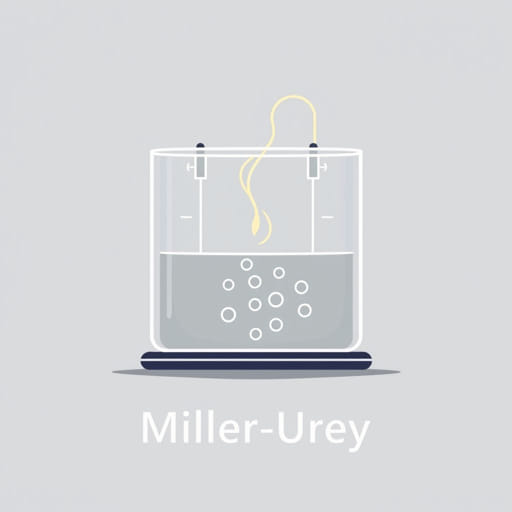
The Miller-Urey experiment remains one of the most iconic studies in the history of biology and chemistry, demonstrating how organic molecules essential to life could have formed under prebiotic conditions on early Earth. Conducted in 1952 by Stanley Miller under the guidance of Harold Urey, the experiment recreated the hypothesized primordial atmosphere and applied electric sparks to simulate lightning. The results shocked the scientific community because they showed that simple inorganic compounds could give rise to amino acids, the building blocks of proteins, providing crucial insights into the origins of life. Understanding the diagram of the Miller-Urey experiment is essential for grasping how this groundbreaking work shaped the field of abiogenesis and prebiotic chemistry.
Overview of the Miller-Urey Experiment
The experiment aimed to simulate conditions believed to exist on early Earth, approximately 4 billion years ago. Scientists hypothesized that Earth’s atmosphere contained gases like methane (CH₄), ammonia (NH₃), hydrogen (H₂), and water vapor (H₂O). In the experiment, these gases were introduced into a closed system and subjected to continuous electrical sparks, mimicking natural lightning. The water was heated to produce vapor, which circulated through the system, and the gases were exposed to the electrical discharges. Over time, the water condensed and collected in a trap where chemical analysis revealed the formation of amino acids, demonstrating that life’s fundamental molecules could arise spontaneously from simple chemical reactions.
Components Illustrated in the Diagram
The diagram of the Miller-Urey experiment provides a visual representation of the experimental setup, highlighting several critical components that worked together to simulate early Earth conditions. These components include
- Boiling FlaskContains water, which represents the primitive ocean. The water is heated to generate vapor that rises into the system.
- Gas MixtureThe gases methane, ammonia, and hydrogen are introduced into the upper part of the apparatus to mimic Earth’s early atmosphere.
- Spark ElectrodesTwo electrodes generate continuous electric sparks to simulate lightning and provide the energy needed to drive chemical reactions.
- CondenserCools the vapor, causing it to condense and fall into the collection trap, similar to rainfall returning organic compounds to the oceans.
- Collection TrapA container where condensed liquids are collected and later analyzed for the presence of amino acids and other organic molecules.
Functionality of the Diagram
The diagram is not merely a visual tool; it also helps explain the functional relationship between each component of the experiment. The boiling water produces vapor, which carries gases into the spark chamber. The electrical discharges break molecular bonds in the simple gases, enabling them to recombine into more complex organic compounds. These compounds then condense in the cooling system and accumulate in the collection trap. By illustrating the flow of gases, the energy input, and the condensation process, the diagram makes the experimental process comprehensible and emphasizes the step-by-step formation of amino acids and other molecules crucial for life.
Significance of the Diagram
Studying the diagram of the Miller-Urey experiment reveals more than just the experimental setup; it underscores the principles of prebiotic chemistry. Each element of the diagram represents a critical stage in molecular synthesis
- The boiling flask emphasizes the role of water as a solvent and medium for chemical reactions.
- The spark electrodes highlight the importance of energy sources in driving chemical transformations.
- The condenser and collection trap demonstrate the recycling of molecules, which is essential for concentration and accumulation of organic compounds.
By visually connecting these elements, the diagram teaches students and researchers how early Earth conditions could have led to the spontaneous formation of biomolecules, bridging the gap between inorganic chemistry and the origins of life.
Results Illustrated by the Experiment
The diagram also indirectly reflects the outcome of the Miller-Urey experiment. After a few days of continuous operation, the collection trap contained a mixture of organic molecules, including glycine, alanine, and other amino acids. These molecules are fundamental to the formation of proteins, which are essential for living organisms. The success of the experiment illustrated that complex organic compounds could arise naturally under conditions thought to resemble early Earth, providing a powerful visual tool to explain this process. The diagram, therefore, serves as both an educational and explanatory resource, summarizing the experiment’s methodology and results in a single image.
Educational Importance
In modern classrooms and laboratories, the diagram of the Miller-Urey experiment is frequently used to teach concepts in biochemistry, molecular biology, and evolutionary biology. It provides a tangible representation of abstract ideas such as chemical evolution, abiogenesis, and the role of environmental factors in molecular synthesis. Students can follow the experimental pathway from simple gases to amino acids, understanding how energy inputs and molecular interactions contribute to the formation of life-essential compounds. The diagram also encourages critical thinking by prompting questions about variables, such as different atmospheric compositions or alternative energy sources, and their effects on organic molecule formation.
Modern Interpretations and Variations
Since the original experiment, scientists have refined and expanded the Miller-Urey model to explore different atmospheric conditions and energy sources. Variations include the addition of carbon dioxide, nitrogen, or hydrogen sulfide, as well as UV radiation or heat instead of electrical sparks. Diagrams of these modern experiments build upon the original Miller-Urey illustration, maintaining the core components while demonstrating new pathways for organic synthesis. By comparing diagrams of various experimental setups, researchers can better understand how early Earth environments may have influenced the diversity and abundance of prebiotic molecules.
The diagram of the Miller-Urey experiment remains a cornerstone in the study of the origin of life, providing a clear, visual representation of how simple gases, energy, and water could produce the building blocks of living organisms. It captures the experiment’s methodology, key components, and functional relationships, making the concepts of prebiotic chemistry accessible to students and researchers alike. Understanding the diagram helps convey the importance of chemical evolution and the plausibility of natural processes leading to life, highlighting the experiment’s enduring impact on biology, chemistry, and the study of life’s beginnings on Earth.