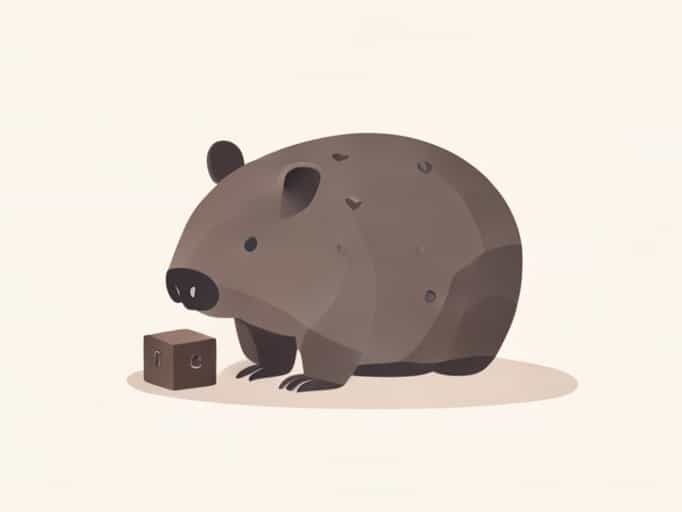
Wombats are fascinating marsupials native to Australia, known for their sturdy build, burrowing habits, and surprisingly unique digestive system. One of the most intriguing facts about wombats is their ability to produce cube-shaped feces, which has captured the curiosity of scientists and animal enthusiasts alike. Unlike most animals whose droppings are round or oval, wombats have evolved to excrete poop in perfectly shaped cubes, a phenomenon that raises questions about their biology, behavior, and ecological adaptations. Understanding why and how wombats produce these distinctive cubes provides insight into their evolutionary strategies and survival mechanisms.
Why Wombats Produce Cube-Shaped Poop
The cube-shaped feces of wombats are not just a quirky trait they serve a critical purpose in the animal’s life. Wombats are territorial creatures, and their droppings play a central role in communication. By leaving fecal markers around the edges of their territory, wombats signal their presence and establish boundaries. The cube shape is particularly advantageous because it prevents the droppings from rolling away, allowing them to remain in specific locations for longer periods. This stability ensures that territorial messages remain clear and intact.
Territorial Marking and Communication
Wombats are mostly solitary animals, and scent marking is crucial for social interaction. The cube-shaped droppings carry chemical signals that convey information about the individual wombat, including identity, reproductive status, and dominance. By arranging these cubic feces on rocks, logs, or dirt mounds, wombats effectively communicate with others in their habitat without direct confrontation. This form of communication is essential in dense vegetation or complex burrow networks where visual contact is limited.
The Biological Mechanism Behind Cube Poop
The question of how wombats create cube-shaped feces has puzzled scientists for years. Unlike most animals, the wombat’s digestive tract is highly specialized. Research shows that the shape is formed in the final section of the intestines, where the feces harden as water is absorbed. Variations in the elasticity and stiffness of the intestinal walls cause the feces to be molded into angular shapes. Essentially, wombats’ intestines act as a natural mold, giving the feces their distinctive cubic form before excretion.
Digestive Adaptations
- Extended Digestive ProcessWombats have a slow digestion system, taking up to 14 to 18 days to process tough plant material, which helps extract maximum nutrients from fibrous grasses and roots.
- Water AbsorptionThe intestines absorb significant amounts of water, which solidifies the feces and contributes to the cube formation.
- Variable Intestinal ElasticityUneven stretching of the intestinal walls is responsible for creating the sharp edges that form the cubes.
Ecological and Evolutionary Significance
The cube-shaped poop is more than a biological curiosity; it is an adaptation that has ecological and evolutionary advantages. By effectively marking territory, wombats reduce the likelihood of direct confrontations with other wombats, which helps conserve energy and prevent injuries. This form of communication supports a solitary lifestyle while ensuring that social interactions are maintained through scent cues.
Impact on the Ecosystem
Wombats’ droppings also play a role in their ecosystem. The feces can contribute to soil fertility by providing nutrients that support plant growth. Additionally, other animals, including insects and microorganisms, may interact with the droppings, integrating the wombat into the broader ecological web. In this way, the cube-shaped feces serve both a behavioral function and an ecological one, illustrating the interconnectedness of animal adaptations and environmental impact.
Fun Facts About Wombat Poop
The cube-shaped feces of wombats have fascinated people worldwide, leading to many interesting observations and studies. Here are a few fun facts about this unique trait
- Wombat cubes are typically 1 to 1.5 centimeters on each side.
- Researchers discovered the shape formation using MRI scans to observe wombat intestines during digestion.
- Cube-shaped droppings are more common in adult wombats due to their fully developed intestines and slower digestive process.
- The unique shape helps droppings stay in piles, making scent-marking more effective and visually noticeable in the wild.
- Tourists in Australia often notice these cubic droppings, highlighting how unusual and memorable this natural phenomenon is.
Comparison With Other Animals
Most animals produce feces that are round, cylindrical, or amorphous due to the uniform structure of their intestines and quicker digestion process. The wombat stands out because its combination of slow digestion, fibrous diet, and variable intestinal elasticity allows the production of cubes. No other species is known to produce naturally cubic feces, which makes the wombat’s adaptation truly unique in the animal kingdom.
Scientific Research and Discoveries
Recent studies have utilized advanced imaging techniques to understand this phenomenon. Researchers found that wombat intestines have regions of varying stiffness, which compress the fecal matter unevenly. This uneven compression is key to producing edges and corners, leading to the cube shape. This discovery has implications not only for understanding wombat biology but also for materials science, as it shows how natural structures can create geometric shapes from soft matter.
Yes, wombats do produce cube-shaped poop, and this remarkable trait is a result of unique biological and evolutionary adaptations. The cubic droppings serve essential functions in territorial marking, communication, and ecological contributions. Understanding the mechanism behind this phenomenon provides insight into wombat behavior, digestive biology, and evolutionary strategies. This unusual adaptation continues to fascinate scientists and nature enthusiasts alike, demonstrating the complexity and ingenuity found in the natural world. Wombats and their cubic feces are a testament to how even small, everyday behaviors in animals can have profound functional and evolutionary significance.