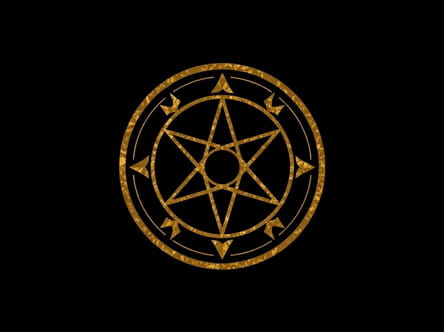
In the universe of Fullmetal Alchemist, the Philosopher’s Stone stands as one of the most powerful and forbidden objects in alchemical science. Known for its ability to bypass the fundamental law of equivalent exchange, the Philosopher’s Stone holds the capacity to perform massive-scale transmutations without cost. One of the most mysterious and vital aspects tied to the creation and use of this artifact is the Philosopher’s Stone transmutation circle. This transmutation circle is unlike typical ones used by alchemists, both in design and moral implication. Understanding this circle requires delving into the mechanics of alchemy, human transmutation, and the dark history behind the Philosopher’s Stone itself.
The Concept of Transmutation Circles in Alchemy
Transmutation circles are essential tools in the practice of alchemy. These circles are geometrical arrangements of symbols that direct energy and define the intent of the alchemical reaction. They often contain runes, mathematical shapes, or spiritual icons that serve specific purposes in shaping matter. In the case of the Philosopher’s Stone, the transmutation circle used to create it carries unique elements designed for high-level manipulation of life energy and matter.
Basic Functions of Transmutation Circles:
- To define the scope and boundaries of an alchemical reaction.
- To stabilize the energy used in the transmutation process.
- To reflect the intent of the alchemist whether it’s to heal, construct, or destroy.
Ordinary circles deal with natural materials like stone, metal, or organic tissue. However, the Philosopher’s Stone requires far more than that it demands life itself.
The Philosopher’s Stone: Alchemy Without Limits
The Philosopher’s Stone allows an alchemist to ignore the law of equivalent exchange, which states that one cannot gain something without sacrificing something of equal value. This law governs all legitimate alchemical reactions. Yet, the stone can override this balance, permitting the user to perform transmutations without any apparent cost.
To achieve such a feat, the Philosopher’s Stone is created by sacrificing countless human lives. Each soul becomes part of the stone’s structure, storing enormous energy that alchemists can use freely. The transmutation circle used in its creation is, therefore, a circle of death and forbidden knowledge.
Key Characteristics of the Philosopher’s Stone:
- Contains condensed souls of multiple humans.
- Grants the ability to perform transmutations without equivalent exchange.
- Can be embedded into a human body or used as a raw source of power.
The Structure of the Philosopher’s Stone Transmutation Circle
The transmutation circle for creating the Philosopher’s Stone is notably complex. Unlike standard alchemical circles, it often incorporates sacred geometry, human anatomical diagrams, astrological symbols, and sacrificial elements. These symbols reflect the manipulation of life force and mass death, distinguishing it as one of the darkest circles in the Fullmetal Alchemist universe.
The exact designs vary, but most include the following components:
- Five-pointed stars (pentagrams)– Represent the human body and the five classical elements.
- Concentric circles– Signify multiple layers of reality or soul containment.
- Runes and glyphs– Refer to ancient or forbidden knowledge, drawn from real-world alchemical texts.
- Human figures– Sometimes shown within the circle to symbolize sacrifice.
Human Transmutation and Its Connection to the Stone
The creation of the Philosopher’s Stone is rooted in the forbidden act of human transmutation. Attempting to create life or bring someone back from the dead requires a level of energy that no normal alchemist possesses. In Fullmetal Alchemist, Father and the Homunculi developed the method to sacrifice entire cities of people in order to create these stones.
These large-scale sacrifices are made through massive transmutation circles that are either etched into the ground, inscribed beneath cities, or activated simultaneously by multiple alchemists. In one of the most chilling examples, Father uses five alchemists, each with a part of a grand design, to absorb the souls of an entire nation.
Important Examples from the Series:
- The Ishvalan massacre used to create a Philosopher’s Stone from a war-driven genocide.
- Father’s nationwide circle designed to turn the entire country of Amestris into a sacrificial circle.
- Marcoh’s modified circle used to destroy a stone by transmuting the souls within back into the atmosphere.
Symbolism and Ethics of the Philosopher’s Stone Circle
Beyond its functionality, the Philosopher’s Stone transmutation circle carries deep symbolic weight. It is often depicted as a mockery of life and creation. Where traditional alchemy seeks to understand and coexist with nature, the Philosopher’s Stone represents domination, greed, and sacrifice. The circle is a blueprint of exploitation, constructed purely for power at the cost of human life.
This creates an ethical rift in the series. Characters like Edward Elric and Alphonse strongly reject the use of Philosopher’s Stones, seeing them as abhorrent and morally unjustifiable. Others, such as Scar and Dr. Marcoh, recognize their power but seek to either destroy them or use them to undo past crimes.
Philosophical Themes:
- The price of knowledge and power.
- The morality of sacrificing few for the many.
- The danger of dehumanizing others for personal gain.
Alterations and Counter-Circles
In some parts of the series, alternative or counter-transmutation circles are introduced to subvert or destroy the power of the Philosopher’s Stone. These circles often reverse the flow of energy, freeing souls or dispersing them rather than containing them. For instance, Scar’s brother studied ancient Ishvalan alchemy to create an inverse circle capable of disassembling Philosopher’s Stones by disrupting the containment matrix.
These counter-circles reflect a deeper understanding of alchemy and its purpose not to rule, but to restore. They offer a symbolic and literal balance to the horror of the Philosopher’s Stone, showing that knowledge can be used to heal rather than harm.
The Philosopher’s Stone Circle in Popular Culture
Since its appearance in Fullmetal Alchemist, the Philosopher’s Stone and its transmutation circle have captured the imagination of fans and scholars alike. The symbol has appeared on merchandise, tattoos, fan art, and even academic discussions on ethics in anime. Its legacy as a powerful visual metaphor remains a central part of the franchise’s lasting impact.
The Philosopher’s Stone transmutation circle represents one of the most complex and haunting symbols in Fullmetal Alchemist. It is a manifestation of ultimate power gained through ultimate sacrifice, made possible through precise yet morally corrupt alchemical design. By exploring its structure, origins, and symbolic meaning, fans gain a deeper appreciation of the themes that make the series resonate: sacrifice, morality, the pursuit of power, and the cost of playing god. In the hands of different characters, this circle becomes either a tool of tyranny or a force to be unraveled reflecting the heart of what alchemy truly is.