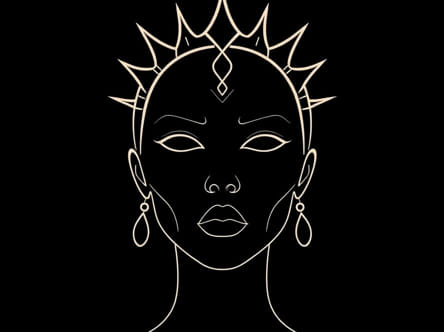
In recent years, the facial reconstruction of ancient historical figures has become a fascinating intersection of science, technology, and archaeology. One such project that has captivated both experts and the public is the facial reconstruction of Queen Nodjmet, a noblewoman from ancient Egypt. As the wife of Herihor, a powerful High Priest of Amun who declared himself pharaoh, Nodjmet occupied a significant role during a complex and transformative period in Egyptian history. The reconstruction of her face has given us a rare glimpse into the personal identity of a woman whose presence was once confined to dusty scrolls and archaeological fragments.
Who Was Queen Nodjmet?
Queen Nodjmet lived during the late 20th and early 21st Dynasties of ancient Egypt, a time marked by political fragmentation and the decline of central authority. While Egypt’s power was waning, figures like Herihor and Nodjmet helped establish a new kind of rule based in Thebes, blending religious authority with royal symbolism. Nodjmet held titles such as ‘Lady of the Two Lands’ and ‘Mother of the King,’ suggesting she played both ceremonial and dynastic roles in her time.
Although little concrete is known about her daily life, her mummified remains and funerary artifacts have provided a wealth of information for modern researchers. Among the most important finds associated with her is the so-called ‘Nodjmet Book of the Dead,’ a richly illustrated papyrus that accompanied her in burial. It is through these ancient remains that technology has enabled us to reconstruct not just her image, but her legacy.
Discovery of Nodjmet’s Mummy
Nodjmet’s mummy was discovered in the Deir el-Bahari cache, a site in Luxor that contained many royal and noble burials reinterred for protection during periods of tomb robbing. Her body was found alongside others from the same dynastic period, carefully prepared and preserved according to the religious customs of the time. The presence of her name on associated papyri helped scholars identify her with a high degree of confidence.
While the mummy had suffered some deterioration over the centuries, it was still in sufficient condition to allow forensic scientists to undertake a detailed facial reconstruction. The skull provided the essential foundation for estimating her facial features, including the structure of her cheeks, nose, and jaw.
The Science Behind Facial Reconstruction
Facial reconstruction combines anatomical science with artistic interpretation to create a realistic image of a person based on their skeletal remains. In the case of Queen Nodjmet, experts used computed tomography (CT) scanning to create a detailed 3D model of her skull. These scans allowed researchers to digitally strip away layers of mummification and simulate soft tissues.
Markers were applied to estimate muscle and tissue depth, based on data from Egyptian populations and similar ethnographic records. Software programs then generated a facial outline, which was refined to include skin texture, eye shape, and other facial features. The final stage involved adding realistic skin tones, hair, and accessories relevant to the era and cultural background of ancient Egyptian nobility.
Technological Advances Used in the Process
- 3D scanning and modeling: High-resolution scans captured the skull in digital format.
- Forensic markers: Tissue depth markers guided the placement of facial muscles.
- Facial approximation software: Algorithms generated a lifelike image from skeletal data.
- Cultural reference: Historical records helped model features consistent with Egyptian aesthetics.
What the Reconstruction Reveals
The reconstructed face of Queen Nodjmet reveals a woman of grace and dignity, with high cheekbones, a gentle jawline, and almond-shaped eyes features commonly associated with ancient Egyptian representations. The reconstruction humanizes her in a way no statue or painting can, bridging the gap between the ancient and modern worlds.
More than just a visual curiosity, the image invites reflection on the lived experiences of women in ancient political systems, particularly those in positions of religious and dynastic influence. It suggests that Nodjmet was not merely a ceremonial figure, but a powerful presence within her society.
Cultural and Historical Significance
The facial reconstruction of Queen Nodjmet contributes significantly to the broader understanding of ancient Egyptian history. It serves as a reminder that historical figures were real people, with families, responsibilities, and roles that shaped their societies. In Nodjmet’s case, she lived during one of Egypt’s most fragmented eras but remained an emblem of continuity and legitimacy.
Her appearance also provides insights into the genetic and cultural heritage of the period. By studying her reconstructed features, anthropologists and historians can make educated assumptions about health, nutrition, and even social status in ancient Thebes. This approach brings a personal dimension to what is often a sterile recounting of dynastic successions and political upheavals.
Public Reception and Academic Impact
When Nodjmet’s face was revealed to the public, it drew wide interest from both academic circles and the general public. Media coverage highlighted the powerful emotional connection viewers felt upon seeing the face of someone who lived over 3,000 years ago. Schools, museums, and cultural institutions used the reconstruction as a way to promote interest in archaeology, anthropology, and history.
Scholars, too, welcomed the project as a valuable tool for further research. It sparked discussions about mummification practices, gender roles, and the reliability of facial approximation in ancient remains. While some experts caution against drawing too many conclusions from reconstructions, most agree that such work adds an invaluable layer of interpretation to traditional archaeological findings.
Legacy of Queen Nodjmet
Queen Nodjmet’s legacy has been revitalized through her facial reconstruction. Once a name on a papyrus and a body wrapped in linen, she now exists as a relatable human figure. Her story encourages deeper exploration of the complex relationships between religion and royalty in ancient Egypt, and how women like her navigated the shifting sands of political power.
Moreover, the technology used in her reconstruction will likely be applied to many other historical figures, contributing to a growing library of faces from the past. In this way, Nodjmet continues to shape the way we understand and engage with history, reminding us that the past is not just a series of events, but a collection of lives once lived.
The facial reconstruction of Queen Nodjmet is a milestone in the fusion of science and history. It sheds light on the role of royal women in ancient Egypt and demonstrates the power of modern technology to reveal the human aspects of archaeological discoveries. As more reconstructions are completed, the faces of the past will continue to emerge from the shadows, bringing with them stories that deepen our understanding of humanity’s rich and diverse heritage.