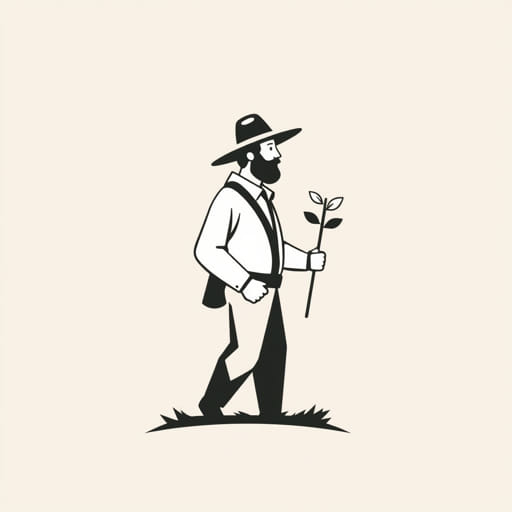
John Chapman, better known as Johnny Appleseed, stands out as one of the most fascinating figures in early American history. He is remembered not only for planting apple orchards across the frontier but also for embodying values of simplicity, kindness, and environmental stewardship. As a pioneer nurseryman, Chapman had a lasting influence on agriculture in the United States during the 18th and 19th centuries. His real legacy lies not just in the trees he planted but in the cultural impact he left behind, blending folklore, horticulture, and American expansionism into a singular historical figure. This topic explores the life, work, and historical significance of John Chapman in the context of US history.
Early Life and Background
John Chapman was born on September 26, 1774, in Leominster, Massachusetts. He was the second child of Nathaniel and Elizabeth Chapman. After his mother died when he was still a young boy, Chapman’s father, who served in the Revolutionary War, eventually remarried. This environment of hardship and patriotism played a significant role in shaping John’s future values and lifestyle.
Chapman received basic schooling, which gave him the literacy needed to read the Bible and the works of Emanuel Swedenborg, a Swedish theologian whose spiritual teachings deeply influenced him. His spiritual devotion later became as notable as his agricultural endeavors.
The Journey Westward
In the late 18th century, the western territories of Pennsylvania, Ohio, and Indiana represented the American frontier. Chapman seized this opportunity to spread apple trees across these areas. Unlike the popular myth that he randomly scattered apple seeds, John Chapman was a practical businessman and a nurseryman. He established nurseries, fenced them to protect from animals, and returned regularly to tend them.
This systematic approach helped him grow thousands of apple trees that would serve settlers moving west. Apple trees were not just for eating fruit they were essential for making hard cider, a staple drink in early American life. Thus, his work was both agriculturally and economically significant.
Business and Land Ownership
Though often perceived as a humble wanderer, Chapman was also a shrewd entrepreneur. He acquired large parcels of land across several states. He planted apple nurseries that he would sell or trade to settlers. His business model was successful because he understood both the frontier economy and the needs of incoming homesteaders.
Chapman’s method of planting apple trees also fulfilled legal land claim requirements in some territories. These laws often required settlers to improve the land in some way, and planting orchards met that criteria. Thus, Chapman facilitated settlement while growing his business interests.
Religious Beliefs and Personal Lifestyle
John Chapman was known for his devout faith in Swedenborgian Christianity. He was a committed missionary who shared religious tracts and teachings with the people he encountered. His belief in kindness, humility, and non-violence was a core part of his identity. He reportedly refused to harm animals and lived a life of voluntary poverty, often going barefoot regardless of the season.
His lifestyle made him a beloved figure among pioneers and Native American tribes alike. He maintained peaceful relationships with indigenous peoples, which was rare during a time of widespread conflict. Chapman’s spiritual message of universal love and harmony resonated in a nation that was still in its formative years.
Folklore and Cultural Legacy
Over time, John Chapman became the subject of American folklore. The image of Johnny Appleseed walking barefoot through forests, planting seeds, and preaching love became iconic. Although embellished, these tales are rooted in truth. His dedication to apple cultivation and his spiritual kindness were real and widely admired.
Johnny Appleseed became a symbol of frontier optimism and environmental harmony. Schools and children’s books helped cement his legend in American culture. Festivals and monuments dedicated to him can be found in several states, especially Ohio and Indiana, where many of his orchards were located.
Apple Varieties and Propagation
One of the lesser-known facts about Chapman’s work involves the science of apple propagation. Apple trees do not grow true from seed meaning the apples from a seed-grown tree are often very different from the parent fruit. Chapman’s trees produced apples that were typically tart or bitter, ideal for cider making rather than eating.
His nurseries contributed to the biodiversity of apple varieties in America. Modern apple growers owe much to the genetic foundation laid by Chapman’s efforts. Although the apples were not always of dessert quality, they were essential in an era where cider was safer to drink than often-contaminated water.
Death and Commemoration
John Chapman died in Fort Wayne, Indiana, in March 1845, reportedly of pneumonia. At the time of his death, he owned over 1,200 acres of orchard land. Despite his modest lifestyle, he had built a successful business and a spiritual legacy that extended beyond his orchards.
Today, Chapman is remembered through various public commemorations. Schools, parks, and statues celebrate his contributions to American agriculture and pioneer life. His gravesite in Fort Wayne is considered a historical landmark.
Impact on American Identity
Chapman’s story is more than just a tale of a man planting trees. It reflects key themes in US history: westward expansion, environmental stewardship, entrepreneurship, and religious freedom. He was a transitional figure bridging the early colonial days with the growing industrial nation that America would become.
His life embodies the pioneering spirit and the ideal of living in harmony with nature. In a rapidly developing country, Chapman offered a model of coexistence between settlers and the land, between spiritual ideals and practical needs.
John Chapman, or Johnny Appleseed, was far more than an eccentric man scattering seeds. He was a pioneer nurseryman whose agricultural work influenced generations. His spiritual mission added a layer of compassion and environmental ethics to the American frontier experience. Through a combination of entrepreneurial vision, religious devotion, and ecological foresight, he planted not just trees, but ideals that continue to grow in the American consciousness. The legacy of John Chapman remains rooted deeply in the landscape and identity of the United States.