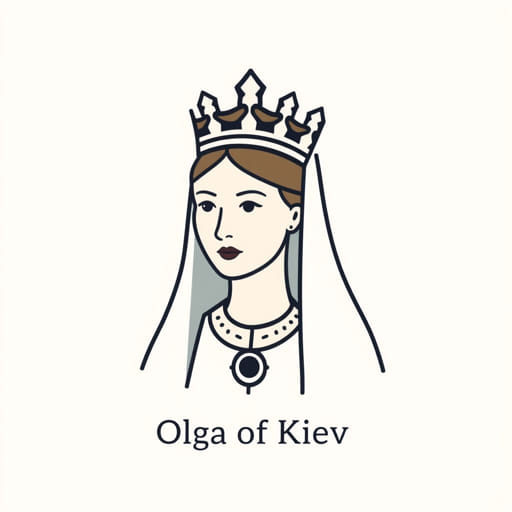
Among the most fascinating female rulers in early medieval Europe, Olga of Kiev stands out for her intelligence, ruthless leadership, and unexpected religious transformation. Living in the 10th century, Olga served as regent of Kievan Rus’ after the assassination of her husband, Prince Igor, and led her people during a time of both political turmoil and expanding influence. Her actions laid critical groundwork for the Christianization of Eastern Europe, a turning point in Russian and Ukrainian history. Olga’s name continues to echo in both historical and religious texts, revered not only as a ruler but also as a saint.
Historical Background of Kievan Rus’
Kievan Rus’ was a powerful federation of Slavic and Finno-Ugric peoples centered in modern-day Ukraine and Russia. During the 9th and 10th centuries, it was a major trade hub and political entity, often engaged in relations and conflicts with the Byzantine Empire and neighboring tribes. It was during this period of growth and transition that Olga of Kiev came into power.
Marriage to Igor of Kiev
Olga was likely born around 890 or 920 AD, although the exact date remains uncertain. According to historical chronicles, she was of Varangian (Viking) origin and married Prince Igor I of Kiev, who ruled Kievan Rus’ following the death of his father, Rurik. The marriage brought her into the ruling dynasty, and she later gave birth to Svyatoslav, who would become a significant ruler in his own right.
The Death of Prince Igor and Olga’s Revenge
In 945 AD, Prince Igor was brutally killed by the Drevlians, a neighboring Slavic tribe, during a dispute over tribute collection. His death could have thrown Kievan Rus’ into chaos, but instead, it marked the beginning of Olga’s rule as regent for their young son.
Olga’s Strategic Retaliation
Olga’s revenge against the Drevlians is legendary. Far from accepting the murder of her husband passively, she orchestrated a series of calculated and cruel acts:
- She tricked the Drevlian ambassadors who proposed she marry their prince, ordering them buried alive.
- She sent for more envoys and had them burned alive in a bathhouse.
- She visited the Drevlian capital under pretense of peace, organized a feast, and had her soldiers massacre the attendees.
- Finally, she besieged the Drevlian city of Iskorosten, demanding tribute in the form of birds and then using them to set the city ablaze.
These actions were not only about vengeance but also about reasserting the authority of Kievan Rus’. Olga proved that she was not only capable of ruling but also of commanding fear and respect.
Administrative Reforms and Leadership
After consolidating power, Olga began implementing major administrative reforms across Kievan Rus’. She reorganized the tribute collection system to prevent further unrest and ensure more efficient governance. This included the establishment of fixed tribute centers, known as pogosti, and greater oversight over local governors. These reforms stabilized the realm and laid a foundation for future economic and political consolidation.
A Woman in Power
In a time when female rulers were rare, especially in Eastern Europe, Olga’s reign is notable for her autonomy and effectiveness. Though technically ruling as a regent, her control over the state was absolute for over a decade. She demonstrated the capability of women to govern large and complex realms with wisdom, decisiveness, and vision.
Conversion to Christianity
One of the most significant aspects of Olga of Kiev’s life was her conversion to Christianity. In 957 AD, she traveled to Constantinople, the heart of the Byzantine Empire, and was baptized by the Emperor Constantine VII. This was a monumental step, as Kievan Rus’ was still predominantly pagan at the time.
Spiritual Legacy
Olga took the Christian name Helena and began promoting Christianity upon her return. Although her son Svyatoslav remained a pagan, she ensured that Christianity would survive and eventually thrive in the region. Her grandson, Vladimir the Great, would later make Christianity the official religion of Kievan Rus’ in 988 AD, a legacy directly tied to Olga’s influence.
Canonization and Sainthood
Olga of Kiev was canonized by the Eastern Orthodox Church as a saint for her pious acts and efforts to spread Christianity. She is known as Equal to the Apostles, a rare title that places her among the highest ranks of sainthood. Her feast day is celebrated on July 11.
Importance to the Russian Orthodox Church
Olga’s sainthood underscores her significance in the religious development of Eastern Slavic Christianity. She serves as a spiritual ancestor to Orthodox Christians in Russia, Ukraine, and Belarus, representing a bridge between the pagan past and Christian future.
Historical Interpretation and Legacy
Historians view Olga of Kiev as one of the most remarkable female leaders of her time. Her ability to govern, seek revenge, implement structural reforms, and adopt a foreign religion with grace and diplomacy makes her an extraordinary figure in Eastern European history.
Olga’s Role in Nation Building
While her grandson Vladimir receives credit for Christianizing the Kievan Rus’, Olga’s earlier efforts created the space for such a monumental transformation. Without her early advocacy for Christianity and stabilization of the state, the later conversion of the realm may have been much more difficult or delayed.
Olga of Kiev was more than just a regent or queen; she was a force of political strategy, administrative innovation, and spiritual guidance. Her story blends dramatic revenge, wise governance, and deep faith in ways that continue to inspire scholars and religious devotees alike. As both a historical and religious figure, Olga remains central to understanding the foundations of Eastern European civilization and the enduring legacy of powerful female leadership in world history.