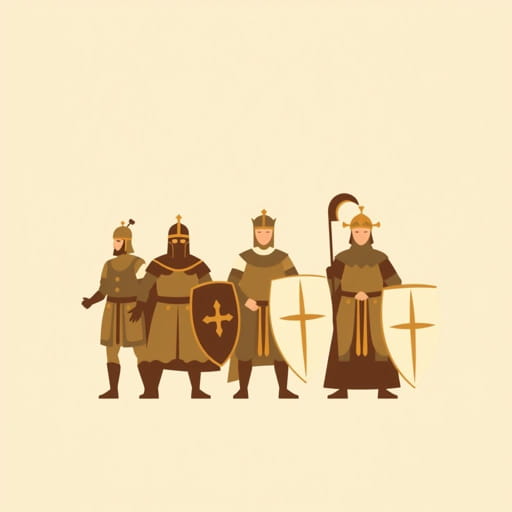
The Frankish people played a major role in shaping medieval European history, rising to prominence during the decline of the Roman Empire and eventually becoming the foundation for what would become France and parts of Germany. Known for their warrior culture, dynamic leadership, and fusion of Roman and Germanic traditions, the Franks helped to preserve elements of Roman governance while also laying the groundwork for feudal Europe. Their influence was not only political and military but also religious, as they became one of the earliest Germanic tribes to convert to Christianity, dramatically altering the religious landscape of the continent.
Origins and Early History of the Franks
The Franks were originally a confederation of several Germanic tribes that lived along the eastern banks of the lower and middle Rhine River. These tribes included the Salians and the Ripuarians, among others. The name ‘Franks’ may have come from a word meaning ‘fierce’ or ‘free,’ reflecting their reputation as bold warriors. By the 3rd century CE, they began to push into Roman territory, initially as raiders but eventually as settlers within the empire’s borders.
As the Roman Empire weakened in the West, the Franks grew in strength and influence. Unlike some other tribes that remained on the periphery, the Franks became deeply embedded in the territories they settled, particularly in what is now northern France, Belgium, and western Germany.
Salian and Ripuarian Franks
The two major branches of the Frankish people the Salian Franks and the Ripuarian Franks had distinct territories and leadership but often cooperated when faced with external threats. The Salians were among the first to be integrated into the Roman military system, receiving land in return for military service. The Ripuarian Franks settled further to the east and developed independently, maintaining closer ties to their Germanic roots for a longer period.
The Rise of Clovis and the Merovingian Dynasty
One of the most important figures in Frankish history was Clovis I, a Salian Frankish king who united the various Frankish tribes under one rule around the late 5th century. Clovis is best known for his military conquests, which expanded Frankish control throughout Gaul, and for his conversion to Christianity, which had lasting religious and political implications.
- Clovis defeated the last Roman governor of Gaul, Syagrius, in 486 CE, marking the true end of Roman rule in the region.
- His conversion to Catholic Christianity (as opposed to Arian Christianity followed by many other Germanic tribes) gained him the support of the Roman Church and the Gallo-Roman aristocracy.
- Clovis founded the Merovingian Dynasty, which ruled the Franks for nearly 300 years.
This alliance between the Franks and the Roman Catholic Church set a precedent that would shape the politics of Europe for centuries. Clovis’s decision to convert also helped facilitate the widespread Christianization of the Frankish people, reinforcing their legitimacy as rulers of former Roman lands.
The Role of the Franks in the Carolingian Renaissance
Following the decline of Merovingian power, another Frankish dynasty emerged the Carolingians. Charles Martel, a powerful Frankish military leader, laid the groundwork for this dynasty through his defense of Christian Europe against Muslim forces at the Battle of Tours in 732 CE.
His grandson, Charlemagne (Charles the Great), would go on to become one of the most celebrated rulers in European history. Charlemagne expanded the Frankish realm into an empire that included most of Western and Central Europe. In 800 CE, he was crowned ‘Emperor of the Romans’ by Pope Leo III, a title that signified both political and religious authority.
Achievements of the Carolingian Franks
- Promotion of education and learning, leading to the Carolingian Renaissance a revival of art, culture, and intellectual activity.
- Establishment of a strong administrative system with local counts and bishops acting under imperial authority.
- Standardization of religious practices and scriptural texts across the empire.
The Frankish Empire under Charlemagne marked a high point in early medieval history. The fusion of Roman, Christian, and Germanic traditions under his rule helped shape European identity and governance for generations to come.
Decline and Legacy of the Frankish People
After Charlemagne’s death in 814 CE, the empire was divided among his heirs, leading to internal strife and fragmentation. By the Treaty of Verdun in 843, the empire was split into three distinct kingdoms, which would eventually evolve into modern European states such as France and Germany.
Though the unified Frankish Empire did not last, the cultural and political influence of the Franks endured. They had laid the foundations for medieval European monarchies, feudal society, and the close relationship between Church and state. The French nation in particular sees its roots in the Frankish kingdom, and the name ‘France’ itself derives from ‘Francia,’ the land of the Franks.
Enduring Impact of the Frankish People
- Christianization of Western Europe through missionary work and political alliances.
- Preservation and adaptation of Roman legal and administrative systems.
- Formation of early medieval European identity based on shared culture, religion, and governance.
While the Frankish people as a distinct ethnic group eventually blended into the populations of the territories they ruled, their historical legacy remains powerful. From the early tribal confederations along the Rhine to the coronation of Charlemagne, the Franks helped shape a continent in transition from antiquity to the medieval world.
The Frankish people were more than just another Germanic tribe they were a transformative force in European history. From their early interactions with the Roman Empire to the heights of the Carolingian Empire, the Franks demonstrated a unique ability to adapt, conquer, and govern. Their contributions to religion, governance, and culture continue to influence Europe today. Understanding who the Frankish people were is essential to understanding the roots of modern European civilization.