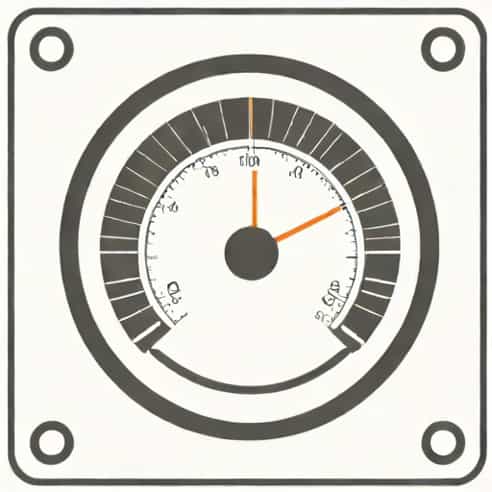
The least count of a milliammeter is a fundamental concept in electrical measurements, especially when precise readings of small currents are required. A milliammeter is an instrument designed to measure current in the milliampere range, which is a thousandth of an ampere. Understanding its least count is essential for engineers, students, and technicians who rely on accurate current measurements in experiments, circuit analysis, and troubleshooting. The least count determines the smallest current increment that the instrument can reliably indicate, which directly affects the accuracy and precision of measurements.
Understanding a Milliammeter
A milliammeter is an analog or digital instrument specifically designed to measure electrical currents in the milliampere range, typically from 0 to several hundred milliamperes. Analog milli-ammeters usually have a moving coil galvanometer mechanism, while digital versions use microcontrollers and analog-to-digital converters to display current values. These instruments are crucial in laboratory settings, electronics repair, and in testing circuits where precise control and monitoring of small currents are required.
Structure and Working
The working principle of a milliammeter depends on the type of instrument. In analog models, the device uses a moving coil galvanometer that deflects a needle on a calibrated scale in response to current flow. The deflection is proportional to the current passing through the instrument. Digital milli-ammeters, on the other hand, measure the voltage across a known resistance and convert it to a digital reading, offering higher precision and easier interpretation.
Definition of Least Count
The least count of a measuring instrument is defined as the smallest quantity or increment that can be accurately measured with the instrument. In the context of a milliammeter, the least count refers to the smallest current change that the instrument can detect and display reliably. The least count is a critical parameter because it determines the resolution and precision of measurements, allowing users to make fine adjustments in circuits and understand subtle variations in current.
Formula to Calculate Least Count
The least count of an analog milliammeter can be calculated using the following formula
- Least Count = Range of the Milliammeter / Number of Divisions on the Scale
For example, if a milliammeter has a full-scale range of 100 mA and the scale is divided into 50 equal divisions, the least count is
- Least Count = 100 mA / 50 = 2 mA
This means that the instrument can detect current changes as small as 2 milliamperes. Digital instruments may have a least count determined by their display resolution and internal circuitry, often offering smaller increments and higher accuracy compared to analog meters.
Importance of Least Count in Measurements
The least count is essential for accurate and reliable measurements. Knowing the least count helps in estimating the uncertainty and error in readings. When using a milliammeter, the least count indicates how finely you can measure the current. A smaller least count implies better resolution, allowing the detection of minor changes in current. This is especially important in electronic experiments, precision instruments testing, and circuits where milliampere-level differences can significantly affect performance.
Factors Affecting Least Count
Several factors can influence the least count of a milliammeter
- Full-scale range A wider range with the same number of divisions results in a larger least count.
- Number of scale divisions More divisions provide finer resolution and a smaller least count.
- Quality of the galvanometer High-quality galvanometers can provide more precise readings.
- Calibration Properly calibrated instruments ensure that the least count reflects the true resolution.
By understanding these factors, users can select the appropriate milliammeter for specific applications, ensuring accurate measurements and minimal error.
Practical Applications of Milliammeter Least Count
The least count of a milliammeter plays a crucial role in practical applications where small currents need to be measured precisely
Laboratory Experiments
In physics and electronics labs, students and researchers use milli-ammeters to measure currents in various circuits. A milliammeter with an appropriate least count allows for accurate observation of small changes in current, which is vital for experiments involving Ohm’s law, Kirchhoff’s laws, and other fundamental principles of electricity.
Electronics Testing
Technicians and engineers rely on milli-ammeters to troubleshoot and test electronic devices. Measuring small currents accurately can help detect faults, short circuits, or leakage currents in sensitive components. A low least count enables the detection of subtle variations that might otherwise go unnoticed.
Medical and Industrial Instruments
Precision current measurements are important in medical devices and industrial control systems. For instance, milli-ammeters are used in monitoring circuits for electrocardiographs and other sensitive medical instruments, where even minor current variations can have significant implications. Similarly, industrial control panels often require monitoring of small currents to maintain optimal operation of equipment.
Tips for Accurate Measurement
To maximize the accuracy of measurements using a milliammeter, it is important to consider the least count and follow good measurement practices
- Select a milliammeter with a least count appropriate for the expected current range.
- Ensure the instrument is properly calibrated before use.
- Read the scale carefully, considering parallax error in analog meters.
- Avoid overloading the milliammeter beyond its full-scale range.
- Use appropriate series or shunt resistors when measuring higher currents to prevent damage.
Understanding Measurement Errors
Even with a known least count, errors can occur due to various factors such as environmental conditions, instrument wear, and human reading errors. The uncertainty in measurement is often approximated as ±1 least count, meaning the actual current could vary by one division above or below the indicated reading. Being aware of this helps in accurate interpretation of results and in improving the reliability of experiments and tests.
The least count of a milliammeter is a key aspect that determines the instrument’s precision and accuracy. Understanding how to calculate and interpret the least count allows users to measure small currents effectively and with confidence. Whether in educational laboratories, electronics testing, or industrial and medical applications, the milliammeter’s least count ensures reliable and repeatable results. Proper selection, calibration, and usage of the milliammeter, along with an understanding of its least count, are essential for achieving high-quality measurements and minimizing errors. By focusing on this fundamental concept, engineers, students, and technicians can enhance the precision and reliability of their electrical measurements, leading to better analysis, troubleshooting, and control in various applications.