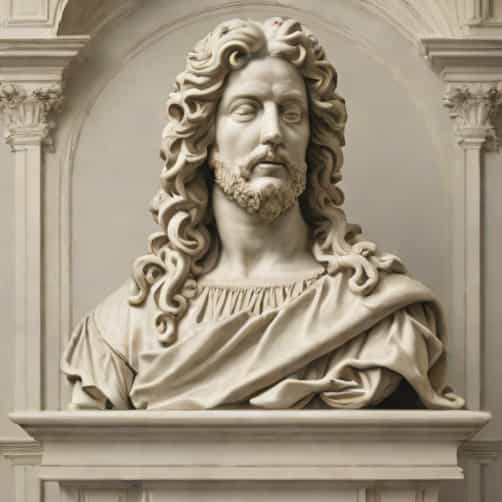
Gian Lorenzo Bernini, widely regarded as one of the greatest sculptors of the Baroque era, had an unparalleled ability to capture both movement and emotion in marble. While he is most famously associated with Rome and his works for the Vatican, his influence extended across Europe. One of the fascinating intersections of art and monarchy involves Bernini’s connection to Louis XIV of France. This relationship, though complex, highlights the interplay between artistic genius and royal ambition, showing how sculpture could serve both as a work of art and a statement of political power.
The Context of Bernini’s Work in 17th Century Europe
The 17th century was a period of grandeur and power for European monarchies. Artistic patronage was not merely a matter of personal taste; it was a tool to communicate authority, wealth, and divine right. Louis XIV, the Sun King, sought to project an image of absolute power. Bernini, who had already achieved immense fame through works such as the Ecstasy of Saint Teresa and his design of St. Peter’s Square, was recognized across the continent as the ideal artist to embody the majesty and splendor that Louis XIV desired. The collaboration between the Italian sculptor and the French king exemplifies the merging of artistic mastery with political symbolism.
Bernini’s Journey to France
In 1665, Louis XIV invited Bernini to France to provide designs for the Louvre and to sculpt the king himself. The visit was highly anticipated, as Bernini had a reputation for transforming marble into lifelike representations that conveyed not only physical appearance but also inner character. His arrival in Paris was met with great excitement, and he was commissioned to produce a portrait bust of Louis XIV, intended to capture the king’s authority and grandeur in a single sculptural form.
The Louis XIV Bust Artistic Vision and Execution
Bernini approached the sculpture of Louis XIV with his characteristic attention to detail and mastery of form. He aimed to portray the king as both regal and approachable, emphasizing the human dimension alongside royal majesty. Bernini’s technique involved careful study of the sitter, translating subtle facial expressions, posture, and gesture into marble. The result was a portrait bust that conveyed a sense of movement, vitality, and power, all hallmarks of Bernini’s Baroque style.
Stylistic Features of the Bust
- Dynamic ExpressionUnlike earlier, more static royal portraits, Bernini’s bust of Louis XIV exhibits a sense of life and movement, reflecting Baroque artistic principles.
- Attention to DetailThe intricacy of the king’s hair, clothing folds, and facial features demonstrates Bernini’s meticulous craftsmanship.
- Psychological InsightBernini sought to capture not only the physical likeness but also the commanding presence and inner confidence of the monarch.
Reception and Critique
Despite Bernini’s mastery, his visit to France was met with mixed reception. French courtiers were accustomed to a more restrained, classical style, contrasting with Bernini’s dynamic and emotive Baroque approach. While some admired the energy and realism of the sculptor’s work, others felt it deviated from traditional French aesthetics. Bernini’s proposals for architectural projects at the Louvre were also seen as overly extravagant and did not fully align with the vision of French royal architects. Ultimately, his stay in France was shorter than anticipated, but the impact of his work remained significant.
Legacy of Bernini’s Louis XIV Sculpture
Although Bernini’s direct influence on French sculpture was somewhat limited by cultural differences, the bust of Louis XIV stands as a testament to the artist’s genius and his ability to navigate royal patronage. The work captured the king’s essence in a way that had rarely been achieved before, setting a standard for lifelike, expressive portraiture. It also highlighted the growing power of art as a means of political communication, demonstrating how sculpture could reinforce the image of monarchy and authority.
Baroque Art and Monarchical Power
Bernini’s sculpture of Louis XIV exemplifies the broader role of Baroque art in 17th-century European courts. Baroque art was characterized by its grandeur, emotional intensity, and dramatic use of light and shadow. These qualities made it ideal for conveying the power and majesty of rulers like Louis XIV. Sculptures, paintings, and architecture all worked together to create a cohesive image of absolute monarchy, with Bernini’s work serving as a key example of how individual pieces could symbolize wider political and cultural narratives.
Influence on French Art and Sculpture
While Bernini returned to Rome after his French visit, his presence left a mark on French art. Sculptors and architects in France were inspired by his innovative approach to movement and realism, gradually incorporating Baroque sensibilities into their own work. The emphasis on emotional expression, detailed texture, and psychological insight became more prevalent in French portraiture, influencing generations of artists beyond Bernini’s direct involvement.
Gian Lorenzo Bernini’s engagement with Louis XIV and his sculptural portrayal of the French king illustrate the intersection of art, politics, and culture in 17th-century Europe. Despite cultural differences and mixed reception, Bernini’s craftsmanship captured the essence of the Sun King, creating a work that combined lifelike detail with grand symbolism. The Louis XIV bust remains a striking example of Baroque portraiture, demonstrating how sculpture can convey both physical likeness and inner authority. Bernini’s influence, though brief in France, extended far beyond his immediate works, shaping the course of European art and highlighting the enduring power of sculpture to communicate political and personal presence.