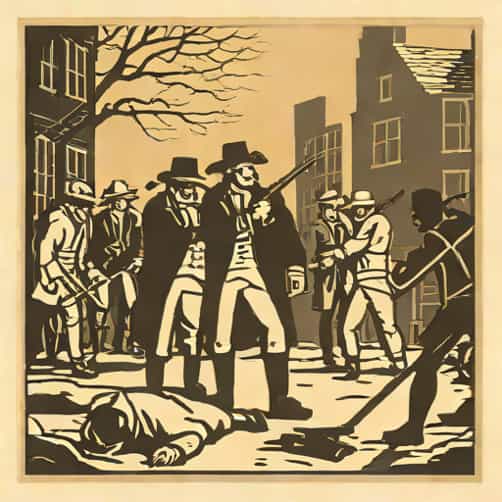
In the years leading up to the American Revolution, tensions between British authorities and colonial residents steadily intensified. Economic pressure, political control, and the presence of British troops created an atmosphere of resentment and distrust in colonial cities. One event in particular captured this growing conflict and left a lasting mark on American history the Boston Massacre and the death of Crispus Attucks. This incident became a powerful symbol of resistance and is often remembered as a turning point in the struggle for independence.
Background Tensions in Colonial Boston
By the late 1760s, Boston had become a center of colonial opposition to British rule. Laws such as the Stamp Act and the Townshend Acts imposed taxes without colonial representation, angering merchants, workers, and political leaders alike.
To enforce these laws and maintain order, Britain stationed soldiers in Boston. Their presence in a busy port city increased friction with local residents, who viewed the troops as symbols of oppression rather than protection.
Economic and Social Pressure
British soldiers often competed with local laborers for part-time work, driving down wages and increasing hostility. Verbal insults and small street confrontations became common.
This constant tension set the stage for a larger conflict.
The Events of March 5, 1770
On the evening of March 5, 1770, a confrontation occurred between British soldiers and a group of colonists near the Customs House on King Street.
The Confrontation Begins
The incident reportedly began when a British sentry was taunted by local residents. A crowd quickly formed, throwing snowballs, ice, and debris while shouting insults.
Additional soldiers arrived to reinforce the sentry, and the situation rapidly escalated.
Shots Fired
In the confusion and noise, shots were fired into the crowd. Five colonists were killed, and several others were wounded.
This moment would soon be labeled the Boston Massacre by colonial leaders.
Who Was Crispus Attucks
Crispus Attucks is widely recognized as the first person killed during the Boston Massacre. His background and identity made his death especially significant.
Early Life and Background
Crispus Attucks was of African and Native American descent. He is believed to have been born into slavery and later escaped, working as a sailor and dockworker.
His life reflects the complex social fabric of colonial America.
Presence at the Massacre
Attucks was among the crowd confronting the soldiers. Historical accounts suggest he was at the front of the group when shots were fired.
He was struck and killed instantly, becoming a symbol of colonial resistance.
The Death of Crispus Attucks
The death of Crispus Attucks carried deep symbolic meaning. As a man of mixed heritage and a former enslaved person, his death highlighted the involvement of marginalized groups in the fight against British authority.
A Symbol of Sacrifice
Attucks was later honored as a martyr for liberty. His role in the Boston Massacre emphasized that the struggle for freedom involved people from diverse backgrounds.
His death was used to inspire unity and resistance among colonists.
Colonial Reaction to the Boston Massacre
News of the Boston Massacre spread quickly throughout the colonies. Patriot leaders used the incident to fuel anti-British sentiment.
Public Outrage
Illustrations, pamphlets, and newspaper topics portrayed the British soldiers as brutal aggressors. These accounts often exaggerated the violence to strengthen colonial unity.
The term massacre itself was a deliberate choice meant to provoke anger.
Funeral and Public Mourning
The victims of the Boston Massacre, including Crispus Attucks, were buried together in a public funeral. Thousands attended, demonstrating widespread outrage.
This collective mourning reinforced the emotional impact of the event.
The Trial of the British Soldiers
Despite public anger, colonial leaders insisted on a fair trial for the British soldiers involved.
Legal Proceedings
The soldiers were defended by colonial lawyers, including John Adams. Adams argued that the soldiers acted in self-defense amid a threatening mob.
This decision demonstrated the colonists’ commitment to the rule of law.
Verdict and Consequences
Most of the soldiers were acquitted. Two were found guilty of manslaughter and received reduced punishment.
The outcome disappointed many colonists but reinforced principles of justice.
Why the Boston Massacre Mattered
The Boston Massacre was not the bloodiest conflict of the era, but its psychological and political impact was immense.
A Turning Point in Colonial Resistance
The incident intensified distrust of British authority and helped unify the colonies against perceived tyranny.
It paved the way for later acts of resistance, including the Boston Tea Party.
Legacy of Crispus Attucks
Over time, Crispus Attucks became an enduring symbol of courage and sacrifice.
Recognition in American History
Attucks is remembered as one of the earliest martyrs of the American Revolution. His legacy is especially significant in African American history.
Monuments and memorials honor his role in the struggle for freedom.
Broader Meaning of His Death
The death of Crispus Attucks reminds us that the fight for liberty involved people from all walks of life.
His story challenges simplified narratives of the American Revolution.
The Boston Massacre in Historical Memory
Historians continue to debate the details of the Boston Massacre, including who fired first and whether the soldiers were provoked.
Despite differing interpretations, its importance remains undisputed.
How the Event Is Remembered Today
Today, the Boston Massacre is taught as a key event leading to the American Revolution.
- It represents colonial resistance to authority
- It highlights the power of propaganda
- It honors early sacrifices for independence
The Boston Massacre and the death of Crispus Attucks marked a defining moment in American history. What began as a street confrontation became a powerful symbol of injustice and resistance.
Crispus Attucks’ death continues to resonate as a reminder that the pursuit of freedom has always involved courage, sacrifice, and the voices of those often left out of traditional narratives. Together, the event and his legacy helped shape the path toward American independence.