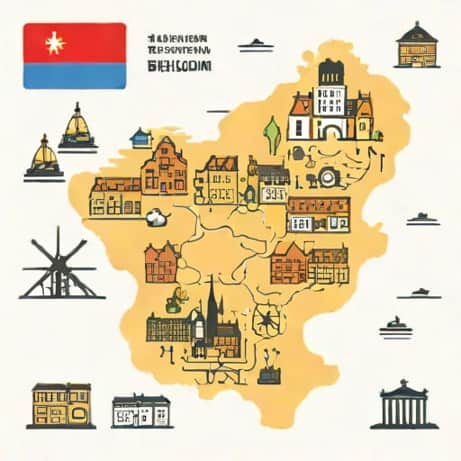
Belgium is a small but remarkably complex country located in Western Europe, known for its rich history, cultural diversity, and strategic position on the continent. Despite its relatively modest size, Belgium has played a major role in European politics, trade, and cultural exchange for centuries. To fully understand the country, it is important to describe the geographical and ethnic composition of Belgium, as these two aspects are deeply interconnected and shape its social structure, languages, and political system.
Geographical Location of Belgium
Belgium is situated in Western Europe and shares borders with France to the southwest, the Netherlands to the north, Germany to the east, Luxembourg to the southeast, and the North Sea to the northwest. Its central location has historically made it a crossroads for trade, migration, and military activity.
The country covers an area of approximately 30,500 square kilometers, making it one of the smaller nations in Europe. However, its geographical diversity within this limited space is notable.
Major Physical Regions of Belgium
Geographically, Belgium is commonly divided into three main physical regions the Coastal Plain, the Central Plateau, and the Ardennes Highlands. Each region has distinct natural features and patterns of human settlement.
The Coastal Plain
The Coastal Plain lies in the northwest of Belgium along the North Sea. This low-lying area is characterized by sandy beaches, dunes, and reclaimed land known as polders. The region has a strong maritime influence and supports activities such as fishing, tourism, and port trade.
Major ports like Antwerp and Zeebrugge play a crucial role in Belgium’s economy and connect the country to global trade routes.
The Central Plateau
The Central Plateau extends across much of northern and central Belgium. It is a gently rolling region with fertile soil, making it ideal for agriculture. This area is also the most densely populated part of the country.
Major cities such as Brussels, Ghent, and Leuven are located here. The plateau supports farming, industry, and urban development, making it the economic heart of Belgium.
The Ardennes Highlands
The Ardennes region is located in the southeast and is characterized by hills, forests, and narrow valleys. It is less densely populated than the rest of the country and has a more rural character.
The Ardennes is known for its natural beauty, outdoor tourism, and historical significance, particularly during major European conflicts.
Climate and Natural Environment
Belgium has a temperate maritime climate, influenced by the North Sea. Winters are generally mild, summers are cool, and rainfall is evenly distributed throughout the year.
This climate supports agriculture and contributes to Belgium’s green landscapes, forests, and river systems such as the Meuse and the Scheldt.
Overview of Belgium’s Ethnic Composition
Belgium’s ethnic composition is closely linked to its linguistic divisions. Rather than being divided strictly by race or ancestry, Belgian society is primarily organized around language and cultural identity.
The country is officially divided into three main communities based on language the Flemish, the Walloons, and a small German-speaking community.
The Flemish Population
The Flemish people make up the largest ethnic and linguistic group in Belgium, accounting for around 60 percent of the population. They primarily live in the northern region known as Flanders.
The Flemish speak Dutch, often referred to locally as Flemish. Flanders is economically strong, with major industries, ports, and international trade.
Cultural Characteristics of Flanders
Flemish culture is influenced by Dutch traditions as well as broader European influences. Art, architecture, and commerce have historically played important roles in the region.
Cities such as Antwerp, Bruges, and Ghent are cultural centers that reflect the region’s heritage and modern identity.
The Walloon Population
The Walloons make up roughly 40 percent of Belgium’s population and primarily live in the southern region called Wallonia. The dominant language in Wallonia is French.
Historically, Wallonia was an industrial powerhouse due to coal mining and steel production. While traditional industries have declined, the region has diversified its economy.
Cultural Identity in Wallonia
Walloon culture is closely connected to French language and traditions. Literature, music, and regional customs play an important role in shaping local identity.
Despite linguistic differences, Wallonia remains an integral part of Belgium’s national framework.
The German-Speaking Community
A small but officially recognized German-speaking community lives in eastern Belgium, near the border with Germany. This group represents less than one percent of the population.
German is the official language in this region, and the community enjoys cultural and political autonomy within the Belgian state.
Brussels A Unique Multicultural Region
Brussels holds a special position in Belgium’s ethnic and geographical composition. Although geographically located in Flanders, Brussels is officially bilingual, with both French and Dutch as official languages.
The majority of Brussels residents speak French as their primary language, but the city is highly diverse due to international migration and its role as the capital of the European Union.
Immigration and Modern Diversity
In addition to its traditional ethnic groups, Belgium has become increasingly multicultural due to immigration. People from Southern Europe, North Africa, the Middle East, and Eastern Europe have settled in Belgium over recent decades.
This diversity is especially visible in urban areas such as Brussels, Antwerp, and Liège, where multiple cultures, religions, and languages coexist.
Political Impact of Geography and Ethnicity
The geographical and ethnic composition of Belgium has a strong influence on its political system. The country operates as a federal state with regions and communities that have significant autonomy.
This structure helps manage linguistic and cultural differences but also makes governance complex, requiring cooperation and compromise.
Language as a Defining Factor
Language plays a central role in Belgian identity. Dutch, French, and German are all official languages, and language laws regulate education, administration, and public services.
This linguistic diversity is a defining feature of Belgium and reflects its unique ethnic composition.
To describe the geographical and ethnic composition of Belgium is to explore a country shaped by diversity within a compact space. From coastal plains and fertile plateaus to forested highlands, Belgium’s geography supports varied ways of life.
At the same time, its ethnic composition, defined largely by language and culture, creates a complex but balanced society. The interaction between geography, ethnicity, and history has made Belgium a distinctive nation, one that continues to adapt while preserving its unique identity in Europe.