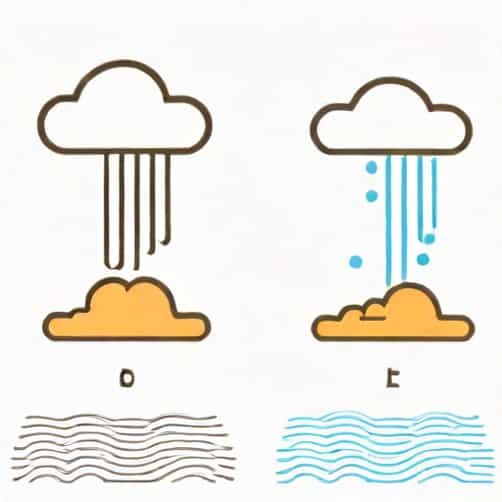
Understanding the processes of evaporation and condensation is fundamental to comprehending the water cycle and many other natural and industrial phenomena. While these processes are closely related and often occur simultaneously in nature, they involve opposite transformations of matter. Evaporation is the process by which liquid water turns into vapor, while condensation is the reverse, where vapor becomes liquid. These transformations are crucial in meteorology, climate science, and everyday life, impacting everything from weather patterns to the operation of cooling systems. Exploring the differences between evaporation and condensation can provide clarity on how energy, temperature, and environmental factors influence these processes.
Definition of Evaporation
Evaporation is the process in which a liquid changes into a gaseous state. This transformation occurs when molecules at the surface of a liquid gain sufficient energy to overcome intermolecular forces and escape into the air as vapor. Evaporation is a surface phenomenon, meaning it happens primarily at the liquid-air interface. It is influenced by factors such as temperature, humidity, air movement, and surface area. Evaporation plays a significant role in the water cycle by transferring water from oceans, lakes, and rivers into the atmosphere.
Key Characteristics of Evaporation
- Occurs at temperatures below the boiling point.
- Primarily a surface phenomenon.
- Requires absorption of heat energy from the environment.
- Can happen slowly over time, even at room temperature.
Definition of Condensation
Condensation is the process by which a gas transforms into a liquid. This occurs when vapor molecules lose energy, slow down, and aggregate to form liquid droplets. Condensation is essential in cloud formation, dew, and the functioning of various industrial processes, such as distillation and refrigeration. Unlike evaporation, condensation releases heat into the surrounding environment, which can affect local temperatures and weather patterns. Condensation is not limited to the surface of a liquid; it can occur wherever the air reaches saturation and the temperature is at or below the dew point.
Key Characteristics of Condensation
- Occurs when gas cools or comes into contact with a cooler surface.
- Involves the release of heat energy into the surroundings.
- Can happen rapidly, forming droplets on surfaces.
- Occurs throughout the volume of saturated air, not just at a surface.
Main Differences Between Evaporation and Condensation
While evaporation and condensation are opposite processes in the phase change of water, they have distinct characteristics and roles in nature and industry. Understanding these differences is crucial for applications ranging from weather forecasting to engineering systems.
Direction of Phase Change
Evaporation involves the transformation of liquid into gas, requiring energy input to break molecular bonds. Condensation, on the other hand, involves the transformation of gas into liquid, releasing energy as molecules slow down and bond together. This opposite direction of phase change is the most fundamental difference between the two processes.
Energy Exchange
Evaporation is an endothermic process, meaning it absorbs heat energy from the environment to facilitate the transition from liquid to vapor. In contrast, condensation is an exothermic process that releases heat into the surrounding air as gas molecules convert back into liquid. This energy exchange plays a critical role in weather phenomena and climate regulation.
Temperature and Conditions
- Evaporation occurs at any temperature, although higher temperatures increase the rate of evaporation.
- Condensation occurs when vapor cools to its dew point or encounters a cooler surface.
- Humidity levels affect both processes high humidity slows evaporation, while it can accelerate condensation.
Location and Occurrence
Evaporation typically occurs at the surface of a liquid, such as a puddle, lake, or ocean. It is influenced by surface area, air flow, and exposure to sunlight. Condensation can occur on surfaces, such as windows or metal objects, but also in the air to form clouds, fog, or mist. This difference in location highlights the contrasting ways in which these processes interact with their environment.
Examples of Evaporation and Condensation
Evaporation Examples
- Water evaporating from oceans, lakes, and rivers.
- Drying of wet clothes in sunlight.
- Perspiration on human skin, which cools the body as it evaporates.
- Evaporation in cooling towers and industrial processes.
Condensation Examples
- Dew forming on grass in the early morning.
- Water droplets on the outside of a cold beverage glass.
- Fog formation near bodies of water.
- Condensation in air conditioning systems and refrigeration units.
Importance in the Water Cycle
Both evaporation and condensation are essential components of the water cycle. Evaporation transfers water from the Earth’s surface into the atmosphere, forming water vapor. This vapor eventually cools, condenses, and returns to the Earth as precipitation, completing the cycle. The balance between these processes maintains ecosystems, regulates weather patterns, and sustains life. Understanding the differences and interactions between evaporation and condensation is critical for meteorologists, environmental scientists, and engineers who study or manage water resources.
Evaporation and condensation are complementary processes that play vital roles in natural and industrial systems. Evaporation transforms liquid into vapor by absorbing heat, while condensation transforms vapor into liquid by releasing heat. These processes differ in direction of phase change, energy exchange, location, and environmental conditions, yet they are interconnected in the water cycle and climate regulation. Recognizing the differences between evaporation and condensation not only enhances comprehension of fundamental scientific principles but also informs practical applications in meteorology, engineering, and daily life. By understanding these processes, we gain insight into the delicate balance of natural systems and the mechanisms that sustain life on Earth.