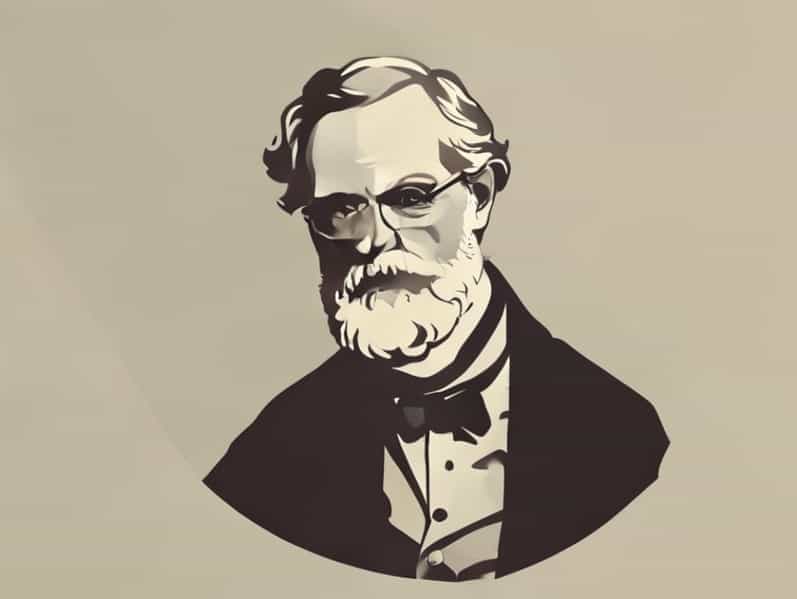
Gregor Mendel’s discovery is considered one of the most important milestones in the history of biology. His experiments with pea plants in the 19th century laid the foundation for modern genetics, revealing the basic principles of heredity that explain how traits are passed from parents to offspring. At the time, his work was largely ignored, but it would later revolutionize the understanding of life and inheritance. Mendel’s careful observations, mathematical approach, and systematic experiments provided the first scientific explanation for patterns of inheritance that had puzzled humans for centuries.
The Life of Gregor Mendel
Gregor Johann Mendel was born on July 20, 1822, in a small village in what is now the Czech Republic. He grew up in a family of farmers and developed an early interest in plants and nature. Despite financial challenges, Mendel pursued education and eventually joined the Augustinian monastery of St. Thomas in Brno. It was there that his scientific curiosity found the perfect environment to flourish.
As a monk, Mendel had access to the monastery’s gardens, where he conducted his groundbreaking experiments. His role as both a priest and a scientist allowed him the time and resources to study the natural world deeply. Mendel’s dual dedication to faith and science shaped his disciplined approach to research.
The Pea Plant Experiments
Mendel chose the garden pea plant (Pisum sativum) for his experiments because it offered many advantages. Pea plants had easily observable traits such as flower color, seed shape, and plant height. They also had the ability to self-pollinate or cross-pollinate, allowing Mendel to control their breeding.
Between 1856 and 1863, Mendel carefully bred and observed over 28,000 pea plants. He focused on seven distinct traits that appeared in two contrasting forms, such as
- Flower color purple or white
- Seed shape round or wrinkled
- Pod color green or yellow
- Pod shape inflated or constricted
- Flower position axial or terminal
- Stem length tall or short
- Seed color yellow or green
By carefully tracking how these traits appeared in successive generations, Mendel noticed consistent mathematical patterns. These patterns became the basis of his laws of inheritance.
Mendel’s Laws of Inheritance
From his observations, Mendel formulated two fundamental principles the Law of Segregation and the Law of Independent Assortment. These laws describe how traits are transmitted from parents to offspring.
The Law of Segregation
The Law of Segregation states that each organism carries two copies of every gene, one from each parent. During reproduction, these two copies separate, and only one copy is passed to the offspring. This explains why offspring inherit one version of a trait from each parent.
For example, when Mendel crossed purebred tall plants with purebred short plants, the first generation (F1) plants were all tall. However, when these F1 plants were self-pollinated, the second generation (F2) showed a ratio of approximately three tall plants for every one short plant. This pattern revealed that the short trait was not lost but hidden in the first generation and reappeared later.
The Law of Independent Assortment
The Law of Independent Assortment explains how different traits are inherited independently of each other. For instance, the inheritance of seed color does not affect the inheritance of seed shape. This concept showed that genes for different traits are passed on separately, leading to genetic variation in offspring.
These two laws formed the core of what would later be known as Mendelian genetics, forming the foundation for modern understanding of DNA and heredity.
Mendel’s Scientific Method
One of the reasons Mendel’s discovery was so significant is the rigorous scientific method he applied. At a time when most naturalists relied on observation and description, Mendel introduced experimentation and mathematical analysis. He recorded large amounts of data, calculated ratios, and used probability to explain inheritance patterns.
His approach was far ahead of his time. Mendel treated biological phenomena as quantifiable, introducing a level of precision that would later become standard in scientific research. This combination of biology and mathematics allowed him to identify predictable patterns where others saw only randomness.
The Initial Reception of Mendel’s Work
In 1865, Mendel presented his findings to the Natural History Society of Brno and published them the following year under the title Experiments on Plant Hybridization. Unfortunately, his work went largely unnoticed. The scientific community at the time did not fully understand the significance of his results. The field of biology lacked the molecular knowledge needed to explain heredity, and many scientists were focused on other theories, such as blending inheritance, which suggested that traits mixed like paint rather than being inherited as distinct units.
For the next several decades, Mendel’s research remained in obscurity. Mendel himself moved on to administrative duties as abbot of the monastery, and his scientific work slowed. He died in 1884, never realizing the profound impact his discovery would eventually have.
The Rediscovery of Mendel’s Work
More than three decades after Mendel’s death, his work was rediscovered independently by three scientists Hugo de Vries, Carl Correns, and Erich von Tschermak, around the year 1900. Each of these researchers was studying heredity and found that their observations matched Mendel’s results.
The rediscovery of Mendel’s work marked the birth of modern genetics. Scientists began to apply his laws to other organisms, confirming their universal applicability. The concept of genes as units of inheritance emerged, and later discoveries in molecular biology, including DNA, built directly upon Mendel’s principles.
The Legacy of Gregor Mendel
Today, Gregor Mendel is widely recognized as the Father of Genetics. His pioneering work laid the groundwork for countless scientific advancements. His experiments not only transformed biology but also influenced fields such as medicine, agriculture, and biotechnology.
Modern genetics continues to rely on Mendel’s ideas. Whether in breeding programs for crops and livestock or in genetic counseling for human health, the basic laws of inheritance remain central. Understanding dominant and recessive genes helps scientists predict traits, diagnose genetic disorders, and develop new treatments.
Why Mendel’s Discovery Still Matters
The discovery of Mendel remains highly relevant in today’s world. Genetic research has advanced far beyond pea plants, but the same laws apply to all living organisms. Mendel’s principles are now integrated with molecular genetics, which studies DNA and gene expression. This combination has allowed for major breakthroughs, such as genome mapping, genetic engineering, and personalized medicine.
Mendel’s discovery also highlights the importance of patience, precision, and curiosity in science. His careful methods serve as a model for how scientific discoveries often emerge through years of meticulous work rather than sudden inspiration.
The discovery of Gregor Mendel was more than an explanation of how traits are passed from one generation to the next it was the foundation of a new science. Through his experiments with pea plants, Mendel identified patterns that revealed the hidden order behind heredity. Although unrecognized during his lifetime, his findings reshaped biology and continue to guide scientific research today. Gregor Mendel’s legacy reminds us that even the smallest observations, when studied with discipline and insight, can change the way humanity understands life itself.