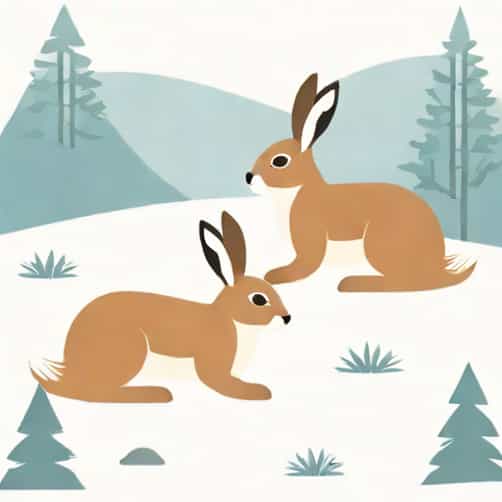
Snowshoe hares are fascinating creatures, well known for their incredible adaptations to survive harsh winter environments. Found primarily in North America, these hares are equipped with large, fur-covered feet that act like natural snowshoes, enabling them to move efficiently across deep snow. One question that often arises is whether snowshoe hares hibernate during the winter months, as many animals in cold climates do. Unlike some mammals that retreat to burrows or dens and enter hibernation, snowshoe hares remain active throughout the winter, relying on their unique physical adaptations and behavioral strategies to survive the cold, scarcity of food, and predation risks.
Snowshoe Hare Biology and Winter Adaptations
Snowshoe hares are medium-sized mammals with a compact body, long ears, and powerful hind legs. Their seasonal adaptations are particularly notable in winter. Their fur changes color from brown in summer to white in winter, providing essential camouflage against predators in snowy landscapes. This seasonal molt allows them to blend into their environment, reducing the risk of predation while remaining active throughout the winter months. Unlike hibernating species, which slow their metabolism and remain inactive for extended periods, snowshoe hares must continuously forage for food to maintain their energy and body heat.
Behavioral Adaptations
To survive the winter, snowshoe hares display a range of behavioral strategies that enable them to thrive in conditions that can be extremely challenging. These behaviors include
- Foraging for available vegetation under snow or near tree bases
- Using dense shrubs and brush to hide from predators
- Moving primarily during dawn and dusk to avoid exposure to predators
- Reducing unnecessary activity during extremely harsh conditions to conserve energy
These strategies allow snowshoe hares to remain active year-round, demonstrating a highly specialized approach to winter survival without the need for hibernation.
Why Snowshoe Hares Do Not Hibernate
Unlike species such as groundhogs or bats that hibernate to survive the winter, snowshoe hares remain active. There are several biological and ecological reasons for this behavior. First, snowshoe hares are herbivores and rely on browsing woody plants, twigs, and bark during the winter. They cannot store enough food to sustain themselves for months of inactivity, making hibernation impractical. Second, their metabolic rate is relatively high, requiring consistent caloric intake to maintain body temperature in freezing conditions. Remaining active allows them to forage regularly and sustain the energy needed for survival.
Ecological Considerations
The ecological role of snowshoe hares further explains their year-round activity. As prey species for a wide range of predators, including lynxes, foxes, owls, and coyotes, snowshoe hares play a critical role in the food chain. By staying active in winter, they continue to support predator populations, which also remain active. Hibernation would disrupt this delicate ecological balance, affecting predator-prey dynamics and the overall ecosystem health.
Survival Strategies in Winter
Surviving winter requires snowshoe hares to employ multiple survival strategies. Their large feet help them navigate deep snow efficiently, minimizing energy expenditure. Their white winter coat not only camouflages them but also provides insulation. Additionally, snowshoe hares adjust their diet according to seasonal availability. During winter, they feed primarily on twigs, bark, and buds of shrubs and trees, shifting from their summer diet of leaves, grasses, and herbaceous plants.
Predation and Risk Management
Predation pressure during winter is intense because limited resources concentrate predator populations. Snowshoe hares employ several strategies to reduce risk
- Remaining motionless to avoid detection
- Using zigzag and bounding escape patterns when fleeing predators
- Utilizing dense vegetation or snowdrifts as cover
These behaviors illustrate the active survival mechanisms that allow snowshoe hares to endure harsh winters without hibernating.
Comparison with Hibernating Species
Understanding why snowshoe hares do not hibernate can be clarified by comparing them with hibernating species. Hibernators typically have low metabolic rates, store large fat reserves, and remain inactive for extended periods to conserve energy. In contrast, snowshoe hares maintain higher activity levels, a leaner body composition, and rely on continuous foraging. This distinction highlights the evolutionary adaptations that enable snowshoe hares to remain active even when food is scarce and temperatures are extreme.
Energy Conservation Without Hibernation
Even though snowshoe hares do not hibernate, they do employ energy-saving strategies. By limiting movement during severe weather, choosing sheltered areas for resting, and timing their activity to the safest periods of the day, they minimize unnecessary energy expenditure. These strategies allow them to maintain health and survival without the physiological shutdown that characterizes hibernation.
Implications for Wildlife Management and Research
Understanding the behavior of snowshoe hares has significant implications for wildlife management and ecological research. Since they remain active year-round, snowshoe hares influence vegetation patterns, predator populations, and overall forest health. Conservation efforts must consider their winter activity and dietary needs, ensuring that habitats provide sufficient cover and food sources even in the harshest months. Additionally, studying snowshoe hares can provide insights into the effects of climate change on seasonal behavior and survival strategies of cold-adapted species.
Impact of Climate Change
Climate change poses challenges to snowshoe hares, particularly as snow cover becomes less predictable. Their seasonal camouflage may become less effective if snow arrives late or melts early, increasing predation risk. Understanding their non-hibernating behavior helps scientists anticipate how snowshoe hares will respond to changing winter conditions and guides the development of adaptive conservation strategies.
snowshoe hares do not hibernate, relying instead on a combination of physical adaptations, behavioral strategies, and continuous foraging to survive winter. Their large feet, white winter coat, and zigzag escape patterns allow them to thrive in snowy environments while avoiding predators. Remaining active year-round has ecological significance, maintaining predator-prey dynamics and influencing forest ecosystems. Studying snowshoe hares provides valuable insights into survival strategies in cold climates, the impact of seasonal changes on wildlife, and the broader effects of climate change on animal behavior. By remaining active and adaptable, snowshoe hares exemplify the resilience and ingenuity of wildlife facing extreme environmental challenges.