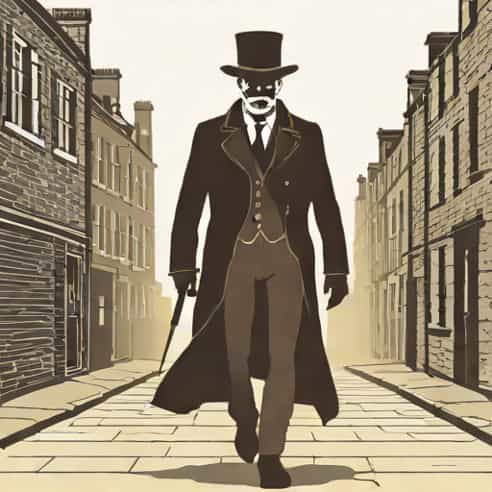
The mysterious and gruesome Jack the Ripper case has fascinated historians, criminologists, and amateur detectives for over a century. Among the many suspects proposed over the years, one name that has occasionally surfaced is George Chapman, a man whose dark history and criminal behavior have drawn suspicion. Understanding why George Chapman has been linked to the infamous Whitechapel murders requires exploring his life, criminal activities, and the broader context of Victorian London, where fear and sensationalism often blurred the lines between fact and speculation.
Who Was George Chapman?
George Chapman, born as Severin Klosowski in 1865 in Poland, immigrated to London in the late 19th century. Chapman’s early life was marked by instability and hardship, and his move to England brought him into the impoverished neighborhoods of London, particularly the East End. It was here that Chapman established himself as a barber, a profession that allowed him both mobility and access to various segments of society. However, his outwardly ordinary occupation masked a more sinister side, one that would later lead to suspicions regarding his possible involvement in the Jack the Ripper murders.
Criminal Activities and Reputation
Chapman’s criminal record was far from minor. He became infamous for poisoning his wives, eventually leading to convictions for murder. His method of killing was methodical and deliberate, using poison to eliminate those closest to him. This cold, calculated approach contributed to suspicions that he could have been involved in the violent and unpredictable killings associated with Jack the Ripper. While Ripper’s murders involved brutal knife attacks, some researchers have theorized that the same psychological tendencies could underlie both forms of violence.
Connection to the Ripper Murders
The suggestion that George Chapman might have been Jack the Ripper is based largely on circumstantial evidence and his presence in London at the time of the murders. The Whitechapel killings occurred in 1888, and Chapman was living and working in areas close to where the victims were found. Some theorists argue that his knowledge of anatomy, gained through his training and work, may have given him the skills to commit the gruesome attacks. Others note that Chapman exhibited violent tendencies and a fascination with death, aligning with psychological profiles of the Ripper.
Timeline of Suspicion
The association of George Chapman with Jack the Ripper arose decades after the murders. During his trial for poisoning his wives in 1902, investigators and criminologists revisited the possibility of his involvement in the Whitechapel murders. Experts examined the methods, locations, and behaviors of the killer, comparing them with Chapman’s known actions and personality. Although there is no direct evidence linking him to the Ripper murders, the overlap in time, location, and psychological traits kept suspicion alive in historical discussions.
Criminal Profiling and Psychological Analysis
Modern criminal profiling has provided insights into why Chapman remains a suspect. Profiles of Jack the Ripper often describe the killer as highly organized, methodical, and socially isolated, traits that Chapman displayed in his personal life. His ability to maintain a façade of normalcy, running a business while committing heinous acts in private, mirrors the duality often observed in serial killers. Additionally, Chapman’s later crimes showed a capacity for premeditation and careful planning, further fueling the idea that he could have committed violent acts without immediate detection.
Criticism and Counterarguments
Despite these connections, many historians caution against definitively labeling George Chapman as Jack the Ripper. The Ripper murders involved extreme mutilation, often in public or semi-public spaces, which differs significantly from Chapman’s known use of poison. Some experts argue that the physicality and spontaneity of the Whitechapel murders suggest a different psychological profile, potentially one motivated by rage and sexual compulsion, rather than the calculated poisonings Chapman committed. Therefore, while Chapman remains a suspect in some theories, definitive evidence linking him to the Ripper killings does not exist.
Historical Context of Victorian London
Understanding the suspicion surrounding Chapman also requires examining the social environment of Victorian London. The East End, where the Ripper murders occurred, was densely populated, impoverished, and often overlooked by law enforcement. Fear and sensational journalism amplified public anxiety, leading to numerous theories and suspects, some with tenuous connections to the crimes. In this context, Chapman’s criminal history and proximity to the area made him a convenient figure to connect to the legend of Jack the Ripper.
Legacy and Continuing Fascination
The debate over George Chapman’s potential involvement in the Jack the Ripper case reflects broader cultural fascination with unsolved mysteries and criminal psychology. Chapman’s life story, combining immigration, criminality, and notorious actions, captures the imagination of historians and true crime enthusiasts alike. While certainty may never be achieved, his case illustrates how historical figures can become entwined with legendary crimes, blurring lines between fact and speculation.
Modern Investigations and Theories
Recent studies of historical records, trial documents, and forensic evidence continue to explore the Ripper case, including Chapman’s potential role. Digital archives, improved analytical methods, and psychological profiling contribute to ongoing debates. Some modern criminologists acknowledge that while Chapman is a plausible suspect, the lack of conclusive forensic evidence prevents a definitive judgment. Nevertheless, his association with the Ripper highlights the complexity of linking historical criminals to notorious unsolved cases.
George Chapman, a man with a dark and violent history, remains one of the many suspects in the infamous Jack the Ripper case. While circumstantial evidence and psychological profiles suggest a possible connection, significant differences in methodology and the absence of direct evidence leave the question unresolved. Chapman’s story is emblematic of the intrigue surrounding the Ripper murders and illustrates the challenges of solving historical crimes with limited records. Ultimately, whether George Chapman was Jack the Ripper may never be known, but his life and criminal actions continue to provide insight into the darker aspects of human behavior in Victorian London and the enduring fascination with one of history’s most notorious mysteries.