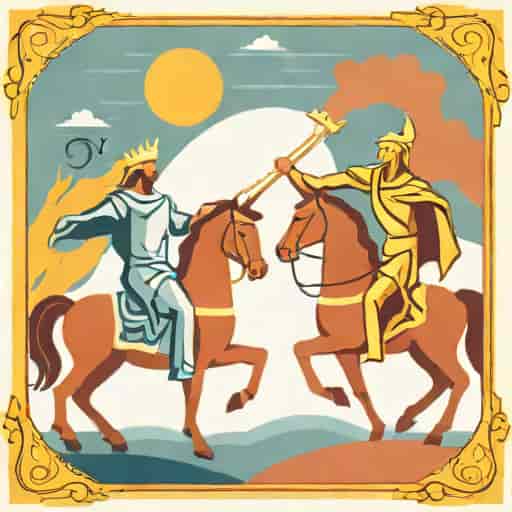
The story of Helios and Phaethon is one of the most dramatic and cautionary tales from Greek mythology, illustrating themes of ambition, recklessness, and the complex relationship between gods and mortals. It tells the story of Phaethon, a young man who struggles with his identity and lineage, and his father Helios, the sun god who drives the chariot of the sun across the sky every day. This myth has captivated audiences for centuries due to its vivid imagery, moral lessons, and tragic ending. The narrative explores the dangers of overconfidence and the consequences of not understanding one’s own limitations, while also highlighting the deep human desire for recognition and approval from those we admire most. The story has been retold in various forms, from classical literature to modern adaptations, emphasizing its timeless relevance and enduring appeal.
Helios The Sun God
Helios, in Greek mythology, is the personification of the sun. Every day, he rides a golden chariot pulled by powerful horses across the sky, bringing light to the world. He is often depicted as a radiant figure, his presence illuminating the earth with warmth and life. Helios is not just a source of light; he is also a powerful divine figure who observes the actions of mortals and gods alike. His knowledge of the world and his role in maintaining cosmic order make him a figure of immense authority and responsibility. The story of Helios and Phaethon begins with the young Phaethon seeking to prove his divine parentage and earn the respect and recognition he craves from both mortals and gods.
Phaethon’s Quest for Identity
Phaethon, the mortal son of Helios, is often described as a young man of noble appearance but uncertain standing. He struggles with questions about his parentage and desires to assert his connection to the divine. Phaethon approaches his mother, who confirms that Helios is indeed his father, and he decides to seek out the sun god to request proof of this lineage. This desire for recognition sets the stage for the tragic events that follow. Phaethon’s story reflects a universal human experience the yearning to understand one’s origins and to be acknowledged for one’s true identity. His journey symbolizes the pursuit of self-knowledge and the risks inherent in reaching beyond one’s capabilities.
The Request and the Warning
When Phaethon meets Helios, he boldly asks to drive the sun chariot for a single day to prove his divine heritage. Helios, deeply concerned, warns Phaethon of the immense danger of controlling the fiery horses that pull the chariot. He describes the chaos that could result if Phaethon loses control, including scorching the earth or freezing it. Despite these warnings, Phaethon’s determination and desire to impress others drive him to insist on taking the reins. This moment in the story emphasizes the tension between youthful ambition and the wisdom of experience. It also serves as a moral lesson about the importance of listening to guidance and understanding one’s limitations before undertaking powerful responsibilities.
The Fatal Ride
Phaethon’s ride begins with awe-inspiring beauty, as the horses lift him into the sky and the world below basks in the sunlight. However, his lack of experience quickly becomes apparent. The horses, sensing Phaethon’s uncertainty, veer wildly, threatening to set the earth ablaze in some areas while leaving others in darkness. Mountains catch fire, rivers boil, and the very balance of the natural world is at risk. The narrative vividly conveys the destructive potential of uncontrolled ambition and recklessness. Phaethon’s struggle to control the chariot represents the consequences of overestimating one’s abilities and failing to respect the forces one seeks to command.
Zeus’ Intervention and Phaethon’s Fall
As the situation spirals out of control, the gods watch in alarm. Zeus, the king of the gods, intervenes to prevent further catastrophe. He strikes Phaethon with a thunderbolt, ending the dangerous ride but also resulting in the young man’s tragic death. Phaethon falls from the sky into the river Eridanus, leaving a legacy of destruction and sorrow. This climactic moment underscores the severity of the consequences when mortals attempt to wield divine power without understanding it. It also highlights the role of the gods as enforcers of cosmic order, ensuring that the natural balance is maintained even when human ambition threatens it.
Aftermath and Moral Lessons
The story does not end with Phaethon’s fall. His sisters, known as the Heliades, mourn him deeply and are transformed into poplar trees, their tears becoming amber. This transformation symbolizes enduring grief and the lasting impact of tragic choices. The myth of Helios and Phaethon carries several moral lessons
- The danger of overestimating one’s abilities and taking on responsibilities beyond one’s experience.
- The importance of listening to advice from those with greater wisdom or authority.
- The consequences of pride and the desire for recognition without consideration of potential outcomes.
- The enduring human struggle to reconcile ambition with humility.
These lessons continue to resonate in literature, psychology, and cultural storytelling, demonstrating the timeless relevance of this myth.
Cultural Influence
The story of Helios and Phaethon has inspired countless works of art, literature, and philosophy. Ancient Greek writers, including Ovid in his Metamorphoses, vividly recount the tale, emphasizing its dramatic and moral dimensions. The myth has influenced Renaissance painters, sculptors, and later writers, who used Phaethon’s story to explore themes of ambition, identity, and human limitation. In modern times, the myth appears in literature, theater, and even popular culture, reflecting the ongoing fascination with tales that combine human emotion, divine intervention, and the natural world.
Symbolism and Interpretation
Scholars often interpret Phaethon’s story as an allegory for the challenges of growing up and assuming responsibility. The chariot of the sun represents powerful forces that must be handled with care, while Phaethon’s fall symbolizes the consequences of failing to respect these forces. Helios embodies wisdom, experience, and the careful management of power. The story also explores the relationship between parents and children, emphasizing themes of trust, guidance, and the limits of human ambition. Through its vivid imagery and moral complexity, the myth encourages reflection on the human condition and the delicate balance between aspiration and restraint.
The myth of Helios and Phaethon remains one of the most enduring and striking tales in Greek mythology. It combines vivid storytelling, moral lessons, and timeless human themes. Phaethon’s desire for recognition, his ambition, and ultimate tragedy offer insight into the human experience, illustrating the dangers of overconfidence and the importance of understanding one’s own limits. Helios, as both a father and a sun god, represents the wisdom, responsibility, and authority that guide the natural and moral order. The story has influenced countless artists, writers, and thinkers throughout history, maintaining its relevance as a cautionary tale about ambition, identity, and the consequences of human actions. Its enduring appeal lies in its ability to convey universal truths through a dramatic and unforgettable narrative, making it a cornerstone of classical mythology and a source of reflection for generations of readers and listeners.