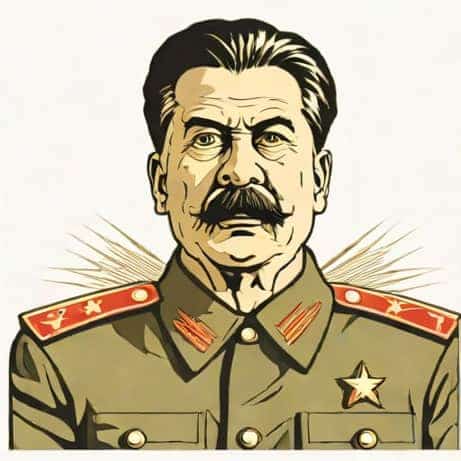
Joseph Stalin’s rise to power in the Soviet Union is one of the most significant and complex political stories of the 20th century. Born in 1878 in Gori, Georgia, Stalin emerged from humble beginnings to become the leader of one of the most powerful and repressive regimes in history. His ascent was marked by strategic political maneuvering, alliances, and the elimination of rivals, all within the chaotic context of the post-revolutionary Soviet Union. Understanding how Stalin came to power requires examining his early life, involvement in the Bolshevik Party, the aftermath of Lenin’s death, and the various strategies he employed to consolidate control over the Communist Party and the Soviet state. This story illustrates how ambition, opportunity, and political skill combined to shape one of the most notorious dictators in modern history.
Early Life and Revolutionary Activities
Joseph Stalin, born Ioseb Besarionis dze Jughashvili, grew up in a modest family and faced a difficult childhood, including poverty and an abusive father. He attended a church school and later a seminary, where he was exposed to ideas of Marxism and socialism. By the early 1900s, Stalin had become actively involved in revolutionary activities, joining the Bolshevik faction of the Russian Social Democratic Labour Party. His early years were marked by organizing strikes, distributing propaganda, and engaging in underground revolutionary work, which often led to arrests and periods of exile.
Stalin in the Bolshevik Party
Stalin’s rise within the Bolshevik Party was gradual but strategic. Unlike some of his peers, he focused on administrative and organizational work rather than public speaking or theoretical debates. He took on roles such as the party’s secretary and worked to strengthen the party’s internal structure. Stalin’s reputation for reliability, discipline, and loyalty to the party helped him gain the trust of key figures, including Vladimir Lenin. His work in these roles gave him detailed knowledge of the party’s bureaucracy and personnel, which later proved crucial in his rise to power.
The Russian Revolution and Civil War
The Bolshevik Revolution of 1917 created the context for Stalin’s eventual rise. After the overthrow of the Provisional Government, the Bolsheviks seized control, and the ensuing civil war provided opportunities for ambitious leaders to demonstrate their loyalty and organizational ability. Stalin played an active role in consolidating Bolshevik power, both administratively and militarily. He was involved in enforcing party discipline, overseeing key regions, and managing critical logistical operations. These responsibilities enhanced his visibility and influence within the party, setting the stage for his later political maneuvers.
Lenin’s Trust and Stalin’s Position
By the early 1920s, Stalin had gained significant influence due to his position as General Secretary of the Communist Party. This role, initially considered administrative and largely bureaucratic, allowed him to appoint allies, build loyalty, and monitor the activities of potential rivals. Although Lenin was aware of Stalin’s ambition and at times criticized his methods, Stalin’s ability to present himself as a loyal party member enabled him to maintain Lenin’s trust and consolidate power quietly. This administrative leverage would become one of his most powerful tools after Lenin’s death.
After Lenin’s Death
Vladimir Lenin died in 1924, creating a power vacuum within the Communist Party. This period was critical for Stalin, who faced competition from prominent figures such as Leon Trotsky, Grigory Zinoviev, and Lev Kamenev. Trotsky, widely regarded as Lenin’s most likely successor, was a brilliant strategist but underestimated Stalin’s political acumen. Stalin capitalized on his position as General Secretary to build a network of loyal supporters and manipulate party structures to his advantage.
Political Alliances and Rivalries
Stalin’s strategy involved forming temporary alliances with rivals to isolate stronger opponents. Initially, he allied with Zinoviev and Kamenev to marginalize Trotsky. Using his control over appointments and party administration, Stalin strengthened his base of loyal supporters in key positions. Once Trotsky was neutralized, Stalin turned against his former allies, gradually consolidating unchallenged authority within the party. These alliances and betrayals highlight Stalin’s strategic patience and ability to exploit political opportunities effectively.
Propaganda and Public Image
In addition to political maneuvering, Stalin used propaganda to cultivate his public image and discredit rivals. He portrayed himself as a dedicated revolutionary, loyal to Lenin’s vision, and a defender of the party’s principles. Through newspapers, speeches, and internal party communications, Stalin emphasized his role in the revolution and downplayed the contributions of his competitors. By controlling both the narrative and party structures, Stalin created an image of inevitability, making his leadership appear natural and unchallenged.
Eliminating Opposition
Once in a position of influence, Stalin systematically eliminated opposition to consolidate absolute power. Trotsky was exiled, and later assassinated, while other rivals were removed from party leadership, imprisoned, or executed. Stalin also implemented purges within the Communist Party, the military, and broader society to eliminate any potential threats. These measures ensured that loyalty to Stalin became the defining characteristic for survival within the Soviet system.
Control of the Party and State
By the late 1920s, Stalin had effectively combined control over the Communist Party with authority over the state apparatus. This dual control allowed him to direct economic policies, enforce ideological conformity, and oversee the centralization of power. His leadership style combined administrative efficiency, ideological enforcement, and ruthless suppression of dissent. The creation of a personality cult further reinforced his authority, making opposition both dangerous and politically futile.
Economic and Social Policies
Stalin’s rise to power was also supported by the implementation of economic and social policies that reshaped the Soviet Union. His programs of collectivization and industrialization consolidated state control over agriculture and industry, while also demonstrating the government’s ability to mobilize resources and transform society. Although these policies were often brutal and caused widespread suffering, they strengthened Stalin’s position by demonstrating effectiveness, discipline, and commitment to Soviet ideology.
Propaganda and Ideological Control
Stalin’s ability to control public perception was essential to maintaining power. Through education, media, and cultural production, he promoted a narrative that glorified his leadership and minimized dissent. This ideological control created an environment in which loyalty to Stalin was equated with loyalty to the Soviet state, further securing his unchallenged authority.
Joseph Stalin came to power through a combination of strategic positioning, political alliances, bureaucratic control, and ruthless elimination of rivals. His rise was facilitated by his early involvement in the Bolshevik Party, his role during the Russian Revolution and Civil War, and the opportunities created by Lenin’s death. By carefully managing alliances, using propaganda to shape perception, and consolidating control over the party and state, Stalin transformed himself from a relatively obscure revolutionary into the absolute ruler of the Soviet Union. His ascent demonstrates the importance of political skill, patience, and opportunism, as well as the dangers of unchecked power in a revolutionary society. Understanding Stalin’s path to power provides insight into the dynamics of political leadership, authoritarianism, and the historical forces that shaped the 20th century.