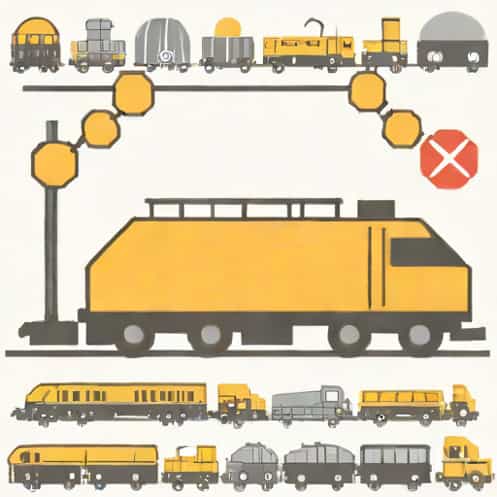
Comparing a train to a macromolecule may seem unusual at first, but the analogy provides a clear and insightful way to understand complex molecular structures. Both trains and macromolecules are made up of individual units linked together in a specific sequence, and their overall function depends on the organization and interaction of these units. Just as a train consists of an engine and multiple cars that work together to transport passengers or cargo efficiently, a macromolecule is composed of repeating monomer units that create large, functional molecules like proteins, nucleic acids, and polysaccharides. This comparison can help students and readers visualize how molecular structures are organized and how their components contribute to the overall purpose of the macromolecule.
Understanding the Structure of a Train
A train is made up of several components arranged in a linear sequence. The engine or locomotive is at the front, providing the energy needed to move the train along the tracks. Following the engine are multiple cars, each serving a distinct function, such as carrying passengers, freight, or specialized cargo. The cars are connected by couplings, which allow them to move together as a single unit while still retaining some flexibility. The train moves along tracks that guide its path and ensure that the energy from the engine is efficiently transmitted to all the cars. This linear, organized structure ensures that each car reaches its destination and that the train as a whole operates effectively.
Key Features of a Train
- Linear arrangement of components engine followed by cars.
- Connections between cars allow coordinated movement.
- Each car can serve a unique function, such as transporting passengers, cargo, or specialized materials.
- The engine provides energy, enabling motion for the entire system.
- Tracks guide the train, maintaining direction and stability.
Understanding the Structure of a Macromolecule
Macromolecules are large, complex molecules essential for life. They include proteins, nucleic acids, polysaccharides, and lipids. Like trains, macromolecules are composed of smaller units called monomers, which are linked together in a specific sequence to form polymers. In proteins, the monomers are amino acids; in nucleic acids, they are nucleotides; and in polysaccharides, they are simple sugars. The order and type of monomers determine the macromolecule’s structure and function, similar to how the arrangement of cars in a train affects its purpose and efficiency.
Key Features of a Macromolecule
- Composed of repeating monomer units forming a polymer chain.
- Monomers are connected by chemical bonds, allowing flexibility and interaction.
- Specific sequences of monomers determine function and properties.
- Macromolecules can fold, twist, or assemble into larger structures to perform specialized tasks.
- Energy is involved in forming and maintaining the macromolecule’s structure.
Drawing the Analogy Train as a Macromolecule
The analogy between a train and a macromolecule can be broken down by comparing components and functions. The engine of a train is similar to the energy source or functional core of a macromolecule, driving its activity and enabling interactions. The cars of the train resemble monomers, which are linked together to form a linear or branched structure. Each car’s unique function is comparable to how different monomers contribute to the overall function of the macromolecule. Couplings between cars can be likened to chemical bonds that connect monomers, providing both stability and flexibility. The tracks guiding the train can represent the molecular environment, such as enzymes or cellular structures, that ensure proper function and direction.
Detailed Comparison
- Engine → Energy SourceJust as a train’s engine powers its movement, certain parts of a macromolecule, like active sites in enzymes, enable biochemical activity.
- Train Cars → MonomersEach car is an individual unit that contributes to the train’s purpose, just as monomers form the building blocks of a macromolecule.
- Couplings → Chemical BondsConnections between train cars allow coordinated motion, similar to how chemical bonds connect monomers to create a stable polymer.
- Tracks → Molecular EnvironmentTracks guide the train’s path, much like the cellular environment or molecular scaffolds direct macromolecular function.
- Overall Train → Polymer FunctionThe complete train, functioning efficiently as a system, mirrors how a polymer carries out its biological role.
Applications of the Analogy in Education
Using the train analogy helps students grasp abstract concepts in molecular biology and chemistry. By relating monomers to train cars and polymers to the whole train, learners can visualize how the sequence, structure, and connections of individual units determine function. This analogy also highlights the importance of organization and interaction in complex systems, whether mechanical or biological. Educators can extend this analogy to explain concepts such as protein folding, nucleic acid synthesis, and polysaccharide assembly by showing how the order and type of monomers influence overall behavior.
Teaching Complex Concepts
- Sequence matters Just as rearranging train cars can change the train’s function, altering the sequence of monomers can change a macromolecule’s properties.
- Function depends on structure The train moves efficiently because of its organized design, similar to how a macromolecule’s shape enables biological activity.
- Interconnections are essential Couplings between train cars and chemical bonds between monomers are critical for stability and flexibility.
- Environmental guidance Tracks ensure the train stays on course, while cellular conditions ensure proper macromolecular folding and activity.
Limitations of the Analogy
While the train analogy is helpful, it has limitations. A train is a macroscopic, mechanical system that can be seen and manipulated directly, while macromolecules are microscopic and operate in a chemical context governed by molecular forces and interactions. Macromolecules can fold, twist, and interact in three-dimensional space in ways that a linear train cannot replicate. Additionally, chemical bonds are dynamic, capable of forming and breaking under specific conditions, unlike the fixed couplings of train cars. Despite these limitations, the analogy remains effective for introducing basic concepts of sequence, connection, and function.
Comparing a train to a macromolecule provides a powerful tool for understanding complex molecular structures. Both systems are composed of linked units, require energy and guidance to function effectively, and depend on the organization and interaction of their components. The train’s engine, cars, couplings, and tracks correspond to elements of macromolecules, including functional cores, monomers, chemical bonds, and the molecular environment. Using this analogy in education can help learners visualize abstract concepts, appreciate the importance of sequence and structure, and understand how individual components contribute to the function of complex systems. While the comparison has limitations, it remains a clear and accessible way to introduce students and readers to the fascinating world of macromolecules.
Keywords macromolecule, polymer, monomer, train analogy, protein structure, nucleic acid, chemical bonds, molecular biology, sequence and structure, biological function.