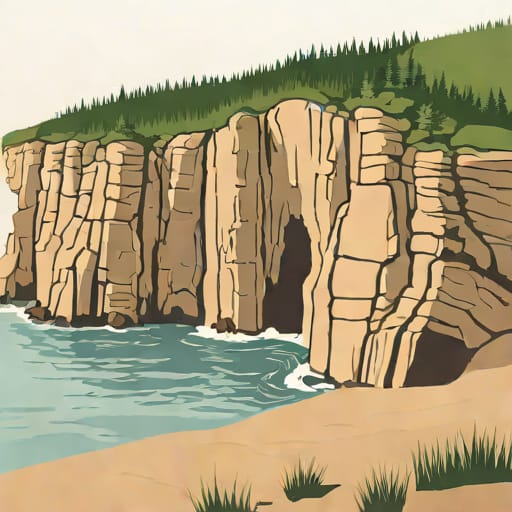
The Joggins Fossil Cliffs, located along the Bay of Fundy in Nova Scotia, Canada, are one of the most significant fossil sites in the world. Stretching over 15 kilometers, these cliffs offer a unique window into life during the Carboniferous period, roughly 300 million years ago. The site is renowned for its exceptional preservation of fossils, including early amphibians, plants, and other ancient life forms, which provide invaluable insights into the evolution of terrestrial ecosystems. The dramatic tides of the Bay of Fundy, some of the highest in the world, continually expose new fossils, making Joggins a living laboratory for geologists, paleontologists, and visitors interested in Earth’s distant past. Its scientific importance and natural beauty have earned it recognition as a UNESCO World Heritage Site, drawing researchers and tourists alike.
Geological Significance
The geological formations at Joggins Fossil Cliffs are remarkable because they contain one of the most complete and well-preserved fossil records from the Carboniferous period. The cliffs are composed primarily of sedimentary rock layers, including sandstones, shales, and coal seams, which formed from ancient river deltas, floodplains, and coastal environments. These layers capture a detailed snapshot of Earth’s history, showing the transition of life from water to land and providing evidence of early forests, swamps, and diverse animal life. The stratified rock formations allow scientists to study the chronological sequence of fossilized life and environmental changes over millions of years.
Carboniferous Period Fossils
The fossils at Joggins are particularly valuable because they represent life during the Carboniferous period, a time when vast swampy forests covered much of the planet. These forests eventually formed significant coal deposits, some of which are still mined today. Fossilized plants, such as ferns, horsetails, and lycophytes, are abundant at Joggins, along with fossilized trees that can reach impressive heights. The site also preserves early terrestrial animals, including primitive amphibians and reptiles, which provide evidence of the evolutionary transition from aquatic to land-dwelling species. Such fossils are rare elsewhere, making Joggins a globally important paleontological site.
Fossil Discoveries and Notable Finds
Over the years, Joggins Fossil Cliffs have yielded numerous significant discoveries that have contributed to our understanding of early life on Earth. Among the most famous finds is the fossil ofHylonomus lyelli, considered the earliest known reptile. This discovery helped scientists understand the evolution of amniotes and the development of eggs capable of surviving on land. In addition to vertebrates, countless plant fossils, including lycopsid tree trunks and ferns, have been studied to reconstruct the ancient ecosystems of the region.
Fossilized Trees and Forests
The fossilized trees at Joggins are especially noteworthy because they preserve not only the trunks but also evidence of ancient root systems and growth patterns. These coal forests give scientists insight into the structure of prehistoric forests and the interactions between plants and animals. Fossilized trees often contain burrows and nests of early amphibians, showing how animals adapted to life in swampy environments. The preservation of such interactions is rare and makes Joggins Fossil Cliffs an exceptional site for studying paleoecology.
Contributions to Science
Research conducted at Joggins has contributed significantly to paleontology and geology. The site has provided data on the diversity of Carboniferous flora and fauna, the evolution of early terrestrial vertebrates, and the environmental conditions of ancient swamps. Scientists continue to study the cliffs to better understand mass extinctions, climate changes, and the development of ecosystems over geological time. Joggins serves as an important reference point for comparisons with other fossil sites around the world.
Visiting Joggins Fossil Cliffs
For visitors, Joggins Fossil Cliffs offer not only scientific importance but also natural beauty and educational opportunities. Guided tours, interpretive centers, and walking trails allow visitors to explore the cliffs safely while learning about the fossils and geological history. The dramatic tidal changes of the Bay of Fundy provide a constantly changing landscape, revealing new fossil beds and making each visit unique. Educational programs for students and researchers further enhance the site’s value as a living classroom.
Tourism and Educational Programs
The Joggins Fossil Centre provides exhibitions, educational workshops, and guided fossil-hunting tours. Visitors can learn about the Carboniferous period, fossilization processes, and the significance of key discoveries. These programs make Joggins accessible to a wide audience, from casual tourists to serious geology students. The site also hosts field trips for schools and universities, offering hands-on experiences that inspire the next generation of scientists.
Safety and Preservation
While exploring the cliffs, visitors are advised to follow safety guidelines due to the changing tides and unstable cliff edges. Conservation efforts are in place to protect the fossil beds from erosion and human impact. By balancing tourism with preservation, Joggins continues to serve both as a scientific resource and a natural attraction, ensuring that future generations can appreciate its value.
UNESCO World Heritage Recognition
In 2008, Joggins Fossil Cliffs were designated a UNESCO World Heritage Site in recognition of their outstanding universal value. This designation highlights the site’s significance for understanding early terrestrial ecosystems and the evolution of life on land. UNESCO recognition has also helped raise awareness about the importance of protecting the cliffs and promoting sustainable tourism. The status brings international attention, attracting researchers and visitors from around the globe and reinforcing the need for ongoing conservation.
Global Importance
The global importance of Joggins Fossil Cliffs extends beyond its geological and paleontological value. The site provides crucial evidence of evolutionary history, offering insights that cannot be found elsewhere. Its fossils inform our understanding of biodiversity, environmental change, and the origins of life on land. Researchers from different countries collaborate at Joggins, contributing to a broader scientific understanding and highlighting the universal significance of this remarkable location.
Joggins Fossil Cliffs on the Bay of Fundy are a natural treasure of immense scientific and educational value. Their well-preserved fossils from the Carboniferous period provide a rare glimpse into ancient forests, early amphibians, and the transition of life from water to land. The cliffs’ dramatic landscape, combined with their rich fossil record, makes them a fascinating destination for both scientists and tourists. Recognized as a UNESCO World Heritage Site, Joggins continues to offer insights into Earth’s deep history while promoting conservation, education, and sustainable tourism. Visiting Joggins allows people to witness firsthand the remarkable story of life millions of years ago, making it one of the most important fossil sites in the world.