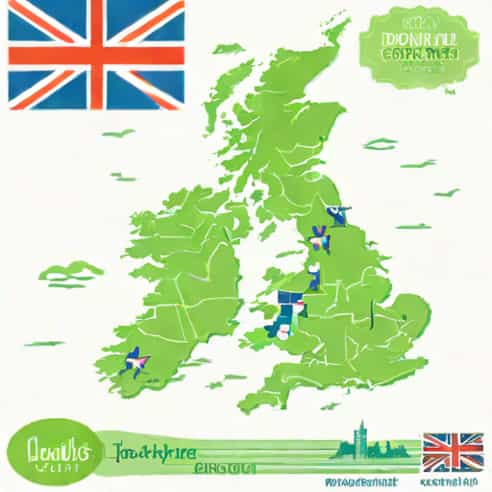
Alexis de Tocqueville is best known for his penetrating analysis of democracy, society, and political life, but his intellectual journey was shaped not only by books and theory. Travel played a crucial role in how he observed the modern world. Among his lesser-known yet highly significant experiences were his journeys to England and Ireland. These travels offered Tocqueville a living laboratory in which to study social class, political institutions, poverty, religion, and the effects of industrialization. His observations during these journeys deepened his understanding of modern society and strongly influenced his later writings.
Alexis de Tocqueville as a Traveling Observer
Tocqueville did not travel as a tourist seeking pleasure or novelty. He traveled as a careful observer, motivated by intellectual curiosity and a desire to understand how societies functioned. His journeys to England and Ireland took place after his famous visit to the United States, and they allowed him to compare different political and social systems within Europe itself.
These journeys helped Tocqueville refine his thinking about liberty, equality, and social order by contrasting democratic tendencies with entrenched class structures.
Historical Context of the Journeys
Tocqueville traveled to England and Ireland during a period of rapid social and economic change. Industrialization was transforming cities, reshaping labor, and altering traditional social relationships. Political reform was being debated, and questions about poverty and social responsibility were increasingly urgent.
England represented industrial modernity and constitutional stability, while Ireland embodied colonial domination, rural poverty, and deep social division. Together, they offered Tocqueville a stark comparison.
Journey to England Industry and Social Structure
In England, Tocqueville focused closely on the effects of industrialization. He visited factories, urban neighborhoods, and rural areas to understand how economic growth was changing daily life. While impressed by England’s wealth and productivity, he was deeply troubled by the social consequences.
He observed a sharp division between social classes. Wealth was concentrated, and the working poor lived in harsh conditions. Tocqueville noted that industrial progress did not automatically lead to moral or social improvement.
The English Aristocracy
Tocqueville paid special attention to the English aristocracy. Unlike the French nobility, which had lost much of its political power after the revolution, the English aristocracy remained influential and adaptable. He admired their sense of public duty but also recognized how their dominance limited social mobility.
This observation reinforced his belief that democracy reshapes societies not only politically but socially and psychologically.
Political Institutions in England
England’s constitutional system fascinated Tocqueville. He studied Parliament, local governance, and legal traditions. He saw stability and continuity, but also rigidity. Reform was possible, yet slow and cautious.
For Tocqueville, England demonstrated how liberty could exist alongside inequality. This contrast helped him clarify what made democratic societies distinct from aristocratic ones.
Journey to Ireland Poverty and Oppression
Tocqueville’s journey to Ireland left a profound emotional and intellectual impact. Ireland was marked by extreme poverty, widespread suffering, and deep resentment toward British rule. Tocqueville traveled through rural areas and spoke with landlords, peasants, and clergy.
What he encountered shocked him. Poverty in Ireland was not merely economic but systemic, rooted in land ownership, religion, and colonial governance.
Land and Social Injustice
Tocqueville observed that Irish peasants lived on land they did not own, under landlords who were often absent. This system produced insecurity and despair. Unlike England, where industrial labor at least offered wages, Irish rural poverty seemed inescapable.
He concluded that political domination combined with economic exploitation created a uniquely destructive form of social misery.
Religion and National Identity in Ireland
Religion played a central role in Tocqueville’s analysis of Ireland. The division between Protestant rulers and a Catholic population intensified social conflict. Tocqueville noted that religious identity in Ireland was inseparable from national identity.
This reinforced his broader insight that religion can act as both a stabilizing force and a source of resistance, depending on political circumstances.
Comparing England and Ireland
The contrast between England and Ireland sharpened Tocqueville’s understanding of power and governance. England showed how institutions could channel conflict and maintain order. Ireland demonstrated what happens when institutions serve only a ruling minority.
This comparison helped Tocqueville argue that political systems must address social realities, not merely enforce authority.
Influence on Tocqueville’s Political Thought
The journeys to England and Ireland influenced Tocqueville’s later reflections on democracy, inequality, and social responsibility. They reinforced his concern that economic progress alone cannot ensure justice or stability.
He became more attentive to the dangers of social fragmentation and the moral costs of ignoring poverty.
Views on Industrial Society
Tocqueville did not reject industrialization, but he warned against its unchecked effects. In England, he saw wealth alongside misery. In Ireland, he saw stagnation enforced by injustice.
These experiences strengthened his belief that political freedom must be accompanied by social responsibility.
Writing and Documentation
Tocqueville recorded his observations in letters, notes, and essays. These writings are less famous than his major works, but they reveal a thinker deeply engaged with real-world conditions.
His descriptive style combined empathy with analysis, avoiding sentimentalism while refusing indifference.
Key Themes from the Journeys
-
The relationship between political power and social conditions
-
The moral limits of economic progress
-
The persistence of class divisions
-
The role of religion in shaping resistance and identity
-
The dangers of ignoring structural poverty
Relevance Today
Tocqueville’s journeys to England and Ireland remain relevant because they address enduring questions about inequality, governance, and social justice. His observations remind readers that political systems cannot be evaluated in isolation from lived experience.
They also show the value of comparative observation in understanding complex societies.
The journeys to England and Ireland were pivotal in shaping Alexis de Tocqueville’s understanding of modern society. Through careful observation, he uncovered the strengths and failures of different political and social systems. England showed him the power and limits of constitutional stability, while Ireland revealed the devastating effects of oppression and neglect.
Together, these journeys deepened Tocqueville’s commitment to examining democracy not as an abstract ideal, but as a lived reality shaped by history, institutions, and human suffering. His insights continue to resonate because they were grounded in real places, real people, and a sincere effort to understand the world as it was.