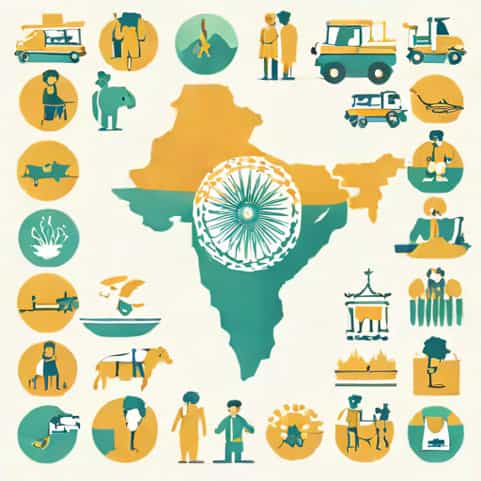
India’s population has long been a central issue in national planning, development debates, and public policy discussions. With its vast size, cultural diversity, and uneven access to health services, managing population growth has never been a simple task. Over the decades, the Indian government experimented with various family planning initiatives, learning from both successes and failures. These efforts eventually led to a more comprehensive and balanced approach, resulting in the formulation of a formal national population framework that aimed to address not just numbers, but overall human development.
Background of Population Concerns in India
After gaining independence in 1947, India faced serious development challenges. High birth rates, declining death rates, poverty, and limited healthcare infrastructure created pressure on resources. Population growth was seen as a major obstacle to economic progress and social welfare.
India was actually one of the first countries in the world to launch an official family planning program in 1952. However, early efforts focused mainly on reducing birth rates without fully considering education, women’s empowerment, or regional differences.
Early Family Planning Programs
The initial family planning programs relied heavily on awareness campaigns and basic contraceptive services. Over time, these programs expanded, but they often lacked coordination and long-term vision. In the 1970s, India experienced a controversial phase when population control measures became coercive during the Emergency period.
This experience deeply influenced public trust. It made policymakers realize that population control could not succeed through force or fear, but only through informed choice and improved living standards.
Changing Perspectives in the 1980s and 1990s
By the 1980s, thinking around population management began to change. There was growing recognition that population growth was closely linked to factors such as education, maternal health, child survival, and women’s status in society.
During the 1990s, global discussions on reproductive rights and sustainable development further shaped India’s approach. The focus shifted from population control to population stabilization, emphasizing voluntary participation and human rights.
When the National Population Policy in India Was Formulated
The National Population Policy in India was formulated in the year 2000. This marked a significant milestone in the country’s demographic planning. Rather than focusing narrowly on reducing birth rates, the policy aimed to create a comprehensive framework addressing health, education, and social development.
The year 2000 was chosen at a time when India was reassessing its development priorities in the new millennium. Policymakers recognized the need for a long-term strategy that balanced population stabilization with economic growth and social justice.
Main Objectives of the National Population Policy 2000
The National Population Policy outlined clear short-term, medium-term, and long-term objectives. These goals were designed to guide government action across multiple sectors.
Short-Term Objectives
The immediate focus was on addressing unmet needs for contraception and healthcare services. This included improving access to reproductive health services, especially in rural and underserved areas.
Medium-Term Objectives
The medium-term goal aimed to reduce fertility rates to replacement levels. This meant encouraging families to have a number of children that would stabilize population growth over time.
Long-Term Objectives
The long-term vision was population stabilization by the year 2045. This goal emphasized sustainable development, improved quality of life, and balanced population distribution.
- Meeting unmet needs for family planning
- Reducing infant and maternal mortality
- Promoting delayed marriage and childbearing
- Encouraging small family norms
Key Strategies Adopted by the Policy
The National Population Policy in India introduced several strategic approaches to achieve its objectives. These strategies reflected lessons learned from earlier programs.
One major shift was the emphasis on decentralization. State governments were encouraged to design population strategies based on local needs, recognizing that demographic challenges vary widely across India.
Role of Women’s Empowerment
Women’s education and empowerment were placed at the center of the policy. Studies had shown that educated women tend to marry later, have fewer children, and seek better healthcare for their families.
The policy promoted girls’ education, economic participation, and access to reproductive health information as essential tools for population stabilization.
Health and Reproductive Services
Improving healthcare infrastructure was another key element. The policy aimed to strengthen primary healthcare systems, expand immunization coverage, and ensure safe childbirth.
Access to a range of contraceptive options was emphasized, allowing individuals and couples to make informed choices without pressure or coercion.
Involvement of Communities and Institutions
The National Population Policy recognized that government action alone was not enough. Community organizations, non-governmental groups, and local leaders were encouraged to participate actively.
Religious leaders, educators, and media outlets were seen as important partners in spreading awareness and changing social attitudes toward family size and reproductive health.
Challenges in Implementation
Despite its comprehensive design, implementing the National Population Policy has not been without challenges. India’s vast diversity means that progress has been uneven across states and regions.
Some states achieved replacement-level fertility relatively quickly, while others continued to experience high birth rates due to poverty, low literacy, and limited healthcare access.
Impact and Progress Since 2000
Since the National Population Policy was formulated in 2000, India has made significant progress in several areas. Fertility rates have declined nationally, and awareness of reproductive health has increased.
However, population momentum continues due to a large base of young people. This means that even with lower fertility rates, the total population continues to grow.
Relevance of the Policy Today
More than two decades later, the principles of the National Population Policy remain relevant. Issues such as urbanization, aging populations, and regional imbalances have added new dimensions to population planning.
Rather than focusing solely on numbers, current discussions emphasize quality of life, employment opportunities, and sustainable use of resources.
The National Population Policy in India was formulated in 2000 as a response to decades of experience, debate, and learning. It marked a shift from narrow population control measures to a holistic approach centered on human development and rights.
By addressing health, education, and empowerment alongside fertility reduction, the policy provided a long-term vision for population stabilization. Its lessons continue to shape India’s approach to development and demographic change in the twenty-first century.