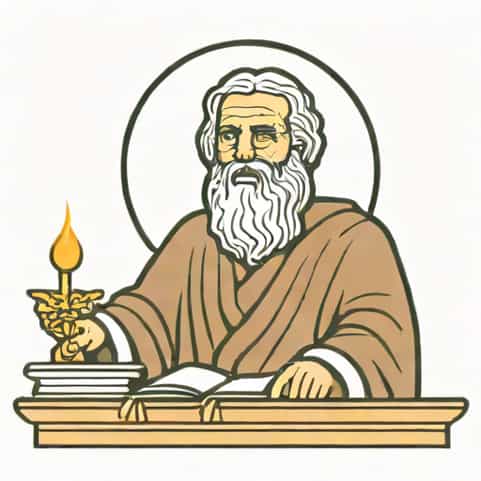
Democritus, a pre-Socratic Greek philosopher who lived around 460-370 BCE, is best known for his groundbreaking ideas about the fundamental nature of matter. Long before the advent of modern science, Democritus proposed that everything in the universe is made up of tiny, indivisible ptopics called atoms. His concept of atoms laid the philosophical groundwork for atomic theory, influencing centuries of thought in both philosophy and science. Understanding what Democritus believed about the composition of matter provides insight into the origins of scientific thinking and the evolution of ideas about the physical world, showing how early thinkers sought to explain the complexity of nature using fundamental principles.
Who Was Democritus?
Democritus was born in Abdera, a Greek city in Thrace, and he was a student of Leucippus, another early philosopher who first developed atomic theory. Known as the Laughing Philosopher due to his cheerful disposition, Democritus traveled widely and studied a variety of subjects, including mathematics, astronomy, ethics, and natural philosophy. Despite living in an era dominated by mythological explanations of nature, he pursued rational and logical inquiry to understand the physical universe. His theories on matter represented a radical departure from the ideas of his contemporaries, emphasizing observation, reason, and conceptual analysis.
The Concept of Atoms
Democritus proposed that everything in the universe is composed of atoms, which he described as indivisible, indestructible, and eternal ptopics. According to him, atoms are too small to be seen or divided, and they differ only in shape, arrangement, and position. These differences in atomic characteristics create the diversity of matter observed in the world. For instance, the hardness of a rock or the softness of water results from the specific arrangement and combination of atoms. In this way, Democritus attempted to explain natural phenomena without invoking supernatural forces, relying instead on logical reasoning and the properties of atoms.
Properties of Atoms According to Democritus
Democritus’ atoms were simple in nature but complex in their interactions. He identified several key properties of atoms that accounted for the material world’s behavior.
Indivisibility
Democritus believed that atoms could not be broken down into smaller components. This indivisibility distinguished them from the macroscopic objects we interact with daily. While modern science shows that atoms can be divided into subatomic ptopics, the core idea of an indivisible unit of matter represented a significant philosophical leap at the time.
Eternity
Atoms are eternal, meaning they have always existed and will always exist. They cannot be created or destroyed; they only move and combine in different ways to form the observable world. This notion provided a rational explanation for the permanence of matter and the continuity of natural processes.
Differentiation by Shape and Arrangement
Democritus argued that the diversity of matter arises from differences in atomic shapes and how atoms combine. For example, smooth and round atoms might form liquids, while jagged, irregular atoms form solids. This early idea foreshadowed the later scientific understanding that physical properties depend on the structure and arrangement of ptopics at a microscopic level.
Void and Motion
In addition to atoms, Democritus proposed the existence of the void, an empty space in which atoms move. The combination of atoms in motion within the void produces all physical phenomena. This insight allowed him to explain change, growth, and decay without resorting to mythological explanations. By attributing natural processes to the movement and interaction of atoms, he provided a mechanistic framework for understanding the universe.
Impact on Philosophy and Science
Democritus’ ideas about atoms influenced both philosophy and science for centuries. Although his work was largely philosophical rather than experimental, it anticipated key principles of modern atomic theory. His insistence on natural explanations and reasoning shaped the development of scientific thought, challenging contemporaries who relied on mystical or religious interpretations of the world.
Influence on Later Philosophers
- EpicurusAdopted and expanded Democritus’ atomic theory, incorporating it into his ethical and natural philosophy.
- LucretiusRoman poet and philosopher who popularized Democritus’ ideas in the poem De Rerum Natura, explaining the universe through atoms and void.
- Scientific Revolution ThinkersPhilosophers like Galileo and Newton were inspired by rational, mechanistic explanations of nature, tracing their intellectual lineage back to pre-Socratic ideas.
Limitations and Criticisms
While groundbreaking, Democritus’ atomic theory had limitations. He lacked experimental evidence and relied solely on reasoning and observation. Additionally, some contemporaries, including Aristotle, rejected the concept of the void and atoms, favoring continuous matter theory. Despite this, his ideas endured, demonstrating the power of conceptual reasoning to shape human understanding even without empirical confirmation.
Atoms and Everyday Matter
Democritus’ notion that all things are made of atoms provides a framework for understanding the material world. According to his philosophy, everything-from rocks and water to plants, animals, and even human beings-is composed of atoms moving and interacting in the void. Changes in matter, such as melting, growth, or decay, result from the rearrangement of atoms rather than the creation or destruction of substances.
Examples of Atomic Combinations
- Solids Composed of tightly packed atoms arranged in structured patterns.
- Liquids Atoms are close together but can move past each other, allowing fluidity.
- Gases Atoms are widely spaced and move freely, explaining expansion and diffusion.
- Living Organisms Complex arrangements of atoms form cells, tissues, and organs, resulting in life processes.
Modern Relevance of Democritus’ Ideas
Although modern atomic theory has advanced far beyond Democritus’ initial concepts, his ideas remain foundational. Today, we understand that atoms consist of protons, neutrons, and electrons, and that chemical properties depend on subatomic interactions. Yet, the philosophical insight that matter is composed of discrete units and that the diversity of the material world arises from their combinations reflects the enduring relevance of Democritus’ thought.
Scientific Inspiration
Democritus’ work inspired generations of scientists to explore the structure of matter, leading to discoveries in chemistry, physics, and molecular biology. His emphasis on observation, reasoning, and natural explanations continues to influence scientific methodology.
Philosophical Lessons
Beyond science, Democritus’ atomic theory teaches important philosophical lessons about inquiry, rationality, and understanding complexity through simple principles. His ideas encourage curiosity, critical thinking, and the search for underlying causes in both natural and social phenomena.
Democritus believed that everything in the universe is made of tiny, indivisible ptopics called atoms, moving through empty space or the void. These atoms combine in various ways to form all matter, accounting for the diversity of objects, substances, and living beings. His insights laid the foundation for modern atomic theory and influenced philosophy, science, and rational thought for centuries. By proposing that natural phenomena could be explained through the behavior of fundamental ptopics, Democritus offered a powerful model for understanding the universe, demonstrating the enduring value of curiosity, reason, and observation in the quest to uncover the nature of reality.