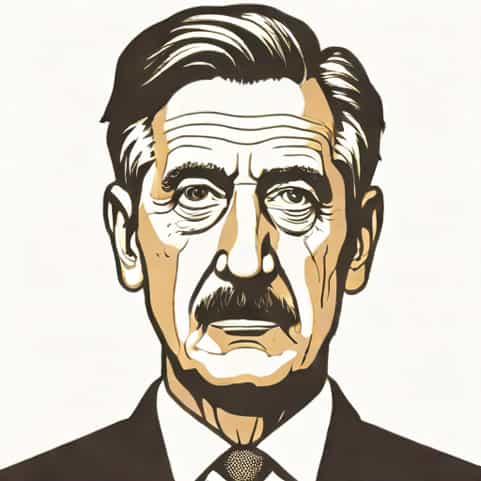
George Orwell’s essay Politics and the English Language remains one of the most discussed works about the connection between language, thought, and power. Written in the aftermath of World War II, the essay reflects Orwell’s concern that careless, vague, and manipulative language was not just a stylistic problem but a political one. By examining how words are used in public discourse, Orwell argued that the decline of language makes it easier for political systems to hide truth, justify violence, and limit independent thinking. Even today, the ideas from Politics and the English Language by George Orwell continue to feel relevant to everyday communication.
The Historical Background of the Essay
Politics and the English Language was published in 1946, a time when Europe was recovering from war and ideological conflict. Political propaganda, bureaucratic language, and misleading rhetoric were common tools used by governments and institutions. Orwell had witnessed how totalitarian regimes manipulated language to control thought, and this experience strongly influenced his writing.
The essay should be understood not only as a critique of writing style, but also as a warning about how political language can shape reality. Orwell believed that bad language habits were both a cause and a result of dishonest politics.
Orwell’s Main Argument
The central idea of Politics and the English Language is that language and thought are closely connected. According to Orwell, when language becomes unclear or inflated, thinking also becomes confused. Politicians and public figures often rely on vague phrases and abstract words to avoid responsibility or disguise uncomfortable truths.
Orwell argued that this decay of language is not inevitable. Instead, it is the result of habits that people accept without question. By becoming more aware of how language is used, individuals can resist manipulation and think more clearly.
Common Problems in Modern English
In his essay, Orwell identifies several common problems that weaken the English language. These problems are not limited to politics, but they become especially dangerous in political writing and speech.
Dying Metaphors
Orwell criticizes the overuse of metaphors that have lost their original meaning. These phrases are often repeated without thought, adding little clarity to what is being said. Instead of helping readers visualize ideas, dying metaphors make writing feel mechanical.
Pretentious Diction
Pretentious diction refers to the use of overly complex or foreign words to make simple ideas sound impressive. Orwell believed that this kind of language is often used to create authority or hide weak arguments. In political contexts, pretentious diction can distance speakers from the public.
Meaningless Words
Orwell also points out words that are frequently used without clear definitions. Terms like democracy, freedom, or justice can become empty when they are used carelessly. In politics, meaningless words allow speakers to sound positive while avoiding specific commitments.
Political Language as a Tool of Control
A key theme in Politics and the English Language by George Orwell is the idea that political language is often designed to make lies sound truthful and violence respectable. Orwell gives examples of how harsh realities are softened through euphemisms.
For instance, actions like oppression or war may be described using abstract language that removes human responsibility. This allows speakers to discuss harmful actions without confronting their moral consequences.
The Relationship Between Language and Thought
Orwell strongly believed that poor language habits encourage poor thinking. When people rely on ready-made phrases, they stop analyzing what they truly mean. Over time, this reduces the ability to think critically and independently.
However, Orwell also suggests that the relationship works both ways. Clear thinking can lead to clear writing, and clear writing can improve thinking. This hopeful perspective sets Orwell apart from purely pessimistic critics.
Orwell’s Rules for Clear Writing
One of the most practical sections of the essay is Orwell’s list of rules for improving writing. These rules are meant as guidelines rather than strict laws, encouraging writers to be more conscious of their language.
- Never use a metaphor, simile, or figure of speech you are used to seeing in print.
- Never use a long word where a short one will do.
- If it is possible to cut a word out, always cut it out.
- Never use the passive voice where you can use the active.
- Never use a foreign phrase or jargon if you can think of an everyday English equivalent.
- Break any of these rules sooner than say anything outright barbarous.
These rules reflect Orwell’s belief that simplicity and honesty in language are essential for meaningful communication.
Impact on Journalism and Media
Politics and the English Language has had a lasting influence on journalism, education, and media criticism. Many journalists and editors still reference Orwell’s ideas when discussing clarity, bias, and ethical writing.
In news reporting, the use of vague or emotionally loaded language can shape public opinion without readers realizing it. Orwell’s essay encourages readers to question not only what is being said, but how it is being said.
Relevance in Modern Politics
Although written decades ago, the essay remains highly relevant in the age of social media, advertising, and 24-hour news cycles. Political slogans, sound bites, and viral messages often rely on simplified or misleading language.
Orwell’s warnings about political language apply equally to modern democracies and authoritarian systems. The manipulation of language is not limited to one ideology, making the essay universally applicable.
Criticism and Limitations
Some critics argue that Orwell’s view of language is too idealistic. Language naturally evolves, and not all complexity or abstraction is dishonest. Political realities can be complicated, and simplifying language does not always lead to better understanding.
However, even critics often agree that Orwell’s core message about awareness and responsibility in language use remains valuable.
Connection to Orwell’s Other Works
The ideas in Politics and the English Language are closely connected to Orwell’s novels, especially 1984. In that novel, the concept of Newspeak shows an extreme version of how language can be used to limit thought.
The essay can be seen as a non-fiction foundation for the themes Orwell later explored through fiction.
Why the Essay Still Matters
The lasting importance of Politics and the English Language by George Orwell lies in its call for personal responsibility. Orwell does not blame language decay on abstract forces alone. Instead, he challenges individuals to write and speak more carefully.
By paying attention to words, people can resist manipulation and contribute to more honest public discussion.
Politics and the English Language is more than an essay about grammar or style. It is a powerful reflection on how language shapes political reality and individual thought. George Orwell’s insights continue to resonate because they address a problem that has not disappeared. In a world filled with information, slogans, and persuasion, the ability to use and understand clear language remains essential. Orwell’s message encourages readers to think critically, question authority, and value clarity as a form of intellectual and political freedom.