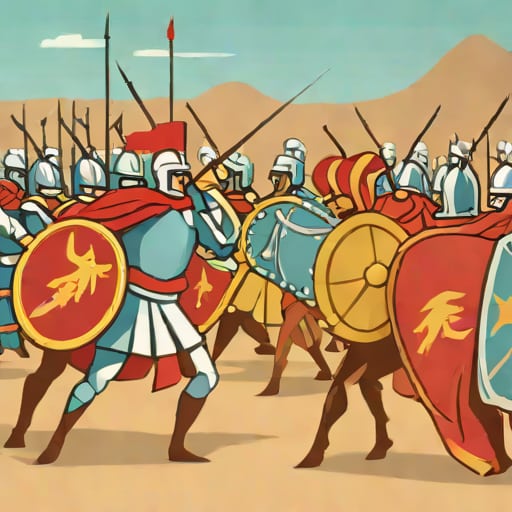
The Battle of Plataea, fought in 479 BCE, marked a decisive turning point in the Greco-Persian Wars, ending the Persian invasion of Greece and solidifying the unity and resilience of the Greek city-states. This battle followed a series of critical conflicts, including the battles of Marathon, Thermopylae, and Salamis, which collectively showcased both the strategic brilliance and determination of the Greek forces. Plataea brought together a coalition of Greek city-states, primarily led by Sparta and Athens, to confront the massive Persian army under the command of Mardonius. The battle was characterized by careful planning, strategic positioning, and a combination of heavy infantry, cavalry, and archery forces. Its outcome not only preserved Greek independence but also established a precedent for cooperative defense among the city-states, influencing the political and military landscape of the region for decades.
Background of the Battle of Plataea
The Persian Wars had been ongoing since 499 BCE, with the Persian Empire seeking to expand its dominion into Greece. The Greeks, although politically fragmented, shared a common interest in resisting Persian domination. The Persian invasion of 480 BCE, led by King Xerxes I, had already seen the famous stand of the Spartans at Thermopylae and the naval victory at Salamis. Following the retreat of Xerxes after the naval defeat, Mardonius remained in Greece with a substantial Persian force, aiming to conquer the remaining Greek city-states and establish Persian control. The Greeks, learning from previous encounters, realized the importance of unified military strategy and decided to assemble a combined force of hoplites, cavalry, and archers to meet the Persian threat near the city of Plataea in Boeotia.
Greek Forces and Strategy
The Greek army at Plataea was composed of approximately 38,000 to 43,000 soldiers, with the majority being heavily armed hoplites from Sparta, Athens, Corinth, and other allied city-states. The Greek strategy focused on exploiting their strengths in close-quarters combat and heavily armored infantry. They positioned themselves on higher ground near Plataea, making it difficult for the Persian cavalry to maneuver effectively. Greek commanders, including Pausanias of Sparta and Aristides of Athens, emphasized discipline, coordination, and the use of phalanx formations. This arrangement allowed the Greeks to counter Persian numerical superiority while minimizing their own vulnerabilities. The choice of terrain and the disciplined coordination of multiple city-states were crucial elements that shaped the battle’s outcome.
Persian Forces and Strategy
The Persian army, under Mardonius, was significantly larger, estimated at 70,000 to 120,000 soldiers, including infantry, cavalry, and archers. The Persians relied on mobility, archery, and numerical advantage to overpower their enemies. Mardonius aimed to force the Greeks into open combat where his cavalry and archers could exploit their superior numbers. However, the Persians faced challenges due to unfamiliar terrain, the well-fortified Greek positions, and the Greeks’ cohesive phalanx formations. The Persian strategy depended on luring the Greeks into disadvantageous positions and using flanking maneuvers to disrupt the Greek formations, but the Greeks’ preparation and tactical choices ultimately neutralized these advantages.
The Course of the Battle
The Battle of Plataea began with initial skirmishes, probing attacks, and tactical maneuvering from both sides. For several days, the armies remained in position, testing each other’s strength and attempting to gain a strategic advantage. Mardonius attempted to provoke the Greeks into leaving their stronghold and engaging in open battle, but the Greek commanders resisted. The turning point came when the Persian forces made a miscalculated advance while the Greek army held firm. The disciplined Greek phalanx launched a decisive counterattack, using their heavily armed hoplites to break Persian lines. Spartan and Athenian coordination proved critical as they focused on penetrating the Persian center while containing the flanks.
During the battle, the Greek forces demonstrated exceptional tactical flexibility, responding to Persian maneuvers with well-timed advances and counterattacks. The Persian army suffered heavy casualties, and the morale of their troops declined rapidly. Mardonius was killed in the fighting, which further demoralized the Persian forces and led to their eventual rout. Greek cavalry and allied units exploited gaps in the Persian lines, pursuing retreating soldiers and securing a comprehensive victory. The combination of strategic positioning, disciplined formations, and leadership coordination ensured that the Greeks overcame the Persian numerical advantage.
Key Factors Leading to Greek Victory
- Unity of Greek City-StatesCooperation between Sparta, Athens, Corinth, and other allies allowed for a coordinated defense that offset Persian numbers.
- Terrain AdvantageGreek forces utilized high ground and natural obstacles, limiting the effectiveness of Persian cavalry and archers.
- Phalanx FormationThe heavily armored Greek hoplites maintained a solid line, creating an impenetrable front that absorbed Persian attacks.
- Leadership and DisciplineSpartan and Athenian commanders maintained control over their troops, ensuring effective execution of battle strategies.
- Persian MiscalculationsErrors in judgment by Mardonius and overconfidence in Persian tactics contributed to their defeat.
Aftermath of the Battle
The Battle of Plataea resulted in a decisive Greek victory, ending Persian ambitions to conquer mainland Greece. The Persian army suffered devastating losses, while the Greek coalition celebrated their success and solidified their reputation as defenders of Greek freedom. The battle reinforced the importance of unity among the city-states and demonstrated the effectiveness of disciplined infantry against larger, more mobile forces. In the years following Plataea, the Greek city-states enjoyed a period of relative security and began to emerge as cultural and military powers, setting the stage for the rise of Athens and the Golden Age of Greece.
Politically, the victory at Plataea allowed Greek city-states to maintain independence and resist further Persian influence. Militarily, it highlighted the value of coordination, training, and strategic planning in overcoming larger adversaries. The lessons of Plataea informed future Greek military campaigns and contributed to the enduring legacy of Greek warfare and strategy. The battle also had symbolic significance, representing the triumph of collective effort and determination over overwhelming odds.
Significance in History
The Battle of Plataea remains one of the most significant engagements in ancient history due to its decisive outcome and its impact on the course of Western civilization. By preventing Persian domination, the Greeks preserved their political structures, culture, and traditions, allowing for the development of democracy, philosophy, and arts in the centuries to come. Plataea is often cited as a prime example of how strategic ingenuity, leadership, and cooperation can overcome numerical inferiority, providing timeless lessons in military history and statecraft.
The Battle of Plataea stands as a landmark event in the Greco-Persian Wars, illustrating the power of unity, strategy, and disciplined forces in achieving victory against a numerically superior foe. The Greek victory not only secured the independence of the city-states but also shaped the future trajectory of Greek civilization. The careful planning, effective leadership, and bravery displayed by the Greeks at Plataea continue to be studied and admired, emphasizing the enduring relevance of this historic battle. It remains a testament to the resilience of the human spirit and the decisive impact of collective action in the face of overwhelming challenges.