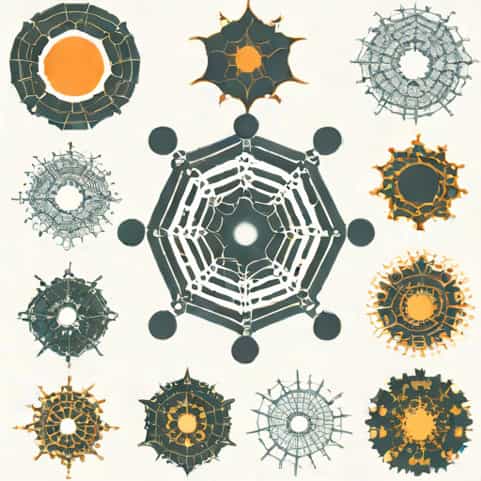
When people first encounter the Mandelbrot set explorer, they often feel as though they are staring into an infinite artwork painted by mathematics itself. This unique tool allows anyone, from professional mathematicians to curious beginners, to zoom endlessly into fractal patterns that reveal new shapes and intricate designs at every scale. Beyond its visual beauty, the explorer represents an extraordinary way of interacting with complex numbers, geometry, and chaos theory. It is not just a program but a window into the relationship between mathematics and imagination, making the Mandelbrot set one of the most famous and accessible fractals in the world.
What is the Mandelbrot Set?
The Mandelbrot set is a collection of points in the complex plane defined by a simple mathematical formula. While the formula itself may look straightforward, the results it produces are incredibly detailed and endlessly fascinating. It was named after Benoit Mandelbrot, a mathematician who pioneered the field of fractal geometry in the late 20th century. By using the Mandelbrot set explorer, anyone can visually interact with this concept, observing how infinite complexity emerges from such simple rules.
The Mathematical Basis
The formula that defines the Mandelbrot set is based on iterative functions. In simplified terms, it examines how a number behaves when repeatedly plugged into a quadratic equation. If the number stays bounded, it belongs to the set. If it diverges to infinity, it does not. The border between these two outcomes forms the iconic, complex, and endlessly detailed fractal image.
The Role of the Explorer
The Mandelbrot set explorer is a digital tool that allows users to zoom into the set, uncovering layers of fractal detail that seem to repeat yet constantly evolve. Each time the user zooms in, new patterns appear, resembling spirals, stars, dendrites, or completely unexpected shapes. This is why the explorer feels both scientific and artistic-it bridges rigorous mathematics with visual wonder.
Zooming into Infinity
One of the most captivating aspects of the Mandelbrot set explorer is the ability to zoom indefinitely. No matter how deep you go, the patterns never end. Instead, they reveal structures similar to the original set or entirely new and surprising forms. This infinite zoom creates a sense of awe, as if one is navigating through a universe contained within numbers.
Colors and Visualizations
The explorer often uses color schemes to highlight how quickly points escape to infinity. Different colors represent the rate of divergence, producing vibrant, kaleidoscopic visuals. These colors are not inherent to the mathematics but are chosen to help users appreciate the structure and complexity hidden within the fractal.
Educational Value
The Mandelbrot set explorer is not only entertaining but also highly educational. It helps students and learners of all ages grasp abstract mathematical ideas through visual engagement. Instead of reading about equations in textbooks, users can see how they work in real time.
- Complex numbersThe explorer shows how imaginary and real components interact visually.
- IterationIt demonstrates the power of repeating a simple process to generate complexity.
- Chaos theoryUsers learn how deterministic formulas can produce unpredictable results.
- GeometryThe fractal structures highlight self-similarity and infinite complexity.
The Artistic Perspective
Artists have long been fascinated by the Mandelbrot set because of its surreal and otherworldly designs. Using the explorer, they can create high-resolution images or animations that look like cosmic landscapes or microscopic worlds. The boundary between mathematics and art blurs in the Mandelbrot set, and the explorer is the tool that makes this crossover accessible to anyone.
Fractals in Popular Culture
Fractal imagery inspired by the Mandelbrot set has appeared in movies, music videos, album covers, and digital art exhibitions. The infinite zoom effect, made possible through explorers, has even been used in visual effects to simulate alien worlds or dreamscapes. This cultural presence has introduced fractals to audiences far beyond the scientific community.
Scientific Relevance
Although the Mandelbrot set is often associated with its aesthetic appeal, it also has profound scientific implications. The study of fractals has influenced fields such as physics, computer science, biology, and even economics. Natural phenomena like coastlines, clouds, and plant growth exhibit fractal-like behavior, and the Mandelbrot set provides a mathematical framework to understand these patterns. The explorer makes these connections tangible, offering a practical way to see how fractals model real-world complexity.
Using the Explorer Today
Modern Mandelbrot set explorers are often available as software, web applications, or even mobile apps. They allow users to adjust parameters, change color palettes, and save snapshots of their zoom journeys. Some explorers also connect to GPU rendering, enabling smoother and faster navigation through the infinite depths of the set. Whether used for education, research, or personal curiosity, these tools continue to draw new audiences into the world of fractals.
Interactive Features
Advanced explorers may include features such as
- Customizable color gradients for unique visual experiences.
- Real-time zooming with mouse or touch controls.
- Options to explore related fractals, such as the Julia sets.
- Export tools to create high-definition images or videos.
The Philosophical Angle
For many, exploring the Mandelbrot set is more than a mathematical exercise. It feels like a journey into infinity, a reminder of how boundless patterns and structures can emerge from simple rules. Philosophically, it raises questions about order, chaos, and the beauty hidden within the universe. The explorer becomes not just a tool but an experience that inspires reflection on the nature of reality itself.
Challenges and Limitations
While the Mandelbrot set explorer opens new horizons, it does come with challenges. Infinite zooming requires immense computational power, and rendering deeper levels can be time-consuming. Additionally, without some mathematical background, users may enjoy the visuals but struggle to grasp the underlying principles. Despite these limitations, the explorer remains an effective gateway for curiosity-driven learning.
The Mandelbrot set explorer continues to captivate people around the world because it combines science, art, and philosophy in one remarkable tool. It shows how mathematics can create visuals that are endlessly intricate, deeply educational, and profoundly inspiring. Whether used in classrooms, studios, or personal computers, it transforms abstract formulas into living experiences. By offering a way to navigate infinite complexity, the Mandelbrot set explorer reminds us of the limitless creativity within both numbers and the human imagination.