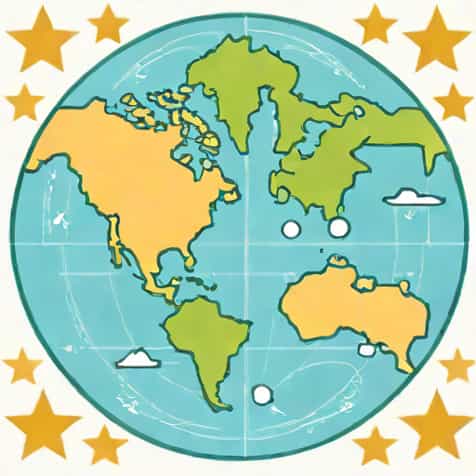
Long before the modern continents took their familiar shapes, Earth’s landmasses were arranged very differently. Scientists studying geology, fossils, and plate tectonics have discovered that today’s continents were once part of much larger ancient land formations. Among the most important of these were two massive continents known as Gondwana and Laurasia. Understanding that the two continents are named Gondwana and Laurasia helps explain how Earth’s surface evolved over hundreds of millions of years, shaping climates, ecosystems, and even the distribution of life itself.
The Origins of Ancient Supercontinents
The idea that continents move was once controversial, but it is now a central principle of Earth science. According to plate tectonic theory, Earth’s outer shell is divided into plates that slowly move over the mantle. Over geological time, these movements cause continents to collide, merge, and break apart.
Before Gondwana and Laurasia existed as separate entities, most of Earth’s land was joined together in an even larger supercontinent called Pangaea. The fact that the two continents are named Gondwana and Laurasia comes from how Pangaea eventually split into two major landmasses.
Pangaea as the Predecessor
Pangaea formed around 335 million years ago and began breaking apart roughly 175 million years ago. This breakup did not happen all at once. Instead, it occurred in stages, leading to the formation of Gondwana in the south and Laurasia in the north.
These two continents became the foundation from which the modern continents eventually emerged.
What Was Gondwana?
Gondwana was the southern of the two continents and was enormous in size. It included land that would later become several of today’s continents.
The name Gondwana comes from a region in India where distinctive ancient rock formations were first studied. Over time, scientists applied the name to the entire southern landmass.
Landmasses That Made Up Gondwana
Gondwana included many areas that are now widely separated
- Africa
- South America
- Antarctica
- Australia
- India
- Parts of the Middle East
The fact that these continents share similar rock layers and fossil records is key evidence that they were once joined together as Gondwana.
What Was Laurasia?
Laurasia was the northern counterpart to Gondwana. While slightly smaller, it was still a vast continent that played a major role in Earth’s geological history.
The name Laurasia combines Laurentia, an ancient core of North America, with Eurasia, reflecting the regions it contained.
Landmasses That Made Up Laurasia
Laurasia consisted primarily of
- North America
- Europe
- Asia (excluding India)
When scientists say the two continents are named Gondwana and Laurasia, they are referring to this major north-south division of Earth’s land after the breakup of Pangaea.
The Separation of Gondwana and Laurasia
The division between Gondwana and Laurasia was marked by a large ocean called the Tethys Sea. This ocean separated the northern and southern continents and influenced climate and marine life.
As tectonic plates continued to shift, Gondwana and Laurasia slowly drifted farther apart, leading to further fragmentation.
Timing of the Breakup
The separation began during the early Jurassic period. Over tens of millions of years, cracks widened, magma rose from below, and new oceanic crust formed.
This gradual process highlights how slow yet powerful plate tectonic forces are.
Why Gondwana and Laurasia Matter
The idea that the two continents are named Gondwana and Laurasia is more than a naming convention. It provides a framework for understanding Earth’s past environments and biological evolution.
By studying these ancient continents, scientists can explain why certain fossils are found on continents now separated by oceans.
Fossil Evidence
Identical fossils of plants and animals have been found in South America, Africa, India, and Antarctica. These discoveries make sense only if these regions were once connected as part of Gondwana.
Similarly, fossil similarities between North America, Europe, and Asia support the existence of Laurasia.
Climate and Environmental Impact
When Gondwana and Laurasia existed, Earth’s climate was very different from today. Gondwana extended over the South Pole, leading to widespread glaciation during certain periods.
Laurasia, being closer to the equator, experienced warmer and more stable climates.
Influence on Life Evolution
These climate differences influenced how plants and animals evolved. Species adapted to cold, dry conditions in Gondwana differed from those in warmer Laurasian regions.
As the continents split further, isolated populations evolved independently, contributing to biodiversity.
The Breakup into Modern Continents
Gondwana did not remain intact forever. It gradually split into smaller continents, including Africa and South America, which separated as the Atlantic Ocean opened.
India broke away and moved northward, eventually colliding with Asia and forming the Himalayas.
Laurasia’s Transformation
Laurasia also fragmented over time. North America separated from Europe, and Asia continued to shift and reshape through collisions with other landmasses.
These movements created mountain ranges, ocean basins, and the continents we recognize today.
Scientific Evidence Supporting Gondwana and Laurasia
The conclusion that the two continents are named Gondwana and Laurasia is supported by multiple lines of evidence.
- Matching rock formations across continents
- Similar fossil records
- Paleomagnetic data
- Plate tectonic modeling
Together, these findings provide a strong and consistent picture of Earth’s ancient geography.
Why This Knowledge Is Still Relevant
Understanding Gondwana and Laurasia helps scientists predict geological activity such as earthquakes and volcanic eruptions. It also aids in locating mineral resources formed under specific ancient conditions.
In education, these concepts help students grasp how dynamic Earth truly is.
A Window into Earth’s Deep Past
Learning that the two continents are named Gondwana and Laurasia gives us a clearer view of Earth’s long history. It reminds us that the planet’s surface is constantly changing, even if those changes are too slow to notice in a human lifetime.
This perspective deepens our appreciation of the planet and the forces that shape it.
The idea that the two continents are named Gondwana and Laurasia represents one of the most important discoveries in geology. These ancient landmasses explain how today’s continents formed, why certain fossils appear across oceans, and how climate and life evolved together.
By studying Gondwana and Laurasia, we gain insight into Earth’s dynamic nature and the powerful tectonic processes that continue to shape our world today.