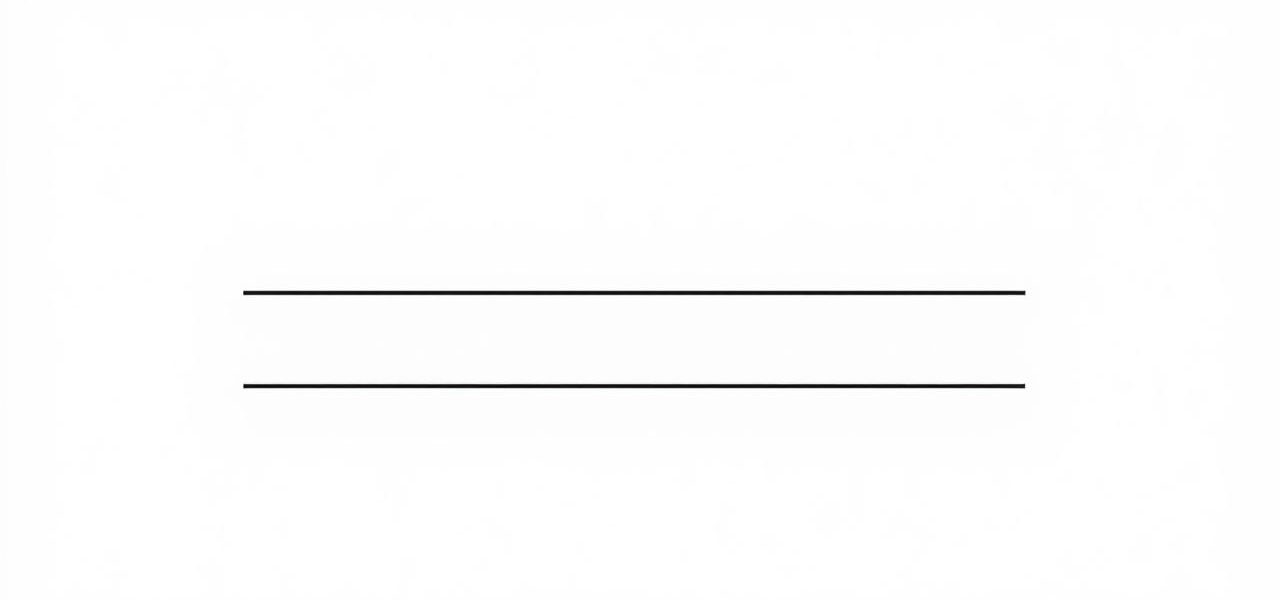
In geometry, parallel and perpendicular lines are fundamental concepts that form the basis of many constructions, proofs, and real-world applications. Understanding how these lines behave, how to identify them, and how to work with their equations is essential for solving a wide range of problems in mathematics. Parallel lines never meet, no matter how far they are extended, while perpendicular lines intersect at right angles. These ideas not only apply to pure geometry but also to coordinate geometry, where slopes and equations provide a clear way to describe and analyze them.
Defining Parallel Lines
Parallel lines are two or more lines that lie in the same plane and do not intersect, no matter how far they extend. They are always the same distance apart and share the same slope when expressed in slope-intercept form (y = mx + b).
Properties of Parallel Lines
- They have identical slopes in a coordinate plane.
- They never cross or meet at any point.
- The perpendicular distance between them is constant.
- They can be horizontal, vertical, or slanted, as long as their direction is the same.
Example in Coordinate Geometry
Consider the equations y = 2x + 1 and y = 2x â 3. Both lines have a slope of 2, so they are parallel. They have different y-intercepts, meaning they are distinct lines that will never meet.
Defining Perpendicular Lines
Perpendicular lines intersect at a right angle (90 degrees). In coordinate geometry, the slopes of two perpendicular lines are negative reciprocals of each other. If one line has slope m, the perpendicular line will have slope â1/m.
Properties of Perpendicular Lines
- They intersect to form four right angles.
- They have slopes that are negative reciprocals.
- In a plane, one line can have many lines perpendicular to it.
Example in Coordinate Geometry
If one line is y = 3x + 2, its slope is 3. A perpendicular line would have slope â1/3, for example y = â(1/3)x + 5.
Relationship Between Slopes
Slopes are a key tool in identifying whether lines are parallel or perpendicular. The slope-intercept form y = mx + b makes this relationship clear
- Parallel lines m1= m2
- Perpendicular lines m1Ã m2= â1
By calculating slopes from two points or from the equation of a line, you can quickly determine their relationship.
Equations of Parallel Lines
To write the equation of a line parallel to a given line, use the same slope but change the y-intercept according to the point it passes through.
Example
Find the equation of a line parallel to y = 4x + 1 passing through the point (2, 3).
- Identify the slope m = 4
- Use point-slope form y â 3 = 4(x â 2)
- Simplify y = 4x â 5
The result y = 4x â 5 is parallel to y = 4x + 1.
Equations of Perpendicular Lines
To write the equation of a line perpendicular to a given line, take the negative reciprocal of the slope and use point-slope form.
Example
Find the equation of a line perpendicular to y = 2x + 4 that passes through (1, â2).
- Original slope m = 2
- Perpendicular slope m = â1/2
- Point-slope form y + 2 = â(1/2)(x â 1)
- Simplify y = â(1/2)x â (3/2)
Angles Formed by Intersecting Lines
When two lines intersect, they create pairs of opposite angles, known as vertical angles, which are always equal. In the special case of perpendicular lines, each of the four angles formed is a right angle.
Parallel Lines and Transversals
When a transversal crosses two parallel lines, several angle relationships occur
- Corresponding angles are equal.
- Alternate interior angles are equal.
- Alternate exterior angles are equal.
- Consecutive interior angles are supplementary.
Real-World Applications
Parallel and perpendicular lines are not just abstract concepts they appear everywhere in daily life
- Railroad tracks are parallel to ensure safe and consistent travel.
- Street intersections often feature perpendicular roads for efficient traffic flow.
- Architects use parallel and perpendicular lines in designing floor plans and structural elements.
- Engineers rely on these relationships in mechanical and civil projects.
In Navigation
Parallel lines help define latitude lines on maps, while perpendicular lines correspond to longitude lines, together forming a grid for locating positions on Earth.
Problem-Solving Strategies
When faced with problems involving parallel and perpendicular lines, a few strategies can make the process easier
- Always start by finding the slope of the given line.
- For parallel lines, keep the slope unchanged; for perpendicular lines, use the negative reciprocal.
- Use point-slope form to incorporate a specific point through which the line passes.
- Check your final equation by comparing slopes and verifying the required relationship.
Common Mistakes to Avoid
- Mixing up the slopes for perpendicular lines remember it’s the negative reciprocal, not just the negative.
- Forgetting that vertical lines have undefined slopes and horizontal lines have a slope of zero.
- Assuming lines are parallel or perpendicular just by visual estimation always verify with calculations.
Special Cases
Horizontal and Vertical Lines
A horizontal line has equation y = c, and its slope is zero. A vertical line has equation x = c, and its slope is undefined. Any horizontal line is perpendicular to any vertical line.
Coinciding Lines
If two lines have the same equation, they are not only parallel but identical, meaning every point lies on both lines.
Practice Example
Given the line 3x â 4y = 12, find
- The slope of a parallel line.
- The slope of a perpendicular line.
- The equation of a parallel line passing through (0, 5).
- The equation of a perpendicular line passing through (â2, 1).
Solution
- Rewrite as y = (3/4)x â 3, so slope m = 3/4.
- Parallel slope 3/4.
- Perpendicular slope â4/3.
- Parallel line y â 5 = (3/4)(x â 0) â y = (3/4)x + 5.
- Perpendicular line y â 1 = (â4/3)(x + 2) â y = (â4/3)x â 5/3.
Mastering parallel and perpendicular lines in both geometric and algebraic contexts allows for more confident problem-solving and deeper understanding of spatial relationships. By applying the concepts of slope, angle relationships, and special cases, you can identify, construct, and analyze these lines with precision. Whether in pure mathematics, physics, engineering, or everyday tasks, recognizing and using the properties of parallel and perpendicular lines is a skill with broad and lasting value.