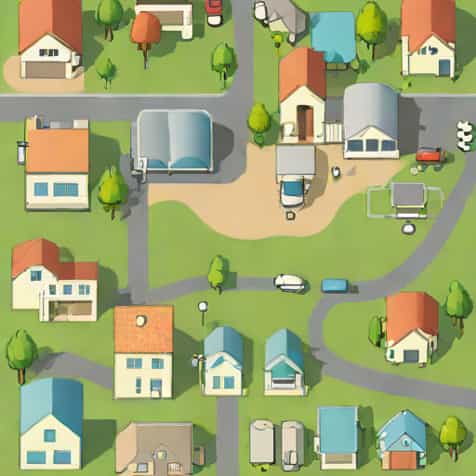
Aerial photography has become an essential tool in a wide range of fields, from cartography and environmental studies to urban planning and agriculture. One important concept in aerial photography is the deliberate use of overlaps between consecutive photographs. Overlaps are necessary for several practical reasons, including ensuring complete coverage of an area, creating stereoscopic views, and improving the accuracy of measurements. Understanding the uses which necessitate overlaps in aerial photographs helps professionals optimize their surveys and achieve precise results in mapping, monitoring, and analysis.
Understanding Overlaps in Aerial Photography
In aerial photography, overlaps refer to the intentional covering of a portion of one photograph by the next photograph taken during a flight. This is commonly expressed as a percentage of coverage, with forward overlap (along the flight line) usually around 60% and side overlap (between adjacent flight lines) around 20-30%. Overlaps are not random but are planned to serve specific purposes that enhance the utility and reliability of aerial imagery. Proper overlap ensures that the data collected is continuous, consistent, and suitable for various applications.
Forward Overlap and Side Overlap
Forward overlap refers to the percentage of one photo that is covered by the next photo taken along the same flight path. This type of overlap is crucial for creating stereoscopic pairs of images, which allow analysts to perceive depth and measure heights accurately. Side overlap, on the other hand, occurs between photographs on adjacent flight lines. Side overlap ensures lateral continuity of the coverage and is particularly important for creating mosaic images or mapping large areas efficiently.
Uses That Necessitate Overlaps in Aerial Photographs
There are several practical uses which necessitate overlaps in aerial photographs. Each use benefits from overlaps in different ways, whether for accuracy, analysis, or comprehensive coverage. Professionals carefully plan flight paths and overlap percentages based on the objectives of the survey.
1. Topographic Mapping
Topographic mapping requires precise measurements of land elevations, contours, and surface features. Overlaps in aerial photographs allow cartographers to create stereoscopic images, enabling them to determine elevation differences and construct accurate topographic maps. Without sufficient overlap, it would be impossible to establish reliable stereoscopic models, and the resulting maps would lack detail and accuracy. For example, mapping mountainous regions or urban landscapes requires overlaps to capture changes in elevation and complex features effectively.
2. Land Use and Land Cover Analysis
Land use and land cover studies benefit greatly from overlaps in aerial photographs. Overlapping images ensure that no areas are missed and that analysts can cross-check features for consistency. This is particularly useful when monitoring agricultural fields, forests, or urban expansion. With adequate overlap, it is easier to identify boundaries, detect changes over time, and produce comprehensive maps that inform planning, conservation, or development projects.
3. Stereoscopic Measurement and Photogrammetry
Photogrammetry, the science of making measurements from photographs, relies heavily on overlaps. Stereoscopic pairs created from overlapping images enable accurate measurement of distances, heights, and volumes. This technique is widely used in engineering, construction, and environmental studies. For instance, calculating the volume of a reservoir, the height of a building, or the slope of a hillside requires overlapping aerial photographs to generate precise three-dimensional data.
4. Disaster Management and Environmental Monitoring
Overlaps in aerial photography are crucial for disaster management and environmental monitoring. During events such as floods, landslides, or forest fires, overlapping images allow analysts to create comprehensive visual records of affected areas. Overlaps help in detecting subtle changes, estimating damage, and planning response strategies. In environmental monitoring, overlaps enable continuous coverage over large regions, which is essential for tracking deforestation, erosion, or urban development over time.
5. Creation of Mosaics and Orthophotos
Mosaics and orthophotos are composite images created by stitching together multiple aerial photographs. Overlaps are essential for ensuring smooth transitions between images and eliminating gaps. Side overlaps are particularly important in this context, as they allow software to align images accurately and maintain consistent scale and perspective. Mosaics are widely used in mapping, land planning, and geographic information systems (GIS) for detailed visual representation of large areas.
Factors Affecting the Amount of Overlap
The degree of overlap in aerial photographs depends on several factors. Flight altitude, camera focal length, terrain complexity, and the intended application all influence how much overlap is necessary. Higher altitudes may require greater forward overlap to maintain stereoscopic accuracy, while areas with complex topography might require increased side overlap to capture all features. Survey planners must carefully consider these factors to ensure that the overlaps provide the desired level of detail and coverage.
Flight Planning and Overlap Optimization
Optimizing overlap in aerial photography involves careful flight planning. Surveyors must determine the flight path, altitude, speed, and camera settings to achieve the desired forward and side overlaps. Modern aerial surveys often use GPS and automated flight control systems to maintain consistent overlaps, minimizing human error and improving the reliability of the imagery. Proper planning ensures that overlaps are sufficient for mapping, stereoscopic analysis, and mosaic creation without unnecessary duplication of images.
Overlaps in aerial photographs are not merely incidental but are essential for a wide range of applications, including topographic mapping, land use analysis, photogrammetry, disaster management, and mosaic creation. Forward and side overlaps provide continuity, enable stereoscopic measurement, and ensure comprehensive coverage of survey areas. Proper flight planning and careful consideration of terrain, altitude, and camera settings help optimize overlaps, making aerial photography a powerful tool for accurate mapping and analysis. Understanding the uses which necessitate overlaps in aerial photographs allows professionals to collect reliable data and achieve high-quality results in surveying, environmental monitoring, and geographic analysis.