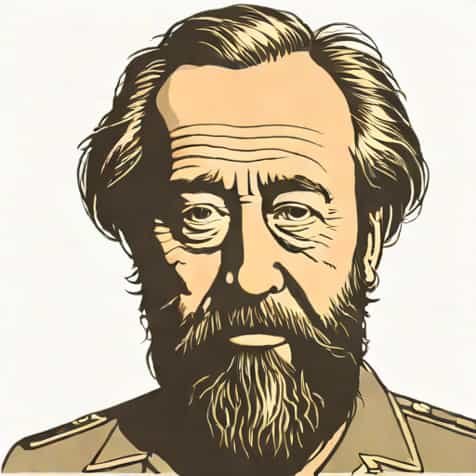
Alexander Solzhenitsyn is best known as a Russian novelist, historian, and outspoken critic of the Soviet Union, whose writings exposed the brutal realities of life under totalitarian rule. His works not only brought global attention to the existence of the Soviet labor camp system, or Gulag, but also highlighted the moral and ethical dilemmas faced by individuals living under oppressive regimes. Solzhenitsyn’s ability to combine personal experience with historical insight made him one of the most influential writers of the 20th century, earning him both admiration and controversy. His legacy endures as a powerful testament to the human spirit, the importance of truth, and the necessity of moral courage in the face of authoritarianism.
Early Life and Background
Alexander Solzhenitsyn was born on December 11, 1918, in Kislovodsk, Russia. Growing up during a period of political upheaval following the Russian Revolution, he witnessed firsthand the social and economic challenges that shaped Soviet society. His early education and upbringing instilled in him a love for literature and a commitment to moral principles, which later influenced his writing. Solzhenitsyn studied mathematics and physics at Rostov State University, but his interest in literature and philosophy remained central to his intellectual development.
Military Service and Imprisonment
During World War II, Solzhenitsyn served as an artillery officer in the Soviet Army. In 1945, he was arrested for criticizing Joseph Stalin in private letters, a reflection of the pervasive surveillance and censorship in Soviet society. He was sentenced to eight years in a labor camp, an experience that profoundly shaped his worldview and provided the basis for much of his later writing. Following his release, Solzhenitsyn was exiled to internal exile in Kazakhstan, where he began documenting the horrors of the Gulag system.
Major Works and Literary Contributions
Alexander Solzhenitsyn’s literary career is defined by works that expose the oppression, fear, and suffering of Soviet life while highlighting the resilience of the human spirit. His most notable works include
One Day in the Life of Ivan Denisovich
Published in 1962, this novella is Solzhenitsyn’s best-known work. It provides a detailed, day-long account of Ivan Denisovich Shukhov, a prisoner in a Soviet labor camp. The book was groundbreaking because it was one of the first literary works published in the Soviet Union to openly acknowledge the existence of the Gulag. Through its vivid descriptions of camp life, routines, and small acts of personal dignity, the novella conveyed the psychological and physical hardships faced by millions under Stalinist rule.
The Gulag Archipelago
Considered Solzhenitsyn’s magnum opus, this extensive three-volume work was published in 1973. It meticulously documents the Soviet labor camp system through a combination of personal experience, testimonies from fellow prisoners, and historical research. The Gulag Archipelago is both a historical record and a moral critique of totalitarianism, demonstrating how systemic oppression can dehumanize individuals and erode societal morality. Its publication led to global awareness of Soviet repression and contributed to the eventual decline of the Soviet regime.
Other Notable Works
- Cancer Ward (1966)A semi-autobiographical novel exploring illness, morality, and the human condition in the context of Soviet society.
- August 1914 (1971)The first book in the Red Wheel series, chronicling the collapse of the Russian Empire and the beginning of the upheaval that led to revolution.
- The First Circle (1968)Depicts life in a special prison for scientists and engineers, highlighting the moral compromises and ethical dilemmas faced by inmates.
Solzhenitsyn as a Dissident
Solzhenitsyn’s writings positioned him as a central figure in the Soviet dissident movement. By openly criticizing the regime, he challenged official narratives and advocated for freedom of expression, human rights, and moral accountability. His works were banned in the Soviet Union for many years, and he faced constant surveillance, harassment, and eventual expulsion from the country in 1974. Despite these obstacles, Solzhenitsyn continued to write and speak out against authoritarianism, both in exile and internationally.
Exile and Global Recognition
After being expelled from the Soviet Union, Solzhenitsyn lived in Switzerland and then the United States. During this period, he continued writing and lecturing, drawing attention to human rights abuses in the Soviet Union and advocating for the preservation of cultural and spiritual values. In 1970, he was awarded the Nobel Prize in Literature, recognizing his courage, literary skill, and dedication to truth. His lectures and essays influenced intellectual and political discourse worldwide, making him a symbol of resistance against totalitarianism.
Impact on Literature and Society
Alexander Solzhenitsyn’s influence extends beyond literature. His works have contributed to historical understanding, political thought, and ethical reflection. By documenting the realities of the Gulag and other oppressive aspects of Soviet life, he provided a voice for millions who suffered in silence. Scholars, historians, and political analysts have relied on his writings to better understand the mechanisms of state repression, the consequences of unchecked authority, and the resilience of human dignity under extreme conditions.
Legacy and Cultural Influence
Solzhenitsyn’s legacy is multifaceted. He is celebrated for
- Exposing the horrors of the Soviet labor camp system.
- Highlighting moral and ethical questions relevant to individuals and societies under authoritarian regimes.
- Influencing global awareness of human rights and freedom of expression.
- Inspiring subsequent generations of writers, journalists, and activists to document injustice and advocate for truth.
Criticism and Controversy
Despite his acclaim, Solzhenitsyn’s work has also been subject to criticism. Some scholars and political commentators have debated his views on Russian nationalism, religion, and his political opinions regarding the post-Soviet era. Critics argue that while his moral vision was clear, some of his later works reflected a conservative or nationalist perspective that was controversial among international audiences. Nonetheless, his contributions to literature and human rights remain undeniable.
End of Life and Return to Russia
After the fall of the Soviet Union, Solzhenitsyn returned to Russia in 1994, where he continued writing and speaking until his death in 2008. He remained a prominent figure in Russian cultural and intellectual life, advocating for moral and spiritual renewal while reflecting on the challenges of modern society. His return symbolized the enduring importance of his work and the reconciliation of his life’s mission with the transformed Russian state.
Alexander Solzhenitsyn is best known for his fearless exposure of Soviet oppression, particularly through works like One Day in the Life of Ivan Denisovich and The Gulag Archipelago. As a novelist, historian, and dissident, he chronicled the experiences of individuals living under totalitarian rule while emphasizing the moral and ethical responsibilities of both citizens and governments. His legacy encompasses literature, historical scholarship, and human rights advocacy, making him a towering figure in 20th-century thought. Through his writings, Solzhenitsyn continues to inspire readers to value truth, courage, and the resilience of the human spirit in the face of injustice.