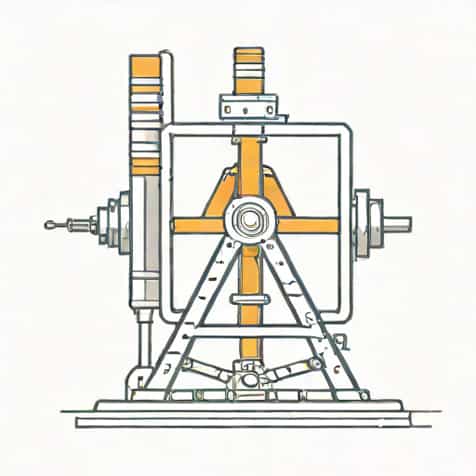
A suspension magnetometer is an important scientific instrument used in physics and geophysics to measure the strength and direction of magnetic fields. It is particularly valuable for studying the magnetic properties of materials and detecting subtle changes in magnetic flux. The principle behind a suspension magnetometer involves the interaction between a magnetic dipole and an external magnetic field. By understanding this principle, scientists and students can use the device to conduct experiments related to magnetism, Earth’s magnetic field, and even electromagnetic applications. The suspension magnetometer is known for its sensitivity and precision, making it a key tool in both educational laboratories and research settings.
Definition of a Suspension Magnetometer
A suspension magnetometer is a device designed to measure magnetic moments, magnetic field intensity, and the direction of magnetic forces. It typically consists of a small magnetic needle or bar suspended by a fine fiber or wire, allowing it to rotate freely in response to an external magnetic field. The instrument can detect tiny changes in orientation caused by magnetic interactions, providing accurate readings of magnetic properties. Suspension magnetometers are often used in experiments involving paramagnetic and diamagnetic materials, and in measuring the horizontal and vertical components of the Earth’s magnetic field.
Components of a Suspension Magnetometer
- Magnetic NeedleA small bar magnet or dipole that responds to external magnetic fields.
- Suspension WireA fine fiber or thread that allows the needle to rotate freely with minimal friction.
- Scale or VernierA graduated scale used to measure the angular deflection of the needle.
- Support FrameA structure that holds the suspension wire and needle in place while allowing free movement.
- Mirror or Optical SystemIn advanced designs, mirrors may be used to amplify deflections for precise readings.
Principle of a Suspension Magnetometer
The fundamental principle of a suspension magnetometer is based on the torque experienced by a magnetic dipole in a uniform magnetic field. When a magnetic needle is suspended freely in a magnetic field, it aligns itself along the direction of the field. If the needle is deflected from this equilibrium position, the magnetic field exerts a restoring torque that tends to bring the needle back to alignment. By measuring the angular displacement or oscillation period of the suspended needle, the strength and direction of the magnetic field can be determined.
Magnetic Torque
The torque Ï acting on a magnetic needle with magnetic moment μ in a magnetic field B is given by the vector cross product
Ï = μ à B
This torque causes the needle to rotate until it aligns with the external magnetic field. The greater the magnetic field strength, the larger the torque and the faster the needle reaches equilibrium. This interaction forms the basis for measuring magnetic fields using a suspension magnetometer.
Equilibrium and Angular Deflection
When a small external magnetic field is applied perpendicular to the initial alignment of the needle, the needle experiences an angular deflection θ. The relationship between the torque and the angular displacement can be expressed as
Ï = kθ
Here, k is the torsional constant of the suspension wire, representing the restoring torque per unit angle. By measuring the angle θ, the magnetic moment μ of the needle or the strength of the external field B can be calculated. This precise measurement is the core principle of the suspension magnetometer.
Working of a Suspension Magnetometer
The operation of a suspension magnetometer involves suspending the needle in a magnetic field and observing its response. Initially, the needle aligns along the horizontal component of the Earth’s magnetic field. When a sample with magnetic properties or an additional magnetic field is introduced nearby, the needle experiences a torque and rotates from its original position. The angular deflection is carefully measured using a scale, vernier, or optical system. These readings allow the calculation of magnetic parameters such as magnetic moment, susceptibility, and field intensity.
Step-by-Step Procedure
- Suspend the magnetic needle using a fine fiber or wire in a support frame.
- Allow the needle to align itself with the Earth’s horizontal magnetic field.
- Introduce an external magnetic field or a magnetic sample near the needle.
- Observe and record the angular deflection of the needle.
- Calculate the magnetic field strength or magnetic moment using the torsional constant and measured deflection.
Applications of a Suspension Magnetometer
Suspension magnetometers are widely used in scientific research, educational laboratories, and geophysical surveys. Their ability to detect small magnetic changes makes them suitable for a range of applications, from studying material properties to exploring Earth’s magnetism.
Educational Applications
- Demonstrating the concept of magnetic torque and dipole alignment in physics classes.
- Measuring the magnetic moment of bar magnets and small magnetic samples.
- Studying the oscillatory motion of magnetic needles under magnetic fields.
Research and Scientific Applications
- Measuring magnetic susceptibility of paramagnetic and diamagnetic substances.
- Detecting subtle changes in laboratory magnetic fields for experimental physics.
- Investigating properties of new magnetic materials in material science.
Geophysical Applications
- Measuring the horizontal component of the Earth’s magnetic field for navigation or mapping.
- Conducting geological surveys to detect magnetic anomalies caused by minerals or underground structures.
- Monitoring variations in Earth’s magnetism for environmental and space studies.
Advantages of a Suspension Magnetometer
The suspension magnetometer offers several benefits that make it a preferred instrument for magnetic measurements
- High sensitivity, capable of detecting weak magnetic fields.
- Precise measurement of angular deflections and magnetic parameters.
- Simple mechanical design with minimal moving parts, reducing maintenance requirements.
- Versatility for educational, laboratory, and field applications.
- Ability to measure both the direction and strength of magnetic fields.
The principle of a suspension magnetometer revolves around the torque experienced by a magnetic needle in an external magnetic field. By suspending a magnetic needle and observing its angular deflection under the influence of a magnetic field, scientists can measure magnetic field strength, magnetic moment, and other related properties. This instrument is not only a valuable educational tool for understanding magnetism but also plays a critical role in scientific research and geophysical studies. With its sensitivity, precision, and simplicity, the suspension magnetometer remains an important device for studying and exploring magnetic phenomena in both laboratory and real-world settings.