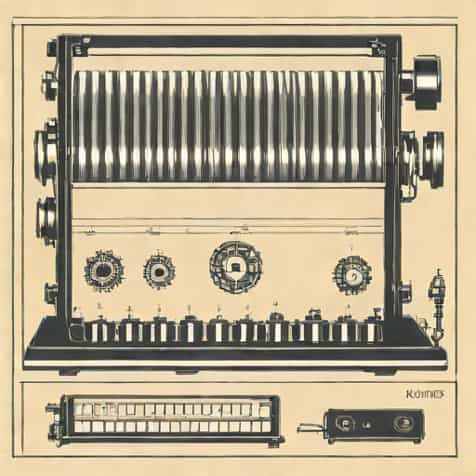
Herman Hollerith was an American inventor whose innovations revolutionized data processing in the late 19th and early 20th centuries. Among his most significant contributions was the development of the tabulating machine, a device designed to automate the collection, processing, and analysis of large amounts of information. Before Hollerith’s invention, handling extensive datasets, such as those required by national censuses, was a time-consuming and error-prone task. The tabulating machine introduced efficiency and accuracy that transformed governmental operations, business practices, and the broader field of data management.
The Origin of Hollerith’s Tabulating Machine
The invention of the tabulating machine stemmed from a practical need. During the 1880s, the United States was preparing for the 1890 census, which required counting a rapidly growing population and analyzing demographic data. Traditional methods of manually tallying census information were proving to be inefficient and inadequate. Herman Hollerith recognized that punch cards, which could represent data through holes in specific positions, could be integrated with electrical circuits to count and sort information automatically. This insight led to the creation of the tabulating machine, capable of handling vast amounts of data faster and more accurately than human clerks.
Basic Functionality of the Tabulating Machine
The tabulating machine used punched cards as a medium to store data. Each card represented an individual record, such as a person in the census, with holes punched in designated positions corresponding to specific information like age, gender, occupation, or marital status. Once cards were prepared, the machine could read them using electrical contacts, tally totals, and sort cards according to different criteria. This automated process drastically reduced the time required to compile large datasets.
- Data entry was done through punch cards, representing individual records.
- Electrical contacts detected holes in the cards to count or categorize data.
- Sorting mechanisms allowed cards to be organized based on multiple attributes.
- Totals and tabulations could be printed directly, eliminating manual counting errors.
Primary Uses of the Tabulating Machine
The tabulating machine was primarily used for large-scale data collection and analysis. Its initial and most famous application was the 1890 United States Census. Hollerith’s machine allowed the Census Bureau to complete the census in a fraction of the time it had taken previous censuses. For example, the 1880 census had taken nearly eight years to process manually, whereas the 1890 census using Hollerith’s tabulating machine was completed in about one year. Beyond the census, Hollerith’s invention found applications in business and industry for payroll management, inventory tracking, and statistical analysis.
Impact on the U.S. Census
The tabulating machine revolutionized the U.S. Census by introducing speed and accuracy previously impossible with manual methods. Census workers could quickly process demographic information, identify population trends, and produce statistical summaries. The efficiency gains from using the tabulating machine not only saved time and labor but also established a model for future censuses in the United States and abroad.
Commercial and Industrial Applications
After its success with the census, Hollerith recognized the potential for his machine in commercial enterprises. Companies began using tabulating machines for payroll calculations, inventory control, and customer data analysis. The ability to sort, count, and tabulate information efficiently helped businesses make informed decisions based on reliable data. For instance, insurance companies could track policies and claims, railroads could manage ticket sales and freight, and manufacturing firms could oversee production statistics more effectively.
- Payroll processing Calculated employee wages and tracked hours worked.
- Inventory management Sorted and counted items to maintain stock records.
- Statistical analysis Compiled data for reports on customers, sales, and production.
- Government record-keeping Applied to tax records, population studies, and election results.
Technological Significance
Hollerith’s tabulating machine represented a major technological breakthrough in the field of data processing. It introduced the concept of using punched cards as a data storage medium and combining electrical mechanisms with mechanical computation. This approach laid the groundwork for modern computing. In fact, Herman Hollerith’s company later became part of what is now known as IBM, one of the world’s leading technology companies. The principles behind his tabulating machine-data encoding, automated counting, and sorting-remained central to computing technologies for decades.
Advantages of the Tabulating Machine
- Efficiency Processed large datasets much faster than manual methods.
- Accuracy Reduced errors associated with hand counting and recording.
- Scalability Could handle growing volumes of data as populations and business needs increased.
- Data management Allowed for sorting and tabulating by multiple categories for better analysis.
Legacy of Herman Hollerith’s Invention
The tabulating machine’s legacy is far-reaching. Beyond its immediate applications in the census and business operations, it represented a fundamental shift in how humans interacted with data. It proved that machines could perform complex data tasks that were previously thought to require human effort. This innovation inspired future inventors and engineers to develop more advanced computing devices, ultimately leading to the computers and data processing systems we use today.
Influence on Modern Computing
Hollerith’s work introduced the concept of encoding information for machine reading, a principle that continues to underpin computer programming and data storage. Punched card systems remained a standard method for processing data well into the 20th century, particularly in government and corporate environments. The success of his tabulating machine also demonstrated the commercial viability of automated data processing, encouraging investment in technological research and development that would eventually yield electronic computers.
Herman Hollerith’s tabulating machine was used for a variety of data processing tasks, with its most famous application being the 1890 United States Census. It allowed large volumes of information to be counted, sorted, and analyzed far more efficiently than traditional manual methods. Beyond the census, the machine found applications in payroll management, inventory control, statistical analysis, and other areas where handling large datasets was necessary. Technologically, it laid the foundation for modern computing, introducing concepts such as data encoding and automated tabulation. Hollerith’s invention not only transformed government and business operations in his era but also set the stage for the development of the computers and information systems that are integral to contemporary life.