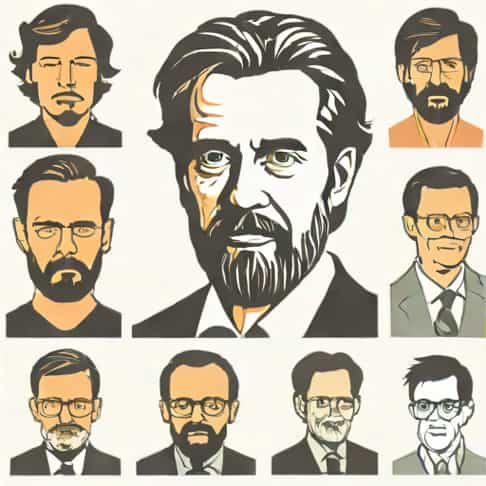
Nikola Tesla remains one of the most intriguing figures in the history of science and technology, a brilliant inventor whose ideas helped define the modern world. His life story is filled with ambition, innovation, challenge, and resilience. Many people today admire Tesla for his visionary approach to electricity, engineering, and creative thinking. His biography continues to inspire new generations of scientists, students, and innovators who explore alternative energy, wireless communication, and groundbreaking inventions.
Early Life and Influences
Nikola Tesla was born in 1856 in a small village called Smiljan, located in what is now Croatia. He grew up in a family that valued creativity, discipline, and education. His father was a priest, while his mother, although not formally educated, was highly skilled at crafting household tools. Tesla often credited her as the source of his inventive spirit.
As a child, he exhibited an extraordinary memory and a vivid imagination. Stories describe how he could solve complex arithmetic problems in his head and visualize intricate mechanical designs without drawing them. These early abilities shaped his future as an inventor and thinker.
Education and Scientific Curiosity
Tesla pursued studies in engineering and physics, attending schools in Austria and the Czech Republic. His academic journey was not always smooth, but his interest in electricity grew stronger each year. He absorbed knowledge rapidly, especially in mathematics, mechanical engineering, and physical science.
Although he did not complete his university degree, Tesla gained advanced theoretical knowledge that later influenced the development of alternating current systems and other technological innovations.
Move to the United States
In 1884, Tesla arrived in the United States with little more than a letter of recommendation and extraordinary ambition. He began working briefly for Thomas Edison, one of the most well-known inventors of the time. However, differences in opinion, work style, and scientific direction led Tesla to leave Edison’s company.
This period marked the beginning of Tesla’s journey toward independence as an inventor and engineer. The challenges he faced did not discourage him; instead, they fueled his desire to prove the potential of his alternative ideas about electrical power.
Building a New Life
Establishing himself in America was not easy. Tesla struggled financially at first and faced skepticism from various investors. Yet, his determination and technical brilliance eventually attracted attention from individuals who believed in his visions for future technology.
These early supporters played an important role in helping Tesla introduce new concepts that would later influence global electricity distribution and scientific exploration.
Breakthrough Contributions
Nikola Tesla’s contributions to science and engineering cover a wide range of fields. His work with alternating current, wireless technology, and electromagnetic systems remains central to modern understanding of electrical power and communication.
Alternating Current and the Tesla Coil
One of Tesla’s most important achievements was the development of alternating current (AC) technology. Unlike direct current (DC), which was promoted by Edison, AC could travel long distances with minimal energy loss. This capability made it ideal for powering cities and large industrial systems.
Tesla’s invention of the Tesla coil further demonstrated his mastery of electromagnetism. The coil produced high-voltage electricity and became the basis for many later experiments in radio, wireless power, and electrical transmission.
- Efficient long-distance electrical transmission
- Foundation for modern power grids
- Innovative electromagnetic engineering
- Influence on early wireless communication
These accomplishments helped establish Tesla as one of the most innovative thinkers of his time.
Work with Westinghouse
Tesla partnered with industrialist George Westinghouse, who recognized the potential of AC power. Together, they helped build the Niagara Falls power plant, one of the world’s first major AC power stations. This achievement proved the reliability of Tesla’s ideas and transformed the global electricity landscape.
The success of AC power distribution helped set the standard for modern electrical systems still used today.
Expanding Scientific Vision
Tesla never limited his imagination to one field. His vision extended to new methods of communication, energy production, and mechanical engineering. Many of his ideas were considered ahead of their time, and some were not fully realized during his lifetime.
Wireless Energy and Communication
Tesla believed that wireless transmission could revolutionize the world. He proposed a global system capable of delivering power and information across long distances without wires. Although he faced financial and technical obstacles, Tesla continued to explore wireless concepts, influencing the development of radio technology and modern communication systems.
Inventions Beyond Electricity
Tesla worked on concepts ranging from robotics to turbine engines. He explored mechanical oscillators, early neon lighting, and even thoughts on vertical takeoff aircraft. While not all ideas reached commercial production, they reflected Tesla’s belief that innovation had no boundaries.
Challenges and Later Years
Despite his brilliance, Tesla struggled with financial stability. Many of his projects required significant funding, and some investors withdrew support when ideas proved too ambitious or difficult to develop. This instability caused Tesla to live modestly in his later years.
However, he remained committed to scientific exploration. Even without the resources he once had, Tesla continued to dream, experiment, and write about future technologies.
Personal Traits and Work Habits
Tesla was known for unconventional routines. He worked long hours, slept very little, and maintained unusual dietary habits. His creativity often came from intense mental visualization, enabling him to design complete machines in his mind before building physical prototypes.
These practices were unique, but they contributed to the remarkable depth and originality of his work.
Legacy and Modern Influence
Nikola Tesla passed away in 1943, but his legacy continues to grow. His contributions to electrical engineering, science, and technology shaped modern systems that millions of people rely on every day. Today, he is celebrated as one of the greatest inventors in history.
Impact on Modern Technology
Much of today’s electrical infrastructure is based on Tesla’s AC power system. Wireless communication, renewable energy research, robotics, and electromagnetic devices all draw from principles he helped explore.
- AC motors and generators
- Radio foundations
- Advanced wireless research
- Inspiration for modern engineering
His ideas continue to influence scientific research and technological development around the world.
Recognition and Popular Culture
Long after his passing, Tesla gained widespread recognition through documentaries, books, scientific awards, and renewed interest in his biography. His name symbolizes creativity, intelligence, and the pursuit of knowledge. Many modern innovators view him as a personal inspiration.
The biography of Nikola Tesla reflects a life filled with groundbreaking ideas, scientific passion, and remarkable creativity. Although he faced obstacles and periods of financial hardship, his dedication to progress left a lasting mark on the world. Tesla’s life reminds us that innovation often requires courage, persistence, and imagination. His influence continues to shape modern technology, making his story one of the most enduring examples of visionary genius in history.