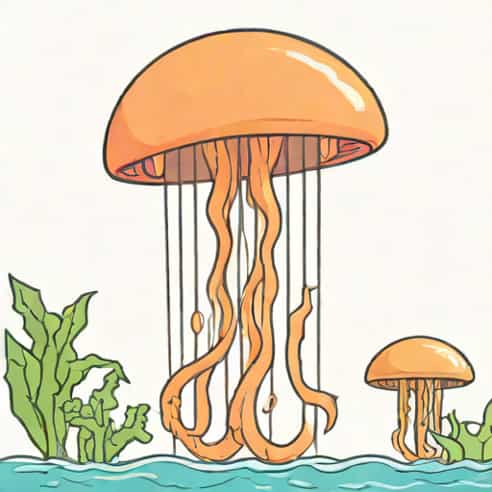
Jellyfish are some of the most fascinating and ancient creatures on Earth, known for their delicate, translucent bodies and unique method of movement through the ocean. They drift with the currents, stinging and capturing prey with their tentacles, yet despite their apparent fragility, jellyfish have existed for hundreds of millions of years. This longevity has prompted many to wonder whether these simple yet effective marine animals predate some of the most iconic creatures in Earth’s history, including the dinosaurs. Exploring the evolutionary timeline of jellyfish provides remarkable insight into life on our planet long before the age of dinosaurs.
Understanding Jellyfish Evolution
Jellyfish belong to the phylum Cnidaria, which also includes corals and sea anemones. Unlike vertebrates, jellyfish do not have a backbone, brain, or heart, yet they have survived for hundreds of millions of years. Fossil evidence and molecular studies indicate that jellyfish evolved during the Precambrian era, roughly 500 to 700 million years ago, making them some of the earliest multicellular animals on the planet.
Fossil Evidence of Jellyfish
Because jellyfish are soft-bodied, they rarely fossilize. However, researchers have discovered rare impressions in sedimentary rock that date back over 500 million years, providing compelling evidence of their ancient presence. These fossils reveal that jellyfish had already developed their characteristic bell-shaped bodies and tentacles long before many modern animal groups existed. This evidence strongly supports the idea that jellyfish not only predate dinosaurs but also represent one of the earliest forms of complex life in the oceans.
The Timeline of Dinosaurs
Dinosaurs, on the other hand, emerged much later in Earth’s history. The first true dinosaurs appeared approximately 230 million years ago during the late Triassic period. Dinosaurs dominated terrestrial ecosystems for over 160 million years before their sudden extinction at the end of the Cretaceous period, around 66 million years ago. Compared to jellyfish, which existed hundreds of millions of years earlier, dinosaurs are relatively recent arrivals on the evolutionary timeline.
Comparing the Timelines
To put this into perspective, jellyfish evolved around 500 to 700 million years ago, long before the supercontinent Pangaea formed and long before the first land plants appeared. Dinosaurs, in contrast, emerged around 230 million years ago, meaning jellyfish had already thrived in the oceans for over 200 million years before dinosaurs even walked the Earth. This comparison highlights the incredible resilience and adaptability of jellyfish over vast spans of time.
Why Jellyfish Have Survived So Long
The longevity of jellyfish as a species can be attributed to their simple yet effective biology. Their soft, gelatinous bodies require minimal energy to sustain, and their simple nervous system allows them to respond efficiently to environmental changes. Additionally, jellyfish have a unique reproductive cycle that includes both sexual and asexual stages, enabling rapid population growth and survival even in fluctuating conditions.
Reproduction and Life Cycle
Jellyfish exhibit a complex life cycle that includes both a stationary polyp stage and a free-swimming medusa stage. This dual strategy allows them to reproduce efficiently and spread across vast ocean areas. Some species, such as the immortal jellyfish (Turritopsis dohrnii), can even revert from the adult stage back to the polyp stage, essentially allowing them to restart their life cycle and potentially live indefinitely under the right conditions. This adaptability has contributed to their survival through multiple mass extinctions.
Surviving Mass Extinctions
Jellyfish have survived multiple mass extinction events, including the Permian-Triassic extinction around 252 million years ago and the Cretaceous-Paleogene extinction 66 million years ago that wiped out the dinosaurs. Their ability to thrive in low-oxygen environments, reproduce rapidly, and adapt to changing conditions has ensured their continuity when many other species vanished. This resilience further underscores their existence well before and beyond the age of dinosaurs.
Ecological Role of Jellyfish
Beyond their evolutionary history, jellyfish play an important ecological role in marine ecosystems. They are both predators and prey, feeding on plankton and small fish while providing sustenance for larger marine animals like turtles and certain species of fish. Their presence in the oceans affects nutrient cycles, population dynamics, and even the structure of marine food webs.
Predatory Behavior
Jellyfish use their stinging tentacles to capture prey, including plankton, small fish, and larvae. Their tentacles contain specialized cells called cnidocytes, which release toxins to immobilize prey. This predatory behavior, while simple, has allowed jellyfish to persist across vast spans of evolutionary time and maintain their position in ocean ecosystems.
Indicator of Ocean Health
Jellyfish populations can also serve as indicators of ocean health. Changes in their abundance may reflect shifts in water temperature, pollution levels, and the availability of prey species. By studying jellyfish populations, scientists gain insights into the broader health of marine ecosystems, further emphasizing their significance beyond their ancient origins.
Jellyfish are among the most ancient creatures on Earth, predating dinosaurs by hundreds of millions of years. Their evolutionary history, adaptability, and ecological significance make them remarkable examples of resilience in the natural world. While dinosaurs roamed the land millions of years later, jellyfish continued to thrive in the oceans, surviving mass extinctions and environmental changes with remarkable efficiency. Their simple yet highly effective biology, unique reproductive cycle, and role in marine ecosystems highlight their importance and the reasons they have endured for hundreds of millions of years. Understanding jellyfish and their place in the evolutionary timeline offers a profound appreciation for life on Earth, emphasizing how some of the planet’s oldest creatures continue to survive and adapt in modern oceans.