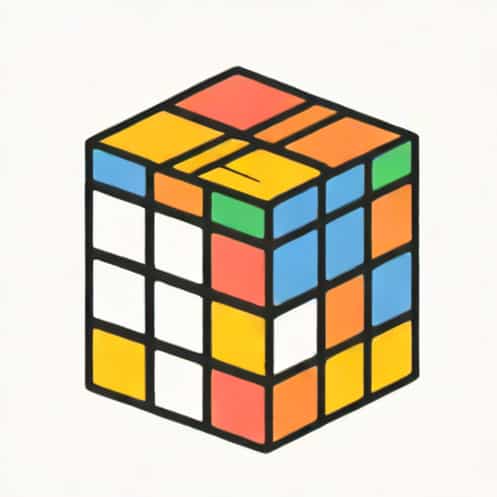
Learning how to solve a Rubik’s Cube may seem overwhelming at first, especially when looking at the colorful scrambled puzzle with pieces that appear to move in every direction. Many beginners think it requires incredible memory or advanced math skills, but the truth is that solving a Rubik’s Cube follows a clear and repeatable method. By understanding the structure of the cube and learning a few simple algorithms, anyone can solve it with practice. As you progress, the logic behind each step becomes more intuitive, and solving the cube transforms from frustration into a satisfying and enjoyable challenge.
Understanding the Structure of the Rubik’s Cube
Before learning how to solve a Rubik’s Cube, it helps to understand how the pieces move and how the cube is built. Each face has nine stickers, but not all pieces behave the same way. Some rotate, some slide into new positions, and some never move from their core location.
Types of Cube Pieces
- Center piecesThese pieces do not move relative to one another. Each center represents the color of that face.
- Edge piecesThese pieces have two colors and sit between corners.
- Corner piecesThese pieces have three colors and sit at the cube’s corners.
Understanding that centers never change position helps guide the entire solving process. Once you know which color belongs on each face, you can start solving layer by layer.
Starting With the White Cross
The most common beginner method for solving a Rubik’s Cube begins with forming a white cross. This technique is easy to learn and helps build a strong foundation for solving the entire cube.
Building the Cross
- Find the white center piece.
- Locate the white edge pieces and move them to form a plus shape around the center.
- Make sure the second color of each edge piece matches the center of its adjacent face.
Many beginners make the mistake of only matching the white stickers without aligning the side colors. For a correct white cross, both sides of each edge must match the centers they touch.
Solving the White Corners
After forming the white cross, the next step is to complete the first layer by placing the white corner pieces. Each corner piece should match the surrounding colors and form a complete face.
Placing Corner Pieces
- Find a white corner piece in the bottom layer.
- Position it under the correct location in the top layer.
- Use the beginner algorithm to insert itRight side up, top side left, right side down, top side right.
This simple sequence helps place the corner without disturbing the white cross. Repeat the process for all four corners to complete the white face.
Solving the Middle Layer
Once the first layer is finished, it’s time to solve the middle layer edges. This step involves inserting the correct edge pieces into the second layer without affecting the solved white face.
Finding the Correct Edge Piece
- Look at the top layer for an edge piece without yellow.
- Rotate the top face to match the edge color with the front center.
- Determine whether the edge belongs to the left side or right side.
Algorithms for Middle Layer
To insert the edge into the right side, use a simple sequence
- Top side right, right side up, top side left, right side down, top side left, front side down, top side right, front side up.
To insert the edge into the left side, use the mirrored version. Repeat until all four middle edges are correctly positioned.
Creating the Yellow Cross
The top layer, which usually contains the yellow color, is solved in stages. First, a yellow cross must be formed. The cube may initially show only a dot, an L-shape, or a line, depending on the scramble.
Forming the Yellow Cross
Use this common algorithm to build the yellow cross
- Front side up, top side right, right side up, top side left, right side down, front side down.
Repeat this algorithm until a yellow cross appears on the top layer.
Solving the Yellow Edges
Once the yellow cross is formed, the next step is to orient the yellow edges so that they match the center colors on all sides. Sometimes two edges match, sometimes none.
Orienting the Edges
- Hold the cube so the matching edges are on your left and back.
- Perform the edge-switching algorithmRight side up, top side right, right side down, top side right, right side up, top side right twice, right side down.
Repeat until all edges match their correct sides.
Positioning the Yellow Corners
The final layer corner pieces must first be placed in the correct position, even if they are not oriented correctly yet. Correct placement means the three colors on each corner correspond to the three center colors around it.
Corner Placement Algorithm
- Hold the cube with a mispositioned corner in the front right.
- PerformTop side left, right side up, top side right, left side up, top side left, right side down, top side right, left side down.
Repeat the sequence until all corners are in the correct location.
Orienting the Yellow Corners
The final step in solving the Rubik’s Cube is rotating the yellow corners so that all yellow stickers face upward. This step completes the cube without disturbing any of the solved layers.
Corner Orientation Algorithm
- Hold the cube so a misoriented corner is in the front right.
- Perform the algorithmRight side down, top side right, right side up, top side left.
Repeat this algorithm only on that corner until the yellow sticker faces upward. Rotate the top layer and repeat for the remaining corners.
Practice Tips for Improving Your Speed
After solving your first Rubik’s Cube, consistent practice helps improve speed and confidence. Over time, recognizing patterns becomes easier, and your hands move more efficiently through each algorithm.
Helpful Practice Suggestions
- Practice solving the cube daily for muscle memory.
- Memorize algorithms slowly and clearly.
- Focus on finger techniques to reduce movement.
- Avoid unnecessary cube rotations.
- Work on solving one stage at a time without rushing.
With patience and repetition, beginners can progress to solving the cube in under a minute or even faster.
Solving a Rubik’s Cube
Solving a Rubik’s Cube is a rewarding experience that combines logic, pattern recognition, and consistent practice. By following a structured method starting with the white cross, building layers, forming the yellow cross, and mastering basic algorithms you can solve the puzzle step by step. Each stage teaches new problem-solving skills and helps build confidence. With time, the movements become second nature, and the cube transforms from a confusing challenge into an enjoyable mental exercise that you can solve anytime.