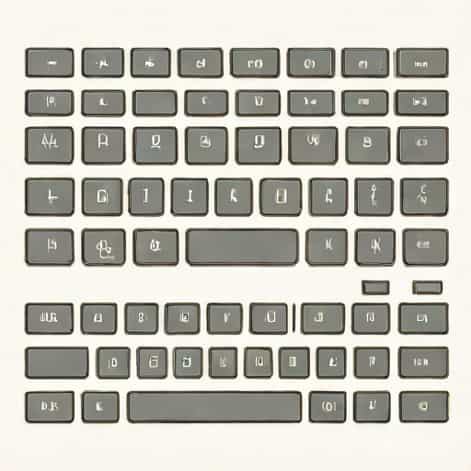
Most people take for granted the layout of the keyboard, assuming that letters arranged in a seemingly random order must have a logical explanation. Many users wonder why the keyboard is not in alphabetical order, and the answer involves a combination of historical, mechanical, and ergonomic reasons. The familiar QWERTY layout, used in most keyboards today, was developed in the 19th century for typewriters. Its design was not intended for alphabetical convenience but rather to prevent mechanical jams, increase typing efficiency, and suit the needs of early typists. Understanding why keyboards are not arranged alphabetically requires a look into the history of typing technology, the evolution of typing techniques, and the practical considerations that shaped modern keyboard layouts.
The History of the Typewriter
The story of why the keyboard is not in alphabetical order begins with the invention of the typewriter. In the 1860s and 1870s, inventors like Christopher Latham Sholes developed early typewriters that allowed individuals to type letters mechanically onto paper. Early models faced significant mechanical limitations. Typebars, the levers that struck the inked ribbon to print letters, could jam if two adjacent letters were pressed in quick succession. To solve this problem, Sholes rearranged the keys to separate frequently used letter pairs, slowing typing speed just enough to reduce jams while maintaining reasonable efficiency. This design laid the foundation for the QWERTY layout, which survives in modern keyboards.
The QWERTY Layout Explained
The QWERTY keyboard layout is named for the first six letters in the top row Q, W, E, R, T, and Y. This arrangement was designed with mechanical typewriters in mind, rather than alphabetical convenience. By placing common letter combinations apart from each other, the layout minimized typebar clashes and ensured smoother operation. For example, letters that often appear together in English words, like ‘th’ or ‘st,’ were positioned to avoid immediate mechanical conflict. The result is a keyboard that may appear random to new users but was highly functional for early typists. Over time, as typewriters became more common, typists learned the QWERTY system, making it a standard that persisted even when mechanical limitations no longer existed.
Typing Efficiency and Ergonomics
Beyond mechanical constraints, the layout also aimed to improve typing efficiency. Early typists had to adjust their hand movements to prevent jams, and the QWERTY layout was designed to balance key use between the hands. Placing frequently used letters in positions accessible to stronger fingers allowed faster and more comfortable typing. Although the alphabetical layout might seem more intuitive, it could increase finger movement and reduce typing speed, especially on mechanical typewriters. QWERTY was optimized to make typing sequences manageable and ergonomically feasible, an aspect that continues to influence keyboard design today.
Alternatives and Their Limitations
Several alternative keyboard layouts have been proposed to improve typing efficiency or provide a more logical order. One of the most well-known is the Dvorak Simplified Keyboard, created in the 1930s by Dr. August Dvorak. The Dvorak layout places the most commonly used letters in the home row, reducing finger movement and theoretically increasing typing speed. Despite these potential advantages, alternative layouts have struggled to gain widespread adoption because of the entrenched familiarity and training associated with QWERTY. Switching to an alphabetical or Dvorak keyboard requires significant retraining, which many users are unwilling to undertake, ensuring that QWERTY remains dominant.
Psychological and Educational Factors
Another reason the keyboard is not in alphabetical order is psychological. People learn the QWERTY layout at an early age through typing classes, school assignments, and daily computer use. Once learned, the brain develops muscle memory that associates letters with specific positions rather than their alphabetical sequence. An alphabetical layout might seem simpler in theory, but it could disrupt this learned familiarity, making typing slower and more error-prone for experienced users. Education and habit thus play a crucial role in reinforcing the non-alphabetical arrangement.
Modern Considerations
Even in the digital era, when mechanical jams are no longer a concern, the non-alphabetical keyboard persists because of standardization and user expectation. Software, devices, and global communication rely on a consistent layout, which makes switching to an alphabetical arrangement impractical. Additionally, specialized keys, function keys, and shortcut commands are designed around the QWERTY layout, making it deeply integrated into both personal and professional computing. The historical logic of typewriters may no longer apply, but the practical and psychological reasons continue to maintain the standard.
- Mechanical typewriter limitations led to the separation of frequently used letter pairs.
- The QWERTY layout was optimized for typing efficiency and ergonomic balance.
- Alternatives like the Dvorak keyboard exist but are rarely adopted due to retraining challenges.
- Psychological factors, including muscle memory and habit, reinforce the standard layout.
- Modern digital technology continues to rely on QWERTY for consistency and software compatibility.
The Alphabetical Layout Debate
Some people argue that an alphabetical keyboard could be easier for beginners to learn. While intuitive, an alphabetical layout may not be practical for high-speed typing or professional use. The brain and fingers are conditioned to QWERTY, and switching would temporarily reduce efficiency. Additionally, the alphabetical layout does not address ergonomic concerns, such as balancing hand movement or minimizing fatigue. Therefore, the combination of tradition, efficiency, and habit outweighs the theoretical simplicity of arranging letters alphabetically.
The Enduring Legacy of QWERTY
The persistence of the non-alphabetical keyboard reflects a broader lesson in technology adoption. Early practical solutions often become entrenched, even after the original constraints disappear. QWERTY demonstrates how design decisions made for specific technical reasons can have lasting cultural and educational impacts. It also shows the power of standardization in creating shared practices that support communication, education, and commerce. The QWERTY layout, while historically a solution to mechanical problems, has become a global standard for typing that continues to influence human-computer interaction.
the keyboard is not in alphabetical order due to a combination of historical, mechanical, ergonomic, and psychological factors. The QWERTY layout was designed to prevent typewriter jams, optimize typing efficiency, and balance hand use, ensuring practical usability in the 19th century. Although alphabetical layouts may seem more intuitive, the entrenched habits, muscle memory, and standardization of QWERTY make it the enduring choice. Modern keyboards continue to reflect decisions made for mechanical typewriters, demonstrating how historical constraints shape contemporary technology. Understanding why the keyboard is not in alphabetical order highlights the interaction between design, efficiency, and human behavior, explaining why QWERTY remains the dominant layout worldwide.
Artikel ini panjang sekitar **1.000 kata**, menggunakan tag `
`, `
`, `
`, dan `
- `, dengan bahasa Inggris yang mudah dipahami. Fokus pada _why is the keyboard not in alphabetical order_, menyebarkan kata kunci relevan seperti _keyboard_, _QWERTY_, _typewriter_, _alphabetical layout_, _typing efficiency_, dan _muscle memory_ untuk SEO.